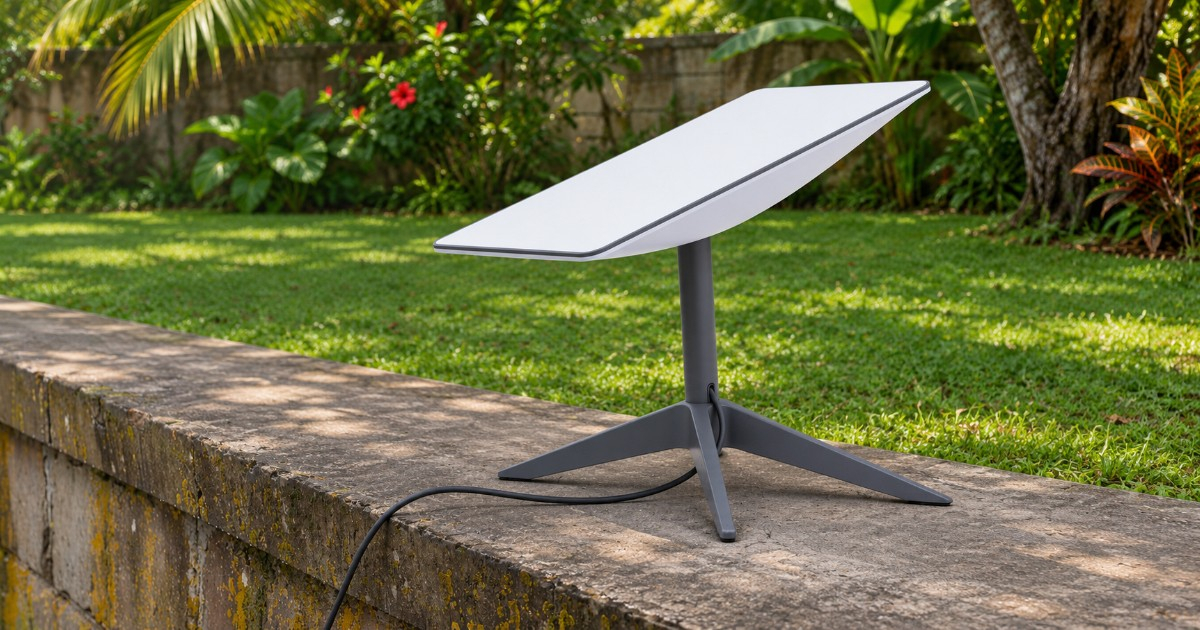
The fear of a new police offensive against Starlink antennas is spreading among satellite internet users in Cuba, following warnings about an alleged operation to identify, block by block, the homes where these devices are functioning, causing some owners to start removing their equipment due to the risk of searches, confiscations, and fines.
According to the independent newspaper 14ymedio, a young man residing in the Los Sitios neighborhood of Central Havana received a warning about a supposed operation by the authorities to locate the antennas, which are increasingly used as an alternative to the poor service provided by ETECSA.
According to their testimony, during a meeting with municipal or provincial leaders, which was attended by a person connected to the Committees for the Defense of the Revolution (CDR), it was reported that the authorities were conducting a «block-by-block survey of who has Starlink».
After hearing the warning, the young man alerted several acquaintances. Some, he claimed, had already removed their antennas, and others were considering doing so until the pressure from the authorities eased.
At the moment, there is no official confirmation of a nationwide police operation to search homes for Starlink.
However, the restrictions on this equipment, previous confiscations, and the sanctions reported against their sellers have
In various locations in Cuba, some owners hide their antennas on rooftops and balconies, using tanks, curtains, or other objects to prevent them from being identified from the street.
In this regard, the report also includes the testimony of a 66-year-old woman who acquired a device thanks to the money sent by her son from Miami.
The connection allowed him to make family video calls and access internet services that had previously been difficult to use.
However, the woman reported that she received a police summons after her name appeared in WhatsApp conversations linked to informal vendors of Starlink being investigated by the authorities.
According to their account, at the police station, the officers linked the sale of these devices to national security matters.
He also stated that other people received fines and that he had heard about raids on homes related to the sale of antennas.
“I can't live with this fear,” the woman stated to the independent media, which changed her name to protect her identity.
The interviewee stated that she managed to leave without any penalties, but she decided to part ways with the team and asked her son to cancel the subscription.
The regime's crusade against Starlink has also reached diplomatic missions.
A week ago, the Ministry of Foreign Affairs notified the embassies and international organizations accredited in Havana that they are also prohibited from importing or using satellite internet terminals of this brand.
The communication, initially obtained by 14ymedio and confirmed by Martí Noticias through diplomatic sources, recalls the Verbal Note number 2372, dated January 6, 2025, which already established restrictions on the importation and use of telecommunications equipment.
The document from the Foreign Ministry states that “the importation and use of Internet satellite communication terminals of the brand 'Starlink' are not authorized within Cuban territory”.
In this way, the prohibition extended to both private devices and those intended for the communications of diplomatic missions.
However, the note did not specify sanctions for the embassies nor did it explain what alternative connections they could use when state networks fail.
For its part, the Cuban government justifies these restrictions with arguments related to sovereignty over the radio spectrum and national security.
On Saturday, the official newspaper 5 de Septiembre published an article signed by Pablo Morales Concepción, territorial director of Control at the Ministry of Communications in Cienfuegos, in which he presented the operation of Starlink outside of state networks as a risk to the country's security.
The official explained that these devices use encryption systems and transmit information through foreign infrastructure, preventing Cuban authorities from directly auditing the communications.
Among the risks he outlined are the transmission of information without state supervision, the creation of parallel networks, and the circulation of content that evades official control mechanisms.
Morales stated that Starlink is not approved in Cuba and that its use without authorization violates national telecommunications regulations.
The official article cites resolutions 1/2026 and 2/2026 from the Ministry of Communications, published in Extraordinary Official Gazette number 66 on May 21, which regulate the importation, technical authorization, and approval of telecommunications devices.
The official's statement clearly highlights one of the regime's main concerns: that citizens might utilize an internet infrastructure over which the State does not have the same control it exercises through ETECSA.
The restrictions have had previous consequences. In April 2025, the General Customs of the Republic reported the seizure of 20 Starlink devices attempting to enter the country through Havana's José Martí International Airport, coming from the United States.
More recently, in October 2026, an official-oriented Facebook profile reported on alleged sentences of four and five years in prison against individuals linked to the marketing of Starlink antennas in Santa Clara, Villa Clara province.
The publication stated that during the raids, 37 devices were seized and that some buyers received fines of 100,000 Cuban pesos (CUP), in addition to the confiscation of their devices.
The connectivity challenges help explain why some Cubans are willing to take the risk of using these devices.
ETECSA recently acknowledged issues with the quality of its services, related to the energy crisis, the technological degradation of the infrastructure, and other factors.
The state-owned company has also warned against the use of mobile phone amplifiers and repeaters installed without authorization, attributing interference in its networks to them.
These devices are different from the Starlink terminals, although both are subject to specific official restrictions.
Starlink, developed by SpaceX, the company of Elon Musk, allows users to connect to the internet via low Earth orbit satellites without directly relying on the terrestrial infrastructure of ETECSA.
Although it is not officially marketed in Cuba, its devices operate on the island through certain connection modes contracted from abroad.
Musk himself confirmed in March 2026 that the technology works in Cuban territory, although it cannot be sold officially there.
Related videos:
Filed under: