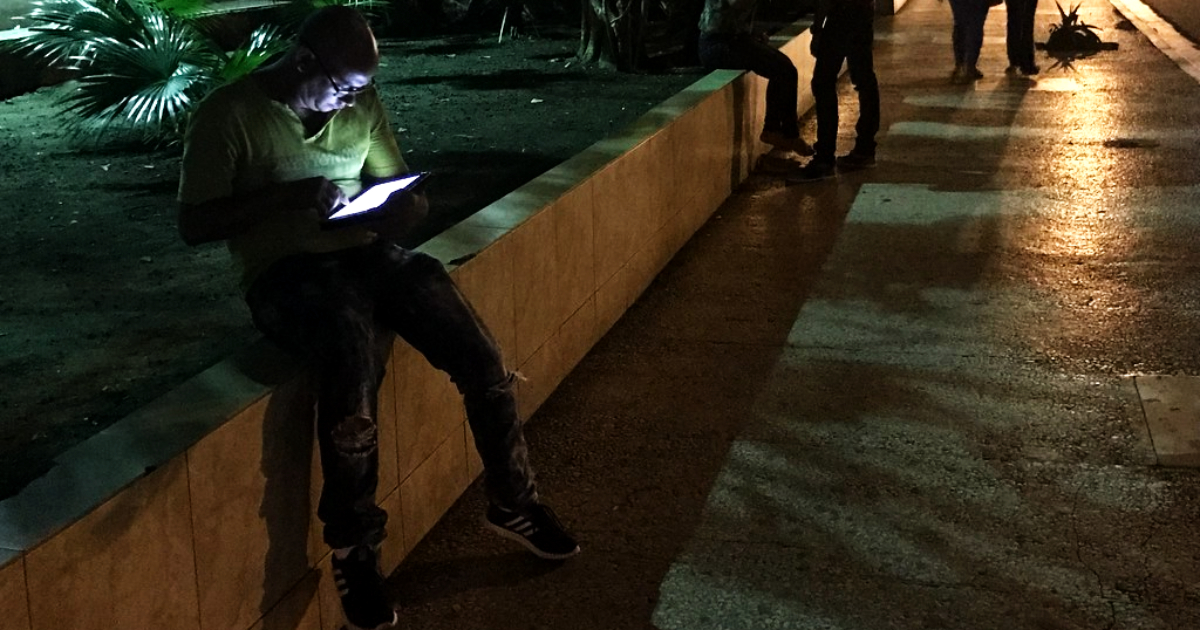
77% of Cubans use the Internet as their main source of information, while only 10% habitually turn to television, according to a national survey conducted within Cuba by the International Republican Institute (IRI) and published this Wednesday.
The results reflect a significant shift in the information habits of the population and pose a challenge to the regime's communication apparatus, which maintains institutional control over the press, radio, and television, but no longer dominates the channels through which citizens claim to get their information.
The study by IRI reveals that 40% of respondents identify social media and messaging apps, such as Facebook and WhatsApp, as their main source of information. Another 37% access the Internet through other means, while radio is relegated to 6% and print media to 3%.
Among young people aged 18 to 35, the difference is even more pronounced: 80% primarily get their information through digital platforms, compared to 4% who use television and another 4% who turn to print media.
However, the most revealing data regarding the relationship between citizens and the official information system appears in another survey question: 87% strongly disagree with the statement that Cuban media are free to report without the Government telling them what to publish.
In other words, the strong preference for digital channels aligns with a predominantly negative perception of the informational independence of national media.
The contradiction extends to the very communication model of the regime. For decades, the Communist Party built a press system aimed at disseminating its interpretation of reality and maintaining control over public information. The expansion of the Internet and social media has opened channels for the circulation of news, testimonies, and opinions that partially escape this institutional monopoly.
Nonetheless, the regime continues to legally maintain that control. In July 2026, CiberCuba reported on the approval of Decree 160, which reserves journalistic activities, news agencies, the publication of newspapers, and radio and television broadcasts for the State, and prevents independent journalism from being legally established as a private economic activity.
The contrast is particularly striking: while the authorities announce reforms to expand certain economic activities, they maintain the restrictions that prevent the legal recognition of independent media outlets.
At the same time, the official propaganda apparatus has intensified its campaigns against digital media that challenge its narrative. Publications such as Granma and Razones de Cuba have repeatedly accused independent journalists and foreign media of promoting the destabilization of the country and serving the interests of Washington.
In July, CiberCuba analyzed one of these offensives, in which the regime blamed foreign and independent media for fueling social protests through their coverage of the Cuban crisis.
The restrictions are not limited to speech. According to data from the Cuban Observatory of Freedom of Expression published by CiberCuba, violations against independent journalists and media workers increased by 129.4% in September compared to August, rising from 17 to 39 documented incidents.
The regime thus faces a communication paradox: it maintains a legal monopoly over much of the journalistic activity, yet the main information channels declared by the public are precisely those where content circulates that does not depend solely on its institutions.
This does not mean that all Cubans using the Internet consume independent media or that digital platforms are free from propaganda, disinformation, or state surveillance. The survey measures the usual channels of information, not the credibility attributed to each media outlet or the political orientation of its users.
However, the results allow for the distinction of two increasingly separate dimensions: the institutional control that the State exerts over the press and its actual ability to determine what information reaches the citizenry.
The study was conducted by NORC at the University of Chicago through in-person interviews with 1,199 adults residing in Cuba between July 22 and September 7, 2026. It used a national probability sampling method and reports a maximum margin of error of ±4.2 percentage points for the mid-range estimates of the total sample, with a confidence level of 95%.
Related videos:
Filed under: