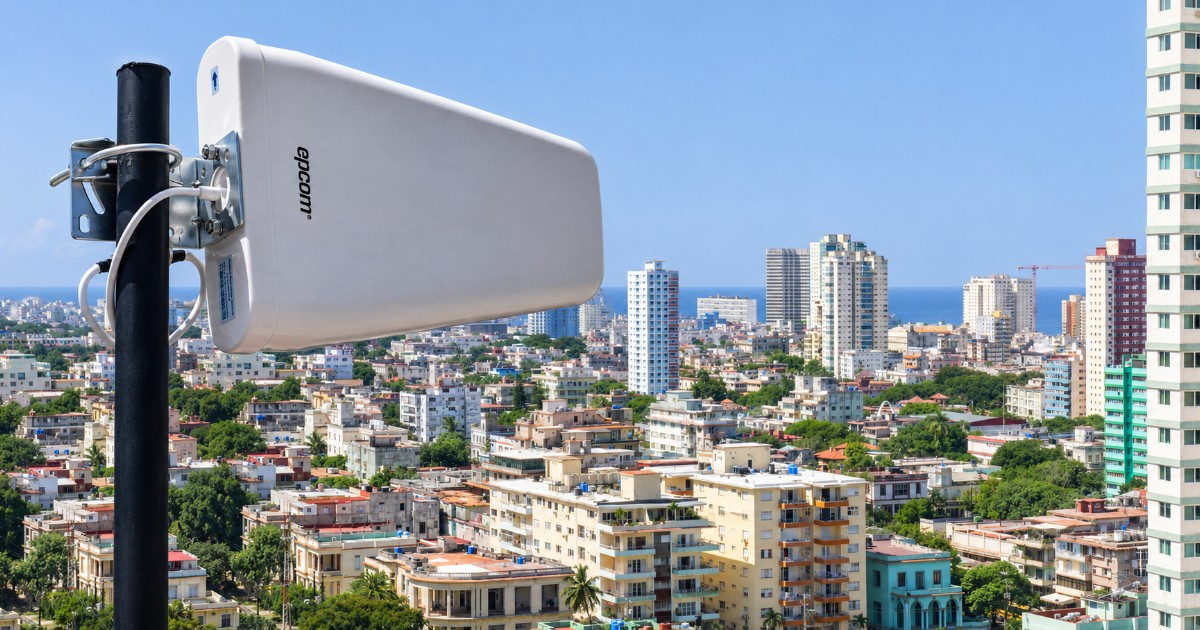
ETECSA publicly acknowledged this week that there are "difficulties affecting the quality of fixed-line and internet services," and pointed to the use of amplifiers or mobile signal repeaters as one of the causes of the deterioration, urging Cubans to abandon that practice.
In an infographic published on their social media, the state telecommunications monopoly stated that these devices "cause interference in radio bases and degrade the cellular service for other users" and quantified the issue: there are around 180 mobile sites affected by this problem, with 44% of them concentrated in Havana.
In a second statement, ETECSA expanded on the list of factors explaining the deterioration: the energy crisis —"the network needs electricity at each of its points" and the available backup "is not sufficient"—, vandalism against the infrastructure, technological obsolescence, and the growth of demand in the face of a limited network.
The consequences of using illegal amplifiers described by the company include signal drop in the area, reduced internet speed, and the inability to make emergency calls.
In parallel, the Ministry of Communications (MINCOM) published its own infographics to warn that the detection of these devices is not random: "It is carried out through technical verification systems that monitor the spectrum and allow the identification of devices that generate interference," the ministry noted, warning that violators will face equipment confiscation and fines.
The MINCOM also reminded that the use and importation of mobile signal repeaters is prohibited in Cuba according to Decree-Law 35, which includes fines of up to 2,000 pesos for individuals. Resolution 1/2026, in effect since July of this year, reinforced that prohibition by expressly banning the importation of these devices.
What the regime omits in its campaign is the reason why Cubans resort to these devices: ETECSA's 4G signal does not reach all regions of the country, and the company has a history of structural failures that have nothing to do with individuals.
The context is devastating. During the national blackout on September 18 —the eighth total collapse of the National Electric System recorded in 2026— over 80% of the base station sites were out of service, and internet traffic plummeted by 58%. Recovery took approximately 32 hours.
Added to this are the thefts: in Camagüey, ETECSA reported the loss of more than 2,000 meters of connection cable due to systematic vandalism against its infrastructure, with some locations affected up to three times. The company accumulated nearly 77,000 reports of fixed-line telephone disruptions by September of this year.
For critics, pointing to private amplifiers as the cause of service deterioration is a maneuver to divert attention from the structural responsibilities of the state monopoly, whose network operates with outdated technology and barely half of its 2,520 radio bases have any energy backup.
It is not the first time that the regime has launched this campaign: in February 2022, the MINCOM had already warned about the illegality of amplifiers, and in July 2025, the UPTCER carried out a seizure of illegal GSM and LTE equipment in Mayabeque. The current offensive is part of a broader crackdown by the regime on connectivity technologies that escape state control.
Related videos:
Filed under: