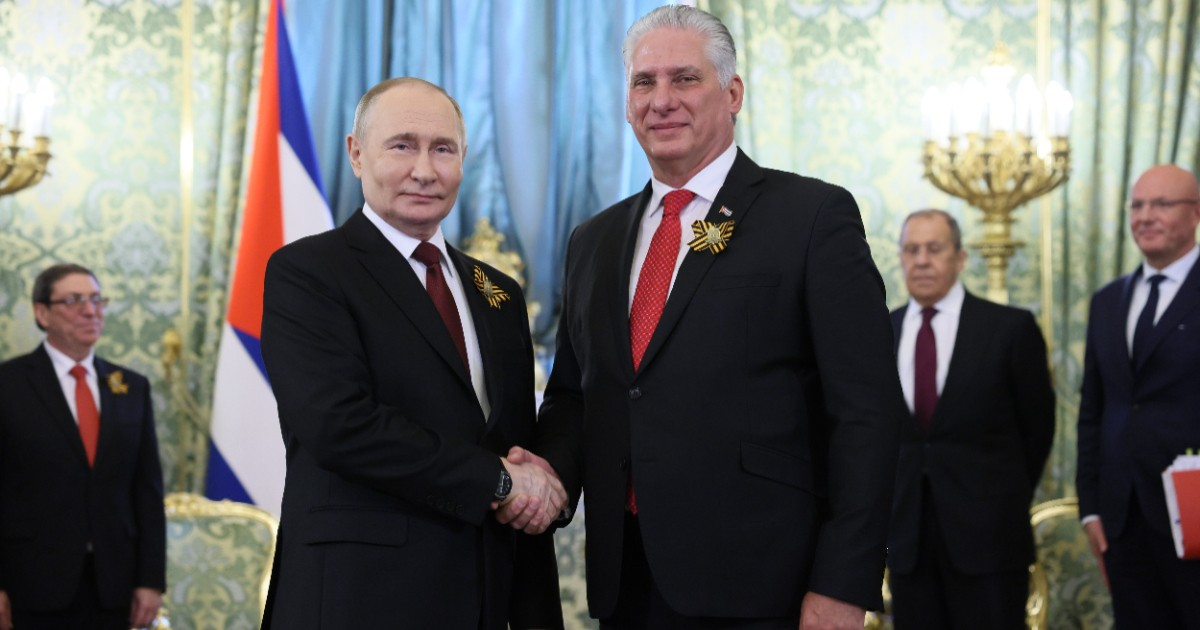
The Deputy Minister of Foreign Affairs of Russia, Serguéi Riabkov, met on Tuesday in Moscow with the ambassador of Cuba in Russia, Enrique Orta González, and reaffirmed Moscow's support for the regime in Havana amid increasing U.S. pressure and an unprecedented energy crisis on the island.
According to the statement issued by the Embassy of Russia in Cuba, also confirmed by the agency TASS, both parties exchanged views on bilateral cooperation and the international agenda in what the official text described as "an atmosphere of traditional friendship and a constructive spirit."
"The firm and unconditional support for the Cuban leadership and the people of the brotherly country during these difficult times was expressed," noted the statement from the Russian embassy.
Russia also expressed its willingness to continue providing Havana with "the necessary political-diplomatic and material assistance," without specifying amounts, fuel shipments, or concrete timelines.
Riabkov also reiterated Moscow's position in favor of the immediate lifting of the commercial, energy, and financial embargo imposed by the United States against Cuba, and demanded that the island be removed from the U.S. list of state sponsors of terrorism.
The in-person meeting takes place just four days after a similar phone call: last Wednesday, at the initiative of Cuba, the Deputy Foreign Minister of Cuba, Gerardo Peñalver, contacted Riabkov, who on that occasion also promised "political and material assistance" without specifying amounts. Both contacts are part of a diplomatic offensive by the regime in response to Trump's escalation, which also included the visit of Foreign Minister Bruno Rodríguez to China and Vietnam.
The energy backdrop surrounding these diplomatic gestures is critical. The only shipment of Russian crude that arrived in Cuba throughout 2026 was from the tanker Anatoli Kolodkin —100,000 tons of Urals crude, approximately 730,000 barrels— which docked in Matanzas on March 31. Ambassador Orta González himself acknowledged in October that this was the only Russian shipment of the year and that the cargo only reduced blackouts for approximately two weeks.
A second shipment announced in April never reached its destination: the tanker Universal changed course towards the South Atlantic in May. Russian Deputy Minister Alexander Alimov acknowledged in October the existence of "logistical difficulties" in maintaining the aid, partly due to Western sanctions that complicate maritime transport.
A document from the International Affairs Committee of the Russian Duma, dated November 6, was even more direct: it acknowledged that, following the tightening of U.S. restrictions in August, Cuba was "practically" without fuel imports.
Pressure from Washington intensified on November 5, when the State Department imposed new sanctions against eight entities, two individuals, and five vessels connected to oil and military support for the Cuban regime, including Chinese companies such as China National Electronic Import and Export Company and Beijing H&C Technologies. A week later, Trump stated in an interview that he would "definitely" consider a "brief military campaign" to address the Cuban issue before the end of his term.
While Moscow multiplies gestures of solidarity, the electrical reality in Cuba this Tuesday was devastating: the Electric Union projected only 1,050 MW available against a demand of 2,750 MW, with a maximum estimated impact of 1,730 MW nationwide.
Related videos:
Filed under: