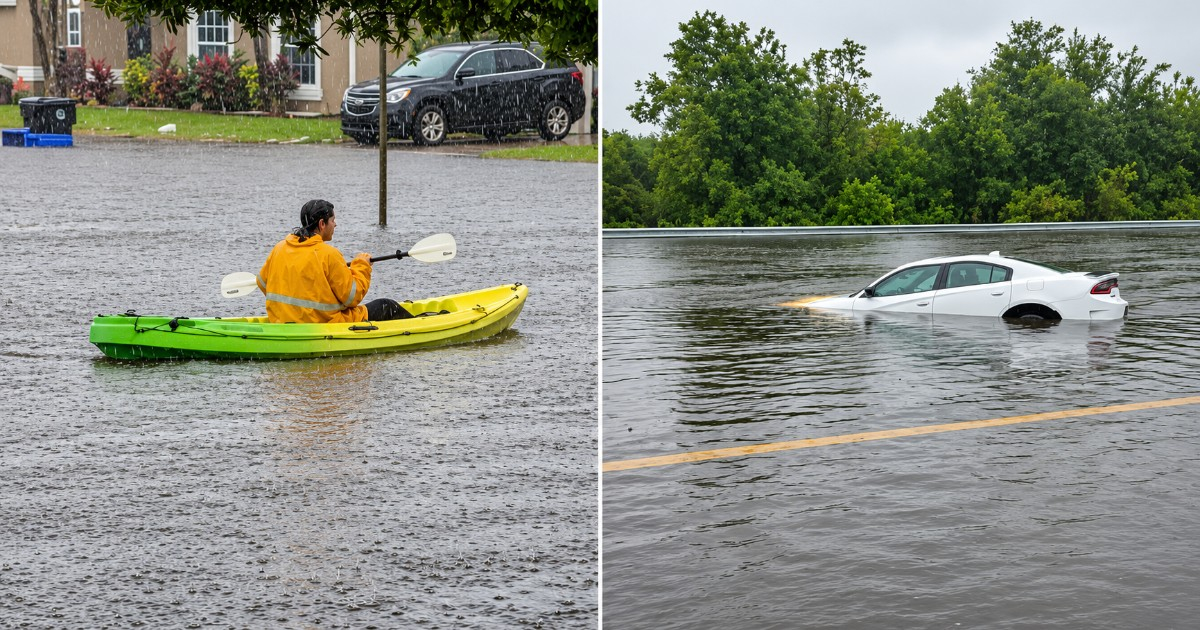
The severe flooding hitting Florida has left shocking images of streets completely submerged, cars partially underwater, and water entering homes, as the St. Johns River reached a historic level near Cocoa and authorities issued mandatory evacuations in a residential area of Palm Bay in Brevard County.
The meteorologist Matt Devitt reported this Thursday on Facebook that several locations in Brevard recorded between 10 and 15 inches of rain over the last 24 hours, especially in the area between Palm Bay and Cape Canaveral.
The specialist shared photographs that show the extent of the flooding, with vehicles trapped in the water and residential neighborhoods affected.
One of the most concerning situations is occurring in the St. Johns River, near Cocoa, where the water level reached 18.1 feet during the morning, surpassing the previous record of 17.55 feet set in 1953, according to data released by Devitt.
The National Weather Service (NWS) officially confirmed that the river had surpassed its historical high. At 8:15 in the morning, the recorded level was 18.1 feet, and forecasts indicated a possible rise to 18.4 feet.
The agency warned that the waters are already affecting residential areas near the river, especially in Lake Poinsett, west of Cocoa, as well as homes in low-lying areas in Silver Pines, Rockledge, and Shakespeare Park, Cocoa.
The flood also threatens to render Providence Road impassable, which would hinder access to several homes.
The NWS has issued a flood warning for the St. Johns River and anticipates that additional rainfall may cause new rises in water levels over the coming days.
Mandatory evacuations in Palm Bay and boat rescues
Due to the advancing floods, the authorities of Palm Bay ordered mandatory evacuations in a section of Palm Bay Estates, specifically in the area located west of the canal and east of the railroad tracks.
For the rest of Palm Bay Estates, voluntary evacuations have been established, according to local station WFTV, citing the announcement from municipal authorities.
Police agents from Palm Bay and members of the Fire and Rescue Department began using boats to evacuate residents from the affected areas. The evacuees are initially taken to Captain's House, where their transportation to shelters is coordinated.
Authorities urged those within the mandatory evacuation area to follow the instructions of emergency teams and to prepare to leave their homes immediately.
Brevard County also announced the opening of a shelter at the Walter Butler Community Center, located at 4201 North Cocoa Boulevard, Cocoa, ZIP code 32927.
The center welcomes individuals from the general population, residents with special medical needs, and families who need to come with pets.
Authorities recommend bringing medications, a change of clothes, hygiene products, and necessary personal items. For information on available assistance, residents can call 2-1-1.
Closed roads and suspension of classes
The floods also caused significant traffic disruptions. The Florida Highway Patrol (FHP) closed state road SR 520 at the junction with SR 528 on Thursday morning after several vehicles became stranded due to water accumulation.
The National Weather Service confirmed road closures near Port Malabar Road and Turkey Creek, where emergency services reported potentially deadly flash flooding.
In the southeast of Brevard, the NWS reported that between three and seven inches of rain had fallen in areas affected by the alert, and warned that an additional two to four inches could still be recorded.
The situation also forced an extension of the suspension of school activities. Brevard public schools will remain closed until Friday, including educational centers and district offices.
The Volusia County schools also announced closures for Thursday and Friday, according to the information published by the Florida Department of Education.
DeSantis expands the emergency to 21 counties in Florida
The worsening of the floods prompted Governor Ron DeSantis to expand the state of emergency declared in early November. Through the Executive Order 26-232, signed on Wednesday, November 18, the declaration was extended from 14 to 21 counties.
The expansion included Broward, Duval, Flagler, Miami-Dade, Monroe, Putnam, and St. Johns, which joined the territories included in the previous orders, among them Brevard, Volusia, Palm Beach, and St. Lucie.
In the document, the governor noted that some areas of Broward, including Fort Lauderdale, Davie, and Hollywood, had received over 10 inches of rain in just 12 hours on November 17.
The order also warns that new rainfall over the east coast of Florida could once again impact communities that have been previously flooded and cause additional damage to roads and essential infrastructure.
Florida is still recovering from the previous floods
The new emergency affects communities that are still facing the consequences of the extraordinary rains recorded at the beginning of November.
On the 2nd, the NWS declared an emergency due to flash floods in Palm Bay and West Melbourne, in light of a situation it deemed potentially catastrophic.
The magnitude of that episode was reflected in the rainfall totals recorded over approximately 48 hours: Malabar received 24.10 inches and Grant-Valkaria, 23.69 inches, amounts equivalent to nearly half a year's worth of usual precipitation in those areas.
Last Monday, Matt Devitt had warned about the possibility of new rainfall of up to 12 inches in areas of the east coast, especially in zones where the ground remained saturated from previous floods.
This Wednesday, the Florida Division of Emergency Management requested that unnecessary travel by road be avoided, warning that just one foot of water, equivalent to about 30 centimeters, can sweep away a vehicle.
The state had also requested a federal major disaster declaration to obtain additional resources aimed at the communities affected by the floods at the beginning of the month.
The approval of that request will determine which federal assistance programs will be made available to those affected.
Related videos:
Filed under: