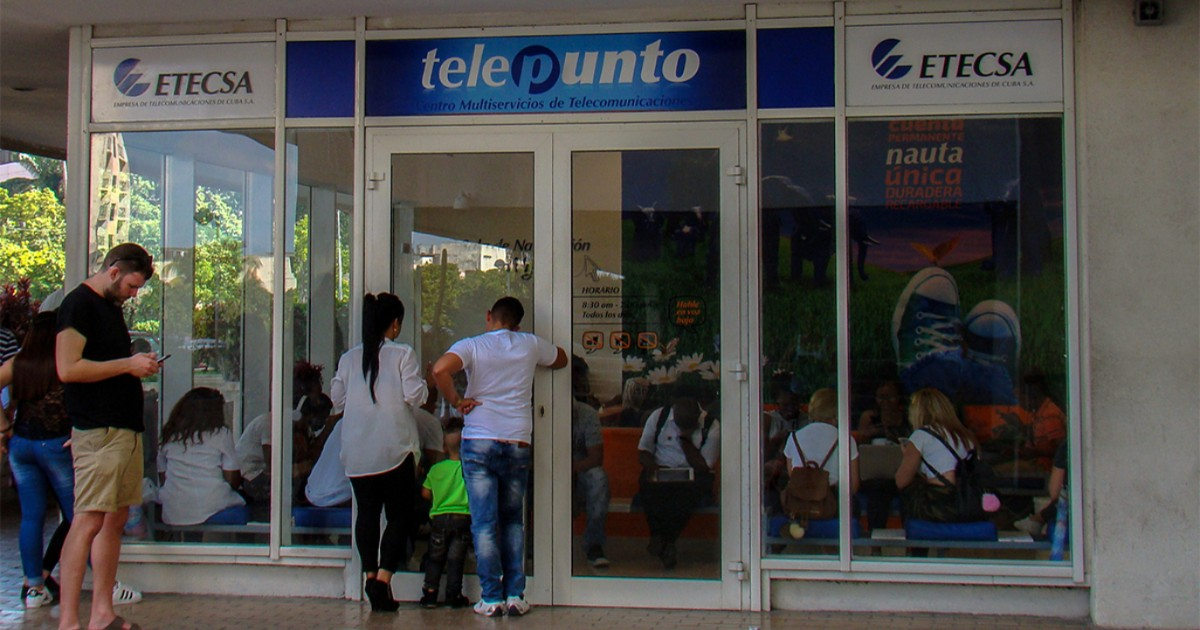
The Cuban regime celebrated this Thursday the election of Cuba as a member of the Council of the International Telecommunication Union (ITU) for the period 2027-2030, during the Conference of Plenipotentiaries held in Doha, Qatar, while the island experiences blackouts, digital censorship, and one of the slowest internet connections in the hemisphere.
The election took place on November 16 during that international conference. Cuba received 152 votes, the lowest of the nine countries selected from Region A (Americas), which also included Mexico — the leader with 167 votes — Brazil, Argentina, the Dominican Republic, Paraguay, Canada, Jamaica, and the United States.
The chancellor Bruno Rodríguez Parrilla celebrated the result on social media, asserting that the election "confirms our country's commitment to continue defending universal, inclusive, and equitable access to information and telecommunications technologies." He added that Cuba "will continue to promote the interests of developing countries" against those who, according to him, seek to "undermine the sovereignty of states through the harmful use of ICT."
The Ministry of Foreign Affairs presented the result as "a recognition of Cuba's history and sustained commitment to the ITU," and took the opportunity to blame the U.S. embargo for significantly limiting "access to technologies, essential platforms, and financing."
The paradox is hard to ignore: the country that will now hold a seat in the main global telecommunications organization records only 7.21 Mbps of internet speed, placing it last in Latin America according to the Speedtest Global Index of May 2026.
The blackouts have systematically devastated the telecommunications infrastructure. The eighth national blackout of the year, which occurred in September, left more than 80% of the base station sites and 70% of the telecommunications cabinets of ETECSA out of service, resulting in a 58% loss of internet traffic. An earlier blackout in March caused a 65% drop in traffic, with recovery taking nearly 29 hours.
The state monopoly ETECSA, whose exclusive concession was extended until 2036, has accumulated approximately 77,000 reports of interrupted fixed services and has halted the expansion of its network to allocate resources to solar panels. Despite having raised over $24.8 million in just 46 days following the rate hike in May 2025, there are no visible improvements in the service.
In terms of digital freedom, the outlook is similarly bleak. Freedom House awarded Cuba just 19 points out of 100 in its Freedom on the Net 2026 report, two points lower than the previous year, keeping it in the "Not Free" category. Only Russia, China, Iran, and Myanmar received worse scores among the 38 countries evaluated.
At least 23 independent media sites remain blocked from the island. Freedom House also noted that ETECSA "apparently facilitated" the hacking of accounts belonging to activists, opponents, and journalists. Several citizens have been sentenced to years in prison for social media posts, including a 14-year sentence.
The ITU Council, composed of 48 Member States elected every four years, acts as the governing body of the organization between plenipotentiary conferences. Cuba has been a member of the ITU since 1918 and has participated in its Council during previous terms, the most recent being from 2023 to 2026.
Kian Vesteinsson, deputy director of research at Freedom House, summarized the global context surrounding this election: "Authoritarian regimes are redesigning the internet as a system of control, deciding who can connect, what can be seen, and whether one can be heard."
Related videos:
Filed under: