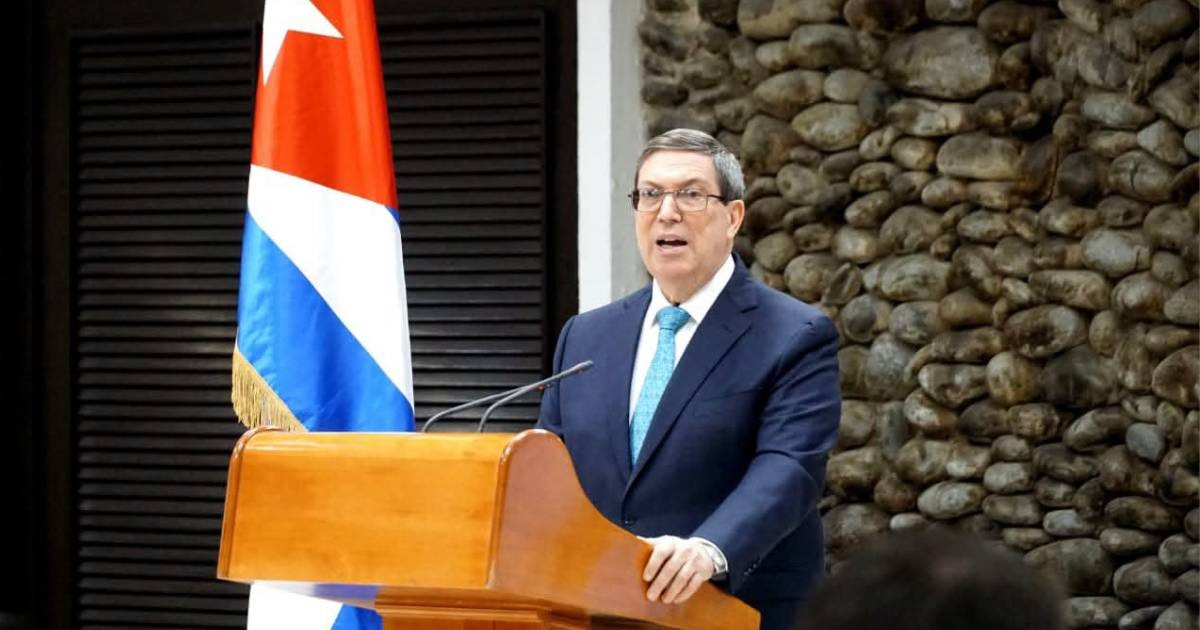
The Cuban Foreign Minister Bruno Rodríguez Parrilla launched a tirade against Washington on Monday by posting a message on X in which he accused the world's leading economic and military power of attempting to impose peace through force and of undermining the foundations of international law.
"The leading global economic and military power seeks to officially establish and impose, through lies and extortion, chaos, barbarism, interference, interventionism, the use of military force, the abuse of its economic might over the weaker, and the implementation of unilateral coercive measures," wrote the Cuban regime's Foreign Minister.
Rodríguez did not mention the United States by name, but the target of his accusations was unmistakable given the context of bilateral tension that Cuba is experiencing in 2026.
The chancellor also denounced that Washington is trying to "destroy and/or rewrite the norms and pillars of international law," rejects the sovereign equality among states, and "employs coercion as a means for negotiation and the supposed peaceful resolution of disputes."
The message concluded with a direct accusation: "They intend to replace International Law with the imperialist doctrine of imposing peace through force."
The post came days after President Donald Trump declared that he would consider a brief military operation against Havana and that he wants to “resolve the issue of Cuba” before his term ends.
On November 17, Rodríguez responded to statements made by Marco Rubio regarding the International Criminal Court and affirmed that "the powerful resort to violating or disregarding the law in International Law because they are left with nothing but the use of force."
The backdrop of this rhetorical escalation includes a tense incident at the UN General Assembly at the end of October, when the Cuban foreign minister and members of the diplomatic corps interrupted the U.S. ambassador Mike Waltz during a speech ahead of the vote on the resolution that Cuba presents annually against the embargo.
Rodríguez accused the American diplomat of lying and approached the podium to interrupt his speech, causing a brief suspension of the session.
Later, Waltz wrote on X: "They may intimidate their own people in Cuba, but think twice before trying that nonsense in the United States of America."
That same week, the General Assembly approved the annual resolution against the embargo with 130 votes in favor, 17 against, and 25 abstentions, the lowest support received by Havana in two decades.
Rodríguez's stance is part of a sustained diplomatic offensive throughout the year, which included interventions before the Security Council in May and the General Assembly in September, always centered around the same theme: presenting Washington's sanctions and energy pressure as violations of international law and as a "collective punishment" against the Cuban people.
Related videos:
Filed under: