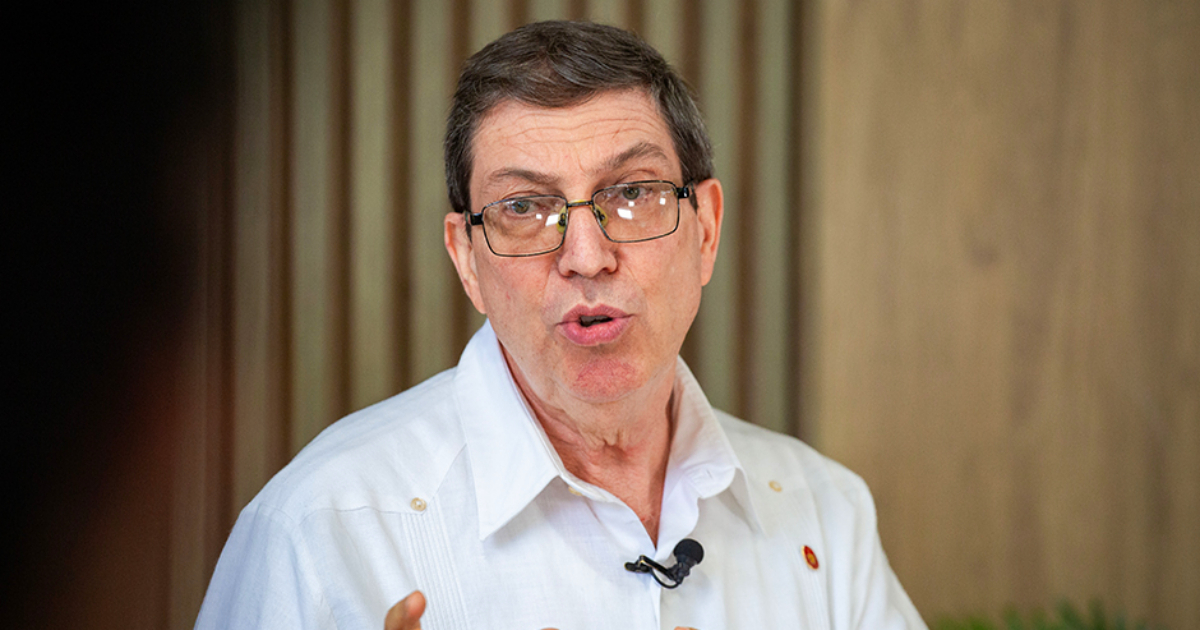
The Cuban chancellor Bruno Rodríguez Parrilla turned to the history of ancient Rome this Tuesday to issue an implicit warning to Washington.
In a message posted on his X account, Rodríguez blends history, politics, and criticism of U.S. capitalism to question the use of force in international relations.
"Just as with common criminals, the powerful resort to violating or disregarding the law in International Law because they are left with only the use of force," wrote the chancellor.
The tweet comes amid a rhetorical escalation between the governments of Cuba and the United States, reaching a critical point on November 12 when Donald Trump declared that he would consider a "brief military campaign" against the island and that he wanted to "put an end to Cuba" before leaving the presidency.
The core of the Cuban chancellor's message is a historical analogy with the Roman general Gnaeus Pompey Magnus, the most powerful man in Rome during his time.
"It may be true that Pompey rejected with his sword in ancient Rome those who wielded the power of the law, but let us remember how Pompey was defeated at the hands of a militarily weaker opponent," Rodríguez pointed out.
The reference points to the Battle of Pharsalus in 48 B.C., where Julius Caesar defeated Pompey despite having a numerically inferior army. The implicit analogy is that the United States, like Pompey, could be defeated by Cuba despite the enormous military asymmetry if it relies on force and disregards the law.
The chancellor concluded his argument with a critique of the historical foundations of American power: "The capitalist development that brought prosperity to North America was built on the blood and genocide of indigenous populations and communities, with the exploitation of slave labor and the forcible usurpation of foreign territory."
The tweet is accompanied by a photograph of the Palace of Nations in Geneva, the headquarters of the UN Office in Switzerland, highlighting the international legal framework through which the Cuban regime aims to articulate its defense.
This message is part of a diplomatic offensive cycle that Rodríguez has been building for weeks. On November 5, at the Ibero-American Summit in Madrid, he condemned the United States' policy towards Cuba as an "economic suffocation war" and "collective punishment."
Afterward, he responded to the G7 stating that the group of countries echoed Washington's arguments in an official declaration where they urged the Cuban authorities to "promote and implement significant and substantial political and economic reforms to enhance prosperity, respect for human rights, and fulfil the legitimate aspirations of the Cuban people."
The leader Miguel Díaz-Canel stated that Cuba would face any aggression and assured that the country has all its wartime structures active.
Last week, the Cuban representative to the UN, Ernesto Soberón Guzmán, acknowledged Cuba's military disadvantage compared to the U.S. but warned that Havana takes the possibility of a military operation seriously.
Related videos:
Filed under: