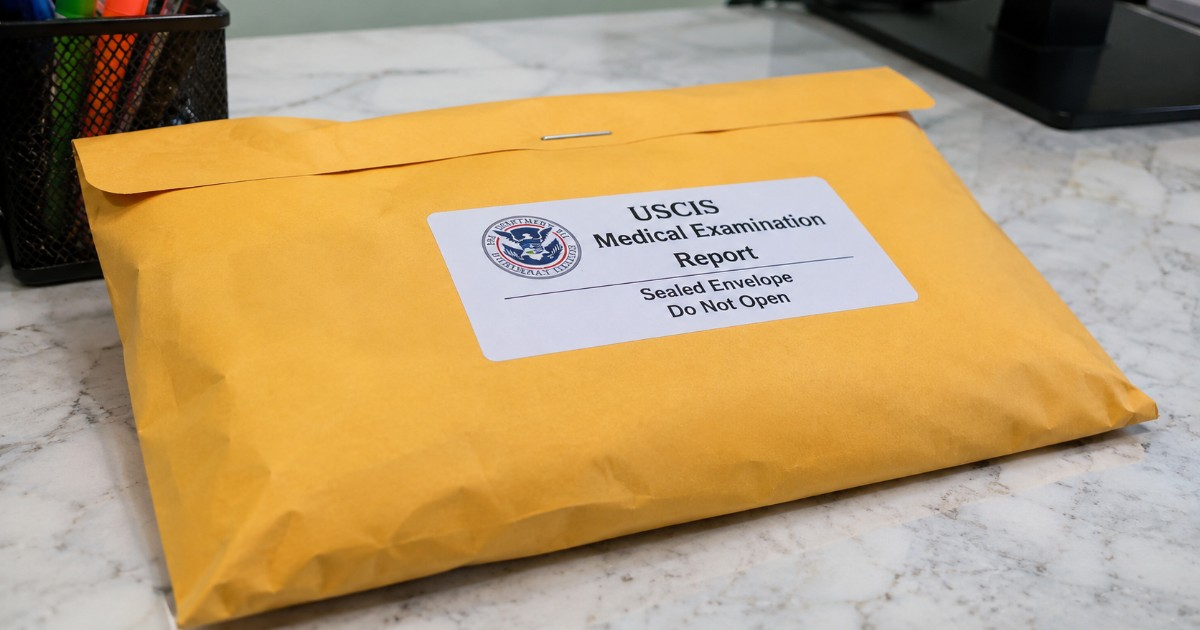
The Board of Immigration Appeals (BIA) established a binding precedent this Tuesday that changes the game for thousands of immigrants seeking permanent residency before a court: no immigration judge can approve the status adjustment on the condition that the applicant submits the I-693 medical exam at a later date.
The decision, identified as Matter of Aguilar Ceballos, 30 I&N Dec. 259 (BIA 2026), was written by the appellate judge Hansell and signed by the panel consisting of Radics, Gallow, and Hansell. Although the ruling was initially issued on October 19 without publishing it, it was designated as a binding precedent for all immigration judges in the country on Tuesday, November 24.
The case arose when an immigration judge granted residency to a Mexican immigrant —identified as J.A.C.— on December 2, 2025, and gave him 60 days after his release to submit Form I-693. The Department of Homeland Security (DHS) appealed that decision; the BIA overturned it and returned the case to the judge solely to review the medical examination and update the criminal background check.
Este precedente de la BIA puede afectar directamente tu proceso de residencia. Sigue todos los cambios en las reglas migratorias en nuestra sección de
The Board was emphatic: "If the only thing missing is the medical exam, the correct course of action is a brief extension of the hearing, not a conditional approval."
That extension, known as a continuance, must be requested under federal regulations and requires a demonstration of just cause. The BIA also rejected two arguments from the applicant: that DHS was obligated to initiate a rescission process to challenge the approval, and that the appeal had become moot because the I-693 was submitted subsequently.
For Cubans, the impact is immediate. Many are applying for residency before immigration judges —through the Cuban Adjustment Act with parole, family petitions, or other avenues— and a significant number find themselves detained in centers like Krome, in Miami-Dade, or in Broward, where access to a civilian doctor authorized by the Citizenship and Immigration Services (USCIS) is limited.
Under the new precedent, arriving at the final hearing without a valid I-693 may mean that the judge does not approve residency on that day, and that an extension could involve additional weeks of detention.
The practical message is clear: anyone with a court residence audience must bring the I-693 form complete, up to date, and in a sealed envelope before that date. Those who are detained should coordinate with their lawyer on how to obtain the examination within the facility or request an extension well in advance.
It is worth noting that USCIS has required since December 2024 the submission of Form I-693 alongside Form I-485 at the time of application to that agency. Additionally, starting in June 2025, a Form I-693 signed from November 1, 2023, will only remain valid while the specific application it was submitted with is pending; if that application is denied or withdrawn, the examination will no longer be valid.
This ruling is the third in a week of unprecedented procedural tightening by the BIA. On November 18, the Board sanctioned appeals based on speculative arguments (Matter of K-L-S-); on November 23, it eliminated the possibility of accepting late appeals on equitable grounds, overturning a precedent from 2023.
This is in addition to a Justice Department rule that will shorten the appeal period from 30 to 10 days starting on December 17.
The context is especially delicate for the Cuban community: the Eleventh Circuit determined in mid-November that the I-220A form does not equate to the parole required by the Cuban Adjustment Act, which had already reduced the options for many Cubans to apply for residency in court. In light of the accumulation of changes, it is advisable to consult an immigration attorney before any hearing.
Related videos:
Filed under: