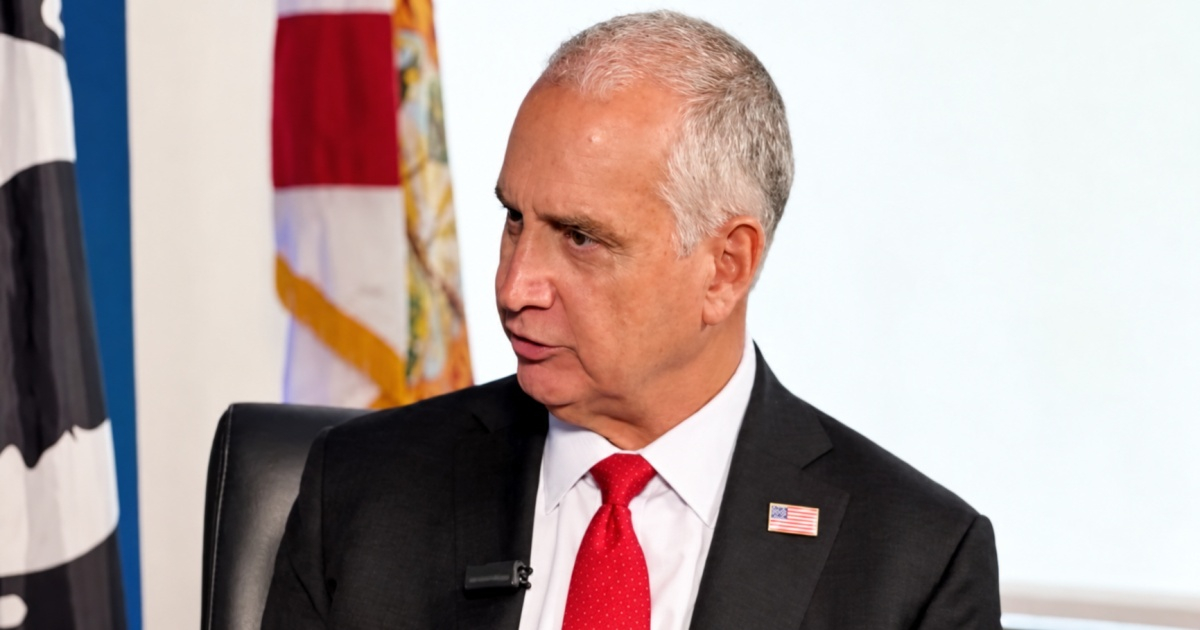
The Republican Congressman Mario Díaz-Balart suggested for the first time, following the ruling of the Eleventh Circuit on November 17, that the Trump administration might consider a Temporary Protected Status (TPS) for Cuba as a relief measure for the hundreds of thousands of Cubans caught in a migratory limbo with the I-220A form.
The proposal emerged on Wednesday during an interview with the podcast Los Pichy Boys broadcasted on Instagram, where the Cuban-American legislator from Florida was directly asked if that measure could be a TPS.
"I believe that the administration has the option to do something temporary. Like a TPS or something. Yes, they could implement a TPS due to the situation in Cuba. That's it, I repeat, that is the decision of one person. Who is the president of the United States," he replied.
Díaz-Balart criticized the Joe Biden administration for leaving those migrants without the parole that would have opened the door to the Cuban Adjustment Act. "It's not a legal limbo, let's be clear, it's an illegal limbo created by the administration with these false promises," he stated, describing the I-220A as an invented document that "at the end of the day meant nothing."
The congressman emphasized that among those affected are individuals who work, run businesses, and have spent years building their lives in the United States, and that some left the island after participating in the protests of July 11, 2021, which were suppressed through arbitrary arrests and abusive legal processes documented by Human Rights Watch.
The proposal arrives as a direct response to the binding ruling of the Eleventh Circuit in the Aguiar-Fernández case, which determined that the I-220A does not equate to the humanitarian parole required by the Cuban Adjustment Act to apply for permanent residency, establishing a binding precedent in Florida, Georgia, and Alabama.
This is also the first time that Díaz-Balart explicitly mentions a TPS for Cuba after that judicial setback. In August, during an interview with Telemundo 51, he had called for TPS for Venezuelans and Haitians and "a pathway" for Cubans with I-220A, but he did not propose a specific designation for Cuba.
What would a TPS mean for Cubans with an I-220A?
A TPS would grant temporary protection against deportation and authorization to work for those who meet the requirements of a potential designation. However, it would not provide permanent residency nor convert the I-220A into the parole required for the Cuban Adjustment Act.
The formal procedure corresponds to the Department of Homeland Security (DHS), which would need to designate Cuba and publish the notice in the Federal Register.
At the time of closing this edition, Cuba does not have any current TPS designation; the only countries currently designated are El Salvador, Lebanon, Sudan, and Ukraine, following the removal of the designations for Venezuela, Haiti, and Nicaragua under the Trump administration.
Meanwhile, the judicial front remains active. The class action Bello-Rubio v. Noem, filed by 992 Cubans before Judge Jacqueline Becerra in the Southern District of Florida, seeks to have the conditions of release at the border recognized as parole; its proponents estimate that a favorable decision could benefit between 500,000 and 600,000 Cubans.
In the legislative arena, the DIGNITY Act (H.R. 4393) introduced by Congresswoman María Elvira Salazar gained 16 new co-sponsors on November 16, reaching a total of 56, but it has yet to be voted on in the full chamber.
The political paradox is evident: the same Cuban-American congress members who support Trump's maximum pressure against the Cuban dictatorship are requesting immigration protection for their compatriots, while the administration deports Cubans at an unprecedented rate —arrests of Cubans by ICE increased by 463% in the first year of the second term— and has eliminated TPS for other countries in the region.
Díaz-Balart was clear about where the final decision lies: "That is the decision of one person. Who is the President of the United States."
La situación migratoria de los cubanos con I-220A sigue en evolución. Mantente informado sobre este y otros temas en nuestra sección de
Related videos:
Filed under: