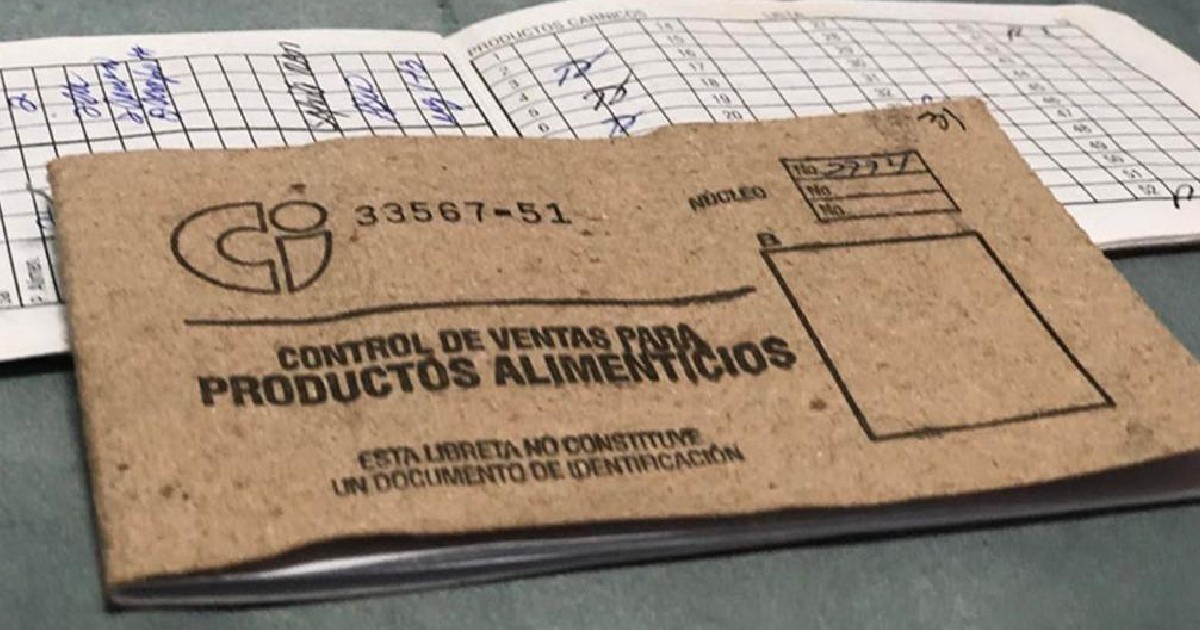
The Cuban regime has effectively brought an end to the rationing system after 64 years of existence: only 1,913 of the approximately 12,000 stores in the country will remain authorized to distribute subsidized food, and only to those whom the State itself classifies as "vulnerable."
Thus announced Marpessa Portal, the General Director of Merchandise Sales at the Ministry of Domestic Trade, on the program "Haciendo Radio," from Radio Rebelde.
The rest of the warehouses have closed, remain empty, or have been leased to the private sector. Economist Omar Everleny summed it up succinctly in an article on IPS: the ration book "has practically disappeared; one could say it has been extinguished."
The universe of beneficiaries of the new assistance system amounts to 883,426 people, a figure presented by the Minister of Labor and Social Security, Jesús Otamendiz Campos, in early November after visiting more than 1.3 million families. This number represents only 9% of an estimated population of 9.4 million.
Independent calculations contradict those numbers: sociologist Mayra Espina, from the Centro Cristiano de Reflexión y Diálogo (CCRD-Cuba), estimates that more than 1.3 million Cubans are in a state of real vulnerability, and that 66% of the population lives in economic poverty with insufficient income to acquire a minimum basic basket.
It is the regime that decides who is included on the lists and who is left off, which has led entire families to falsify their situation during the censuses.
"I had to say that I didn't have a husband because the situation is really bad. We can't make ends meet at all. The other day we couldn't eat until we found the supply in the store," confessed a mother of three who concealed the presence of her husband to qualify for assistance, as reported by IPS Cuba.
The monthly module for recognized beneficiaries consists of five pounds of rice, one pound of sugar, and one pound of legumes. Sunflower oil—one of the most expensive and scarce products—is provided by the World Food Program, which delivers it bi-monthly.
For those who do not qualify as vulnerable, the official alternative is the "neighborhood markets," set up in former warehouses and managed by small businesses or private cooperatives.
The promise was to offer prices between 10% and 30% lower than the market, but Prime Minister Manuel Marrero Cruz himself acknowledged this Tuesday that those prices could even be the same or higher than those of other stores.
In Ciego de Ávila, oil at a neighborhood market was sold this month for 3,000 pesos, compared to 2,600 pesos at nearby private stores.
The situation of those left out of the lists is summed up by Carlos Garrido, a 63-year-old bricklayer living in Havana: "I haven't received rice for months. Neither sugar, coffee, nor beans. Chicken, if I remember correctly, since 2025. Now they say they are going to eliminate the Libreta, but I think they had already effectively removed it."
The dismantling is not a sudden decision. Raúl Castro proposed in 2011 to replace the "product subsidy" with targeted assistance for individuals; the system cost more than 1 billion dollars annually, and the State only recovered 12% of the actual value.
Díaz-Canel reiterated this necessity in 2020, but the elimination was postponed until June 2026 when the PCC and the National Assembly formalized it as part of a package of 176 economic transformations.
The end of the universal ration book further intensifies the pressure on the diaspora. Only 37% of Cuban households receive remittances, and a survey by the International Republican Institute published this month revealed that 38% of those who do receive them still cannot meet their basic needs; among those who do not receive money from abroad, that proportion rises to 48%.
Related videos:
Filed under: