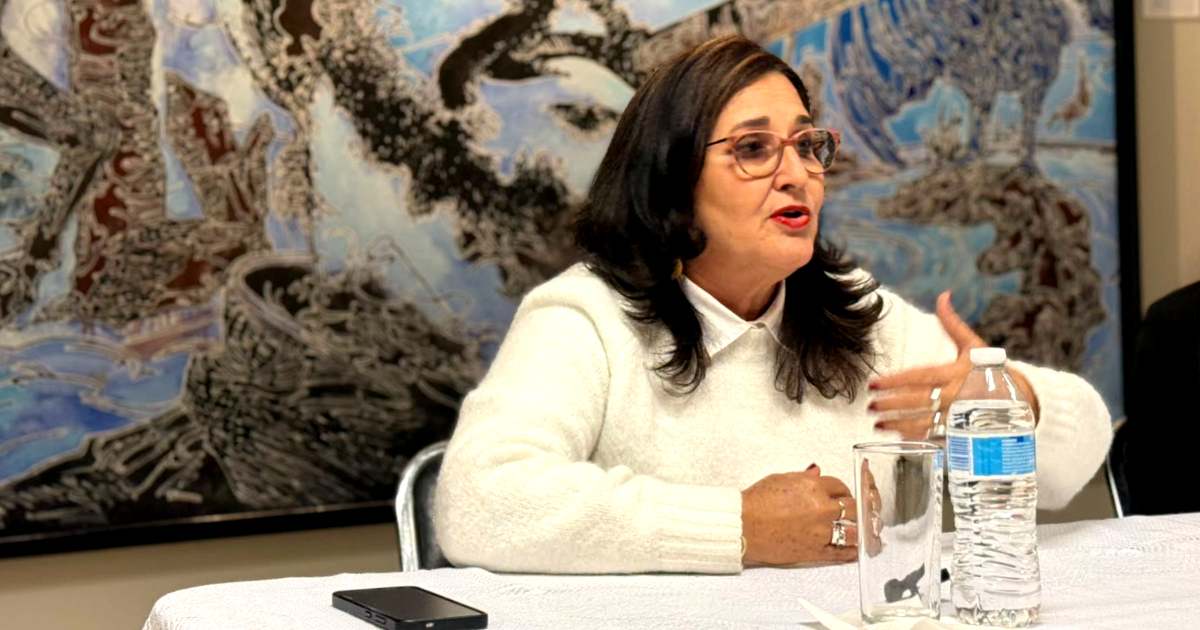
The Cuban ambassador Johana Tablada de la Torre has once again resorted to one of the most persistent arguments in the official discourse: attributing the deterioration of the regime's international image to a misinformation campaign funded by the United States.
During a meeting with young artists, writers, journalists, and progressive communicators in Mexico, the deputy head of the Cuban diplomatic mission stated that Washington allocates millions of dollars to communication campaigns aimed at holding the Cuban government responsible for the consequences of U.S. sanctions.
According to the post from the Cuban embassy, Tablada warned of a media offensive aimed at discrediting Cuba and distorting its reality, without identifying specific outlets, concrete operations, or information whose falsehood has been proven.
The fallacy of the media conspiracy
From Miguel Díaz-Canel and Bruno Rodríguez Parrilla to the television programs of Humberto López, the government has been portraying the questioning of its management for years as a manifestation of foreign hostility, or a supposed strategy of the "external enemy."
The existence of U.S. funding programs for civil society organizations and independent media is well known. However, receiving a grant does not in itself demonstrate editorial subordination, nor does it determine the truthfulness or falsity of information.
The fallacy lies in discrediting the messenger instead of evaluating the message.
Does Washington also fund the coverage of Reuters, Associated Press, AFP, EFE, and the numerous international media outlets that document the Cuban crisis? Do their correspondents work under the orders of the State Department?
Many of these outlets report both on the consequences of U.S. sanctions and on the structural deficiencies of the Cuban economy and the population's frustration. The alignment of their reports does not indicate a conspiracy, but rather reflects the observation of a shared reality.
Tablada and the construction of an alternative reality
The diplomat has a long history of defending government positions before foreign audiences ideologically aligned with Havana.
In April 2023, in front of more than 150 representatives of U.S. organizations gathered at the 1830 restaurant in Havana, Tablada de la Torre asserted that Cuban hotels belonged to the people and that the income from tourism financed health and education.
The official overlooked the control exerted by the military conglomerate GAESA over a significant part of the tourism industry, the opacity of its accounts, and the disproportionate hotel investments compared to essential sectors for the population.
In 2024, according to data from the National Office of Statistics and Information (ONEI), Cuba allocated 11,936 million pesos to investments in hotels and restaurants, compared to 1,977 million invested in public health and social assistance.
Those figures do not come from the State Department, but from the government institutions that Tablada supports.
Her role in the dissemination of government propaganda is among the reasons why the Foundation for Human Rights in Cuba added her to its database of repressors in May 2023.
The loss of the informational monopoly
What the official discourse portrays as a media offensive coincides with a transformation that has eroded the regime's ability to control the international representation of Cuba: the expansion of the internet and social media.
Cubans can document their living conditions without going through the filters of the state media, showcasing the deterioration of hospitals, collapses, food shortages, and protests against blackouts.
Does Washington pay every retiree who reports the inadequacy of their pension, every mother who demands medication, or every citizen who questions Díaz-Canel's decisions?
Attributing that discontent to a foreign operation implies denying Cubans the ability to form their own judgment about their reality and their leaders.
The paradox is that, while Tablada de la Torre denounces the supposed distortion of Cuban reality abroad, the regime restricts the practice of independent journalism and the freedom of expression of its own citizens.
The discredit of the regime is not the discredit of Cuba
Tablada asserted to his Mexican counterparts the right of the Cuban people to sovereignly decide their destiny. He omitted that this right also encompasses the possibility of questioning their rulers, overseeing power, and modifying the political system.
Confusing the government with the nation allows any criticism of its authorities to be presented as an aggression against Cuba and turns the defense of a particular political model into a matter of national sovereignty.
The meeting in Mexico concluded with a call to strengthen communication strategies to counter misinformation.
However, neither the electrical deficits announced by the UNE, nor the statistics from the ONEI, nor the testimonies of Cubans can be refuted by a communication strategy.
Tablada attributes a media campaign to a crisis of credibility, the causes of which must be sought in the management of the power it represents. Informing about the consequences of that management does not equate to fabricating a reality: it means subjecting it to public scrutiny.
Related videos:
Filed under: