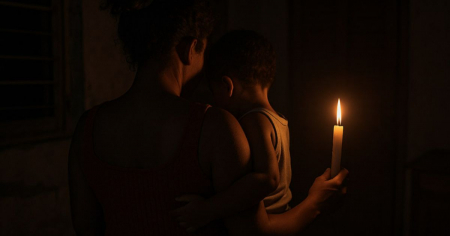
The events of May 20 marked a critical point in the energy crisis currently affecting Cuba. While the Electric Union (UNE)
From the early hours of the day, thousands of Cubans took to social media to share their desperation, exhaustion, and anger. The tone of their testimonies was unanimous: long hours without electricity, entire nights without sleep, spoiled food, mosquitoes, heat, and a complete lack of concrete official information.
Blackout Without Borders: Provinces at the Limit
Although the impact is felt throughout the country, reports indicate that the hardest-hit provinces have been Villa Clara, Cienfuegos, Camagüey, Granma, Ciego de Ávila, Las Tunas, Holguín, Artemisa, and Santiago de Cuba.
In Villa Clara, municipalities such as Remedios, Sagua la Grande, Camajuaní, and Caibarién reported power outages lasting between 18 and 30 hours, often without scheduling or notice, according to feedback gathered by CiberCuba from comments on a survey conducted on Facebook and Telegram.
In Cienfuegos, Palmira, Aguada de Pasajeros, and Cruces also reported daily outages of more than 20 hours. In Granma, from Yara to Manzanillo and Bayamo, the blackouts are so prolonged that many only recognize "moments of light" as an exception, not the norm.
Camagüey is not falling behind: in Florida, Guáimaro, Esmeralda, and the municipal seat itself, reports indicate only 2 to 3 hours of electricity per day. In Ciego de Ávila, from Bolivia, Chambas, and circuit 59 of Trinidad, the situation is described as hellish: entire nights without electricity and temperatures exceeding 30 degrees.
In Holguín and Las Tunas, towns such as Moa, Antilla, Rafael Freyre, San Manuel, and Manatí are experiencing consecutive days without electricity. In Guantánamo, Baracoa, San Antonio del Sur, and Caimanera, reports indicate more than 24 hours without light, gas, and water.
In Artemisa and Pinar del Río, power outages are also constant: in Guira de Melena and San Cristóbal, there are reports of "blackouts" lasting only 2 hours, and in Bahía Honda, the lack of electricity even prevents the pumping of water for the buildings.
In Havana, although with less intensity, outages were also reported in San Miguel del Padrón, Marianao, Cerro, Diezmero, and Playa, in some cases lasting up to 12 accumulated hours. Nevertheless, the capital remains one of the few areas in the country with some privilege in service distribution.
Mosquitoes, diseases, and domestic collapse
Beyond the darkness, what reigns is despair. In all the provinces, the testimonies agree: children cry from the heat and the bites, the elderly cannot rest, and mothers struggle to cook or preserve food.
There is no time to cool a refrigerator or heat up food, and the fans are now merely decorative pieces.
The proliferation of mosquitoes is being reported amidst outbreaks of dengue and respiratory illnesses exacerbated by a lack of rest and the prolonged use of makeshift stoves with charcoal or firewood.
"They are killing us slowly," wrote a user from Mayabeque, where blackouts also exceed 20 hours.
In rural areas, the impact is even more profound: the lack of electricity hinders water supply, and many families have to carry buckets from wells, cisterns, or nearby streams. In high-rise buildings, this means climbing stairs while carrying heavy loads in extreme heat.
A weary country with no answers
The overall sentiment is one of abandonment, mockery, and institutional cruelty. Many Cubans claim that they no longer believe the daily reports from the UNE, which speak of "scheduled disruptions" while reality far exceeds any planning.
It is noted that while the population struggles to sleep, the leaders enjoy continuous electricity, air conditioning, and fully stocked refrigerators.
There are also those who criticize the “happy crowds” from the past May Day, pointing out that those images served as an excuse to maintain the statu quo and to justify to the outside world a normalcy that does not exist. “Now we pay for the parade with more blackouts,” said a resident from Santiago de Cuba.
Between despair and sarcasm, Cubans have coined a new term to describe their routine: “alumbrones,” instead of blackouts. Because normalcy is no longer having electricity, but rather catching a fleeting glimpse of it.
In the year 2025, Cuba exists in a state of physical, economic, and political twilight. And for many, the worst part is that no end is in sight.
Filed under: