
Related videos:
In Matanzas, water is pumped for only two hours a day, and there are areas where the delivery cycle by tankers has extended to 16 days, a combination that leaves thousands of people trapped in a crisis that remains without a real solution.
While the first secretary of the Party in the province, Mario Sabines Lorenzo, and the governor Marieta Poey Zamora toured the most affected areas this Monday and discussed solutions, the data confirms an alarming situation, especially in the municipality of Ciénaga de Zapata and the upper and middle areas of the city of Matanzas.
The head of the water distribution brigade, Emilia Pérez Cuba, was clear: “It should be pumped for 16 hours under normal circumstances, and now we are barely doing it for two hours.”
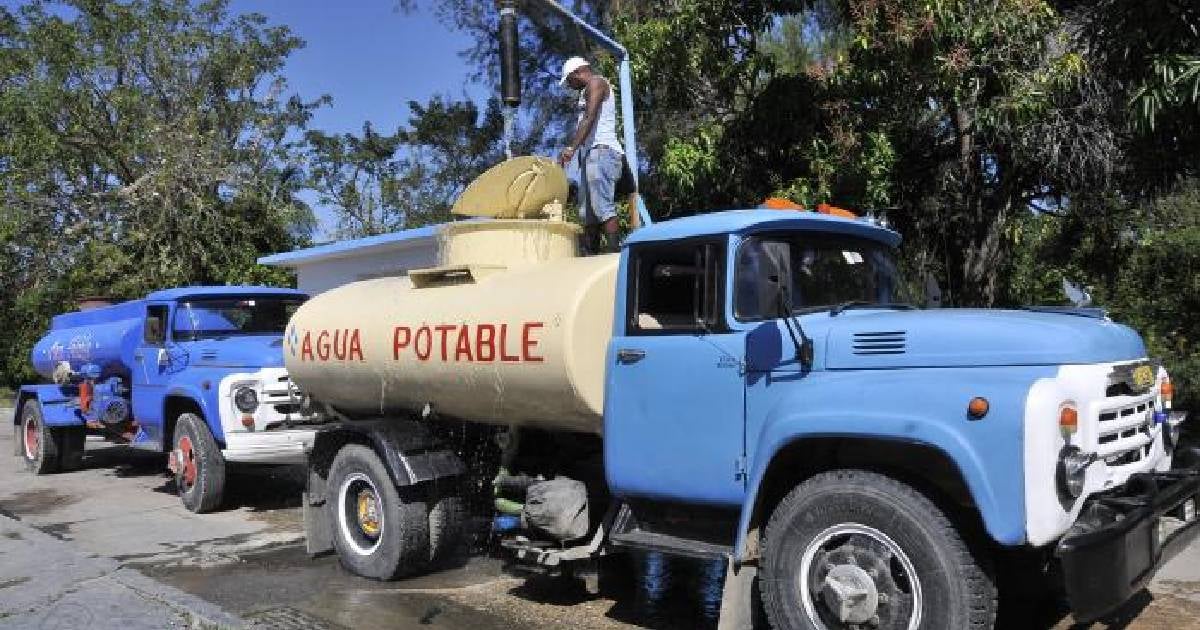
This is compounded by the fact that the cycle of supplying the vital liquid via tanker trucks reaches 16 days. "We have one truck for those registered, meaning the 12 routes for which we must ensure water delivery because they do not receive it through pipes," although "when there are significant disruptions, the cycles are altered because it is not always possible for us to comply," Pérez stated, as cited by the official newspaper Girón.
The Zapata Swamp tops the list of critical areas. A smaller capacity pump was supposed to be installed there on Tuesday, a temporary measure that will only provide relief to a minimal fraction of households. The rest will continue to rely on water delivered by tanker trucks, the newspaper reported.
In Colón, the San José de los Ramos water pump is out of service and undergoing repairs. The provincial director of Aqueduct and Sewerage, Guillermo Cué Lugo, estimated at least 48 more hours without service.
Meanwhile, in Jovellanos and other municipalities, systematic power cuts worsen everything: from May 13 to 19, there were 15 interruptions in wells, totaling more than 16 hours of disruptions, which caused an average of 39 hours without pumping.
"This primarily affects the pumping stations at Naranjal and the prioritized centers such as the Pediatric Hospital, Matanzas Oeste, and the central area. Sudden breakdowns, such as damaged valves, have also impacted the supply,” Pérez indicated, adding that this Sunday, two broke down: one at the Pedraje pumping station and another at Naranjal Norte.
According to the explanation, in the case of the city of Matanzas, there are five tankers in operation—two of which are broken—and an additional three for support. "In these three days, there have been 127 tanker trips, which, despite the efforts, is still insufficient to meet the demand," he acknowledged.
Cué stated that the pumping from San Carlos should be restored this Tuesday, while Canímar 3 remains out of service, also in the capital of Matanzas.
During the authorities' inspection, solutions were also discussed for neighborhoods like La Cumbre in Versalles, where population growth has overwhelmed the infrastructure. Officials emphasized "the need for a close relationship between the water and sewage company and the Matanzas electric company, to reduce the impact on pumping in the province," as if that would resolve a system that has been suffering from decades of deterioration.
Matanzas is facing one of its worst water supply crises in years, with pumping equipment out of service, collapsed hydraulic networks, constant blackouts, and an infrastructure at its breaking point, despite being, ironically, an area with abundant underground water reserves.
The province has 225 pumping units, but many are inactive or operating with serious limitations. In addition to technical failures, there is a more significant issue: the energy crisis, which reduces the operating time to just four or five hours a day, far from the 16 hours that should be met. And when electricity service is finally restored, systems can take up to four more hours to stabilize, local authorities have acknowledged.
Residents have reported that, despite the lack of water in their homes, they sometimes see it flowing in the streets without reaching their houses. They also pointed out that, although the supply has been managed through water trucks, these do not arrive, and warned that this measure does not address the underlying problem: the absence of a stable service from the aqueduct.
Although the rainy season has already begun, several Cuban provinces are facing a severe drought that has led to the collapse of their main water sources, further complicating water supply. This situation is exacerbated by power outages, which severely hinder pumping operations.
In Holguín, more than 370,000 people are affected by the prolonged lack of rainfall, constant power outages, and technical failures in the supply system.
Meanwhile, in Santiago de Cuba, the municipalities of Palma Soriano and Songo-La Maya are facing extreme situations: the delivery cycle exceeds 30 days in the former and reaches up to 85 days in the latter.
In Sancti Spíritus, the number of people relying on water distributed by tanker trucks has doubled in just one year, rising from 40,000 in May 2024 to nearly 82,000 currently.
Ciego de Ávila is not exempt from the crisis. The reduction of water flow in the main sources and the low efficiency of the pumping equipment have necessitated the establishment of a water delivery cycle of 24 hours every nine days in all the popular councils of the capital municipality, with serious consequences for production, services, and daily life.
Frequently Asked Questions about the Water Supply Crisis in Matanzas
What is the current duration of water pumping in Matanzas?
The water pumping in Matanzas has drastically reduced to only two hours a day, leaving thousands of people in a critical situation. This problem is compounded by the long delivery cycles of water via tankers, which extend up to 16 days in some areas.
What measures are the authorities taking to address the water crisis in Matanzas?
The authorities have promised temporary solutions, such as the installation of a smaller capacity pump in Ciénaga de Zapata, but these measures only provide partial relief and do not address the underlying problem. The deteriorating infrastructure and the energy crisis remain significant obstacles.
How does the energy crisis in Cuba affect the water supply in Matanzas?
The energy crisis has reduced the operating time of pumping systems to just four or five hours a day, which is far from the necessary 16 hours. This has worsened the water shortage in Matanzas, as constant blackouts hinder the proper functioning of the pumping system.
What impact does the lack of water have on the daily lives of the people from Matanzas?
The lack of water seriously impacts the daily lives of the residents of Matanzas. Neighbors have reported that water is often wasted as it flows down the streets without reaching homes. Furthermore, reliance on water trucks is not an effective solution, as they do not guarantee a regular and stable supply.
Filed under: