
Related videos:
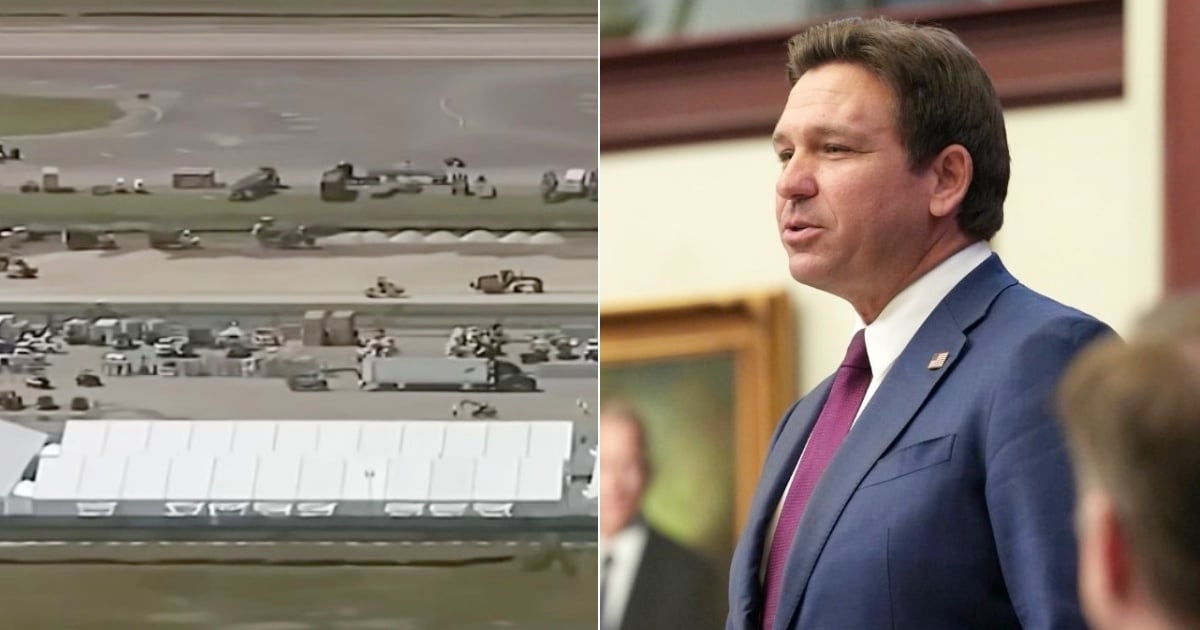
The governor of Florida, Ron DeSantis, firmly defended the continuation of state immigration operations after it was revealed that the controversial immigrant detention center in the Everglades - popularly known as "Alligator Alcatraz" - could be emptied within days.
In statements made this Wednesday in Orlando, DeSantis assured that his administration will continue to focus on the detention and deportation of immigrants as part of a state effort complementing that of the federal government.
"Our role is to provide more space for processing, detention, and deportation. DHS determines who enters and who exits those facilities," stated the governor, referring to the Department of Homeland Security.
Despite the order from a federal judge that mandates the closure of the center within 60 days, DeSantis emphasized that the state of Florida will continue its mission.
“We are here to be a force multiplier in all of that, and we will continue to do so; I believe it is an important mission,” he stated.
The governor insisted that the need for infrastructures such as "Alligator Alcatraz" remains high.
"The need remains very strong", he noted.
He also recalled that the state is currently building a second detention center in Baker County, nicknamed "Deportation Depot," with a capacity for 1,300 people.
This facility would complement the existing one in the Everglades, which was designed to accommodate up to 3,000 detainees.
An accident as justification for immigration policy
During his speech, DeSantis also used a recent case to reinforce his tough stance on immigration.
He recounted the incident of a driver from India who, as he stated, entered the country illegally, obtained a commercial license in the state of Washington without speaking English, and subsequently caused a fatal accident in Florida.
“That individual did not have the proper training to drive a truck. That’s what happens when there are no regulations,” he stated.
DeSantis announced that his administration is working to extradite the driver and prosecute him in Florida, insisting that his objective is to "protect the people" from what he described as failures of federal immigration policy.
While DeSantis promises more centers, Alligator Alcatraz empties
The governor's words contrast with the events unfolding simultaneously.
According to the AP agency, a high-ranking state official stated via email that the center “will likely be empty in a few days.”
The message was sent on August 22 by Kevin Guthrie, director of Florida's Division of Emergency Management, in response to a request related to religious services for the detainees.
This happens just after federal judge Kathleen Williams ordered the dismantling of the center.
The court's decision was in response to a lawsuit filed by environmental organizations and the Miccosukee tribe, which reported a violation of environmental protection laws due to the construction of the center in a fully protected area of the Everglades.
Although the state of Florida and the federal government have appealed the decision and requested a temporary stay of the closure order, the number of detentions has sharply decreased.
Of the nearly 1,000 that were housed at one time, between 300 and 350 remained last week, according to Democratic Congressman Maxwell Frost.
Some have been deported; others have been transferred to alternative centers.
Demands for inhumane conditions
Judicial and environmental pressures are compounded by three lawsuits from civil rights organizations that describe deplorable conditions at "Alligator Alcatraz":
Among them are foods with worms, unusable toilets, floors flooded with black water, a constant presence of insects, and detainees without charges and خارج the public tracking system of ICE.
Lawyers assert that these issues represent an anomaly within the U.S. immigration system itself and condemn the lack of transparency in the state's operation since its official opening on July 1, just two months ago.
A necessary center or a failed symbol?
While Governor DeSantis insists on expanding the detention infrastructure, his administration faces a judicial setback, social pressure, and an apparent contradiction between political rhetoric and logistical decisions already in progress.
"If it were that difficult, they likely wouldn't have achieved it already," questioned Elise Pautler Bennett, an attorney at the Center for Biological Diversity, referring to the rapid depletion of the center.
Filed under: