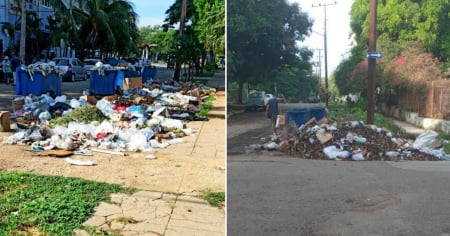
More than 35 thousand cubic meters of trash were collected this weekend in Havana, as part of a mobilization organized by the Cuban regime to address the health crisis affecting the capital.
The official data is serious and will increase, as there are still sanitation tasks pending in over a thousand districts.
The operation was called by Miguel Díaz-Canel, who chaired a follow-up meeting on these actions alongside senior officials from the State, the Government, and the Party this Monday.
During the meeting, it was reported that solid waste was only collected in the streets of around 300 districts, while over a thousand continue to accumulate garbage.
Díaz-Canel acknowledged that the effort made is not enough to solve a problem that has persisted for decades.
“We made an effort this weekend, but we won't solve everything. We must keep going. People have already seen a response. Now what everyone is asking is how it will be sustained. Well, we will sustain it if everyone works together,” the leader declared on Sunday.
He admitted that there is no sustainable plan for waste collection in the capital, and called for the “systematization” of actions like the one carried out, which mobilized state workers, citizens, army recruits, and members of the National Revolutionary Police.
Díaz-Canel also pointed out that in some neighborhoods of Havana, there was no response to the cleanup call and urged to involve more people and institutions to achieve better results.
“A large part has been mobilized, but some have not shown up and believe that others should solve the problem,” he said.
The problem of garbage accumulation is a national issue and is due to various causes such as the lack of fuel, the deterioration of infrastructure, and the poor management of solid waste by the state.
However, far from offering structural solutions, the ruler insisted that "people, inspired by the example of Havana, will do their part in each territory as well."
The health situation in the capital has been reported by citizens and experts. Trash accumulates in the streets, vacant lots, and corners of the city, which is home to two million people. On rainy days, the waste floats and reaches the doors of hospitals, schools, and homes.
In September, the Minister of Science, Technology, and Environment, Armando Rodríguez Batista, publicly acknowledged the magnitude of the problem. “That trash is not contained: it is scattered all over Havana,” he wrote on his Facebook account.
Despite the targeted operations and images of Díaz-Canel and Manuel Marrero sweeping the streets around the Palace of the Revolution, the hygiene crisis persists in the capital and in other provinces of the country.
Frequently Asked Questions About the Trash Collection Crisis in Havana
How many cubic meters of garbage were collected in Havana during the mobilization?
More than 35 thousand cubic meters of waste were collected in Havana as part of a mobilization organized by the Cuban regime to address the health crisis in the capital.
What problems does Havana face with garbage collection?
La Habana is facing a collapse in garbage collection due to a lack of fuel, the deterioration of infrastructure, and poor state management of solid waste. Over a thousand districts have yet to be addressed, and garbage is piling up in streets, vacant lots, and corners, worsening the city's health situation.
Are there sustainable plans for waste collection in Havana?
There is no sustainable plan for trash collection in the Cuban capital. Miguel Díaz-Canel has acknowledged that the cleaning efforts made are insufficient and that there is no clear strategy to sustain the initiative in the long term.
How has the population reacted to the sanitary crisis in Havana?
The population has expressed its discontent through social media and protests, criticizing the lack of structural solutions from the government. Many citizens believe that the responsibility for the collapse lies with state inefficiency and poor management of community services.
What measures has the Cuban government taken to address the garbage crisis?
The Cuban government has organized massive mobilizations, involving state workers, recruits, and police to clean the streets. However, these specific actions have not solved the problem, and the government has been criticized for failing to provide long-term solutions or address the structural causes of the waste management collapse.
Filed under: