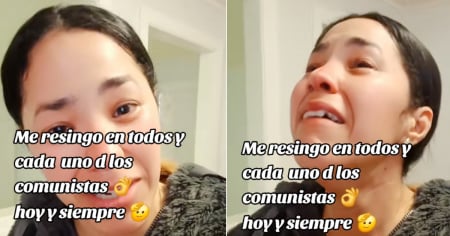
The Cuban mother identified as @anita.cubanita64 on TikTok has gone viral in recent hours after sharing a video in which she starkly—and with dignity—documents what a typical day in her home is like without electricity or water.
"We were without electricity all night since 9 PM, and they didn’t restore it. All of Alan's puree went bad," she laments in the video, as she shows the completely disordered kitchen due to the lack of resources and food that has thawed after hours without refrigeration. The scene is as domestic as it is devastating: spoiled food, empty containers, a refrigerator with a foul odor, and a small child who still needs to be fed homemade puree.
Despite everything, the mother manages to keep going: she rearranges the kitchen, boils root vegetables over charcoal, improvises recipes, and even celebrates a simple cup of coffee. "Coffee in Cuba is very strong, that's why we drink it in small amounts," she says, trying to maintain a cheerful spirit. "I took a shower for the first time in 68 years," she jokes, laughing at herself for the ants that attacked her while she was showering with a sponge.
The video sparked a wave of reactions: from household tips for preserving food or keeping mosquitoes away, to words of encouragement from Puerto Rico, Venezuela, Mexico, and other countries where many mothers claim to have experienced similar situations. There were also criticisms from some users who questioned the authenticity of the testimony, suggesting there might be hidden interests behind the video. Others, however, defended its authenticity and highlighted its resilience.
A drama that unfolds daily
Anita's testimony adds to a series of videos published by other Cuban mothers who, from the everyday reality of their homes, have chosen to showcase on social media the harshness of living without basic services.
In a previous video shared in March, the same user recounted her experience after more than 48 hours without electricity: “Everything was cooked over charcoal,” she explained as she prepared food under precarious conditions and relied on a neighbor with a generator to charge her mobile phone.
Another recent case was that of @lizzmaria.la.cuba, who showed how she started her day without electricity or water, making coffee over charcoal embers while her son slept with a rechargeable fan. “This is what it’s like to wake up living in Cuba, my loves,” she said tenderly, in a video that wasn't meant to evoke emotions but ended up touching hearts.
Equally moving was the case reported by journalist Mario J. Pentón, where a mother could not explain to her son why there was no electricity or milk at home. With tears in his eyes, the boy asked why the leader Miguel Díaz-Canel “turned off the power.” The full story was featured in this article, which became a symbol of the shared pain of many Cuban families.
Cuba, between scarcity and domestic resistance
Through these testimonies, which are increasingly frequent on social media, Cuban women—especially mothers—are documenting a reality that goes beyond official statistics: blackouts that spoil food, a lack of water for personal hygiene or cooking, and children who can't sleep due to the heat and mosquitoes.
The videos not only reveal precariousness but also creativity, community solidarity, and the effort to maintain some semblance of normalcy. However, they also express a pent-up rage, a physical and emotional exhaustion that doesn't always find space in state media.
Despite the humor that many of these mothers incorporate into their videos, the underlying situation is alarming. Childhood in Cuba is being marked by scarcity. As one commentator expressed: “Children have no ideology; they only have needs. And they are dying from exhaustion and sadness.”
These videos are, without a doubt, a silent scream that cuts through censorship, fear, and exhaustion. It’s not just about blackouts. It’s about the dignity of living and resisting, even when it seems there is nothing left to lose.
Frequently asked questions about the energy crisis and everyday difficulties in Cuba
How does the energy crisis affect Cuban families?
The energy crisis in Cuba deeply affects the daily lives of families, who face constant blackouts that hinder basic tasks such as cooking, refrigerating food, and getting adequate rest. The lack of electricity causes food to spoil, forces families to cook with charcoal, and leaves them without ventilation on hot nights, which particularly impacts young children.
What strategies do Cuban mothers use to cope with power outages?
Cuban mothers, like @anita.cubanita64, resort to ingenious methods to cope with power outages, such as cooking with charcoal stoves, improvising recipes with the few available ingredients, and using rechargeable fans to alleviate the heat. They also rely on neighborly solidarity, like charging phones in neighbors' houses with generators, to maintain some sense of normalcy in their homes. Resilience and creativity are key to surviving under these conditions.
What is the reaction of the international community to the situation in Cuba?
The international community has shown solidarity and empathy towards the difficult situation faced by Cuban families, particularly through social media. The testimonies of Cuban mothers have sparked reactions of support, understanding, and proposals for financial assistance from various countries, which share their own experiences of scarcity and energy crisis.
Why are blackouts frequent in Cuba?
Blackouts in Cuba are due to a deficit in electricity generation, caused by a lack of fuel, the deterioration of energy infrastructures, and constant breakdowns in thermal power plants. This situation has worsened over time, severely affecting the quality of life of the population, which must adapt to living without basic services on a regular basis.
How do Cuban mothers face criticism for not emigrating?
Cuban mothers, like Anita, face criticism by explaining that emigration is not a viable option for many due to economic and administrative constraints. Their priority is to fight for their families amidst the crisis, and many express that waiting for an improvement in Cuba to have children would prevent them from ever starting a family. Through their testimonies, they seek to highlight the reality they live in and the resilience needed to survive under these conditions.
Filed under: