
Related videos:
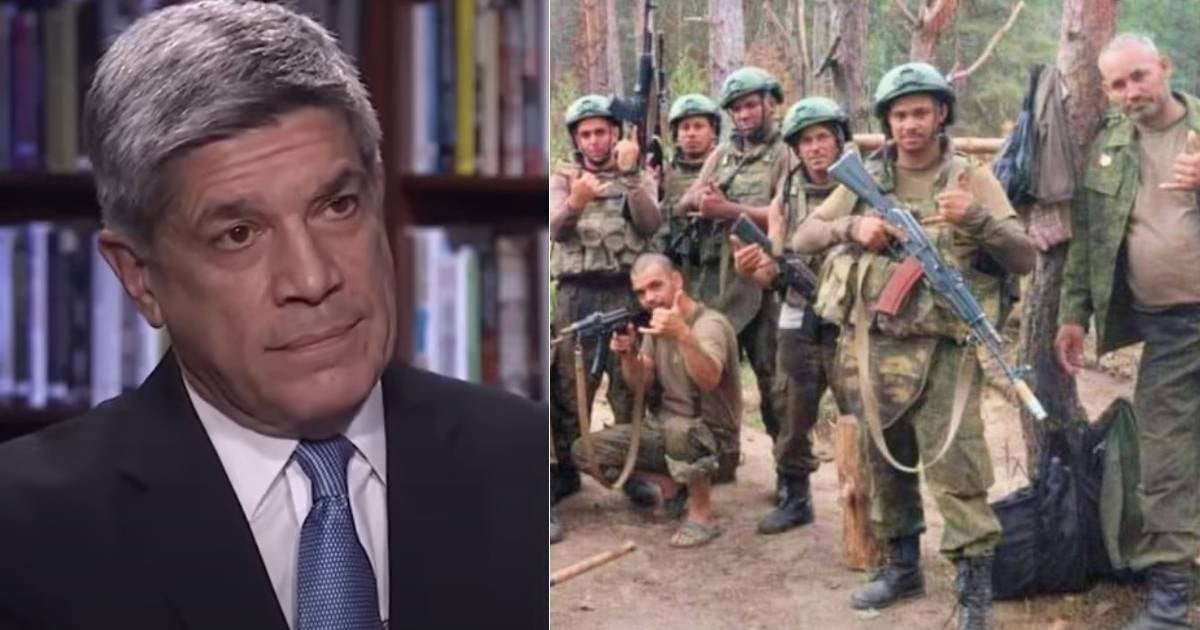
The Cuban government claims it is not responsible for the recruitment of Cuban citizens to participate as mercenaries in the war between Russia and Ukraine, despite the allegations and testimonies that have shaken families both inside and outside the island.
In an interview with the American program Democracy Now!, Cuban Vice Minister Carlos Fernández de Cossío stated that Havana "made public and denounced" the phenomenon of Cubans recruited as soldiers in that armed conflict.
"It was even made public that we had taken action, we had spoken with governments related to the issue", declared the official, downplaying the accusations that have circulated in international media such as BBC or El País.
Fernández de Cossío stated that Cuban citizens have been identified fighting on both sides of the conflict. “Cubans have been detected on the Russian side and Cubans have been detected on the Ukrainian side.”
According to the deputy foreign minister, recruiting networks in Europe targeted citizens from various countries, including Cubans, to send them to the front lines.
"Our laws prohibit a citizen under our jurisdiction from participating in the wars of other countries. It is something that is punished by law in Cuba," he declared.
Testimonies that contradict the regime
However, multiple investigations and testimonies from Cubans involved in the conflict paint a very different picture. A report from the Ukrainian media Schemes revealed the presence of several hundred Cubans fighting for the Russian army, many of whom are part of the 106th Airborne Division, active in some of the bloodiest battles of the war, such as the one in Bakhmut. Cuban fighters were even identified with insignias of the Wagner group and promoting war propaganda on social media.
One of the most touching cases was that of the young Cubans Andorf Velázquez and Alex Vega, both only 19 years old, who reported being deceived with false promises of construction jobs and ended up being recruited at a Russian military base.
"It has all been a scam. We are scared", they cried in a video shared by AmericaTeVé, in which they also reported being beaten, tortured, and stripped of their documents.
Both suffer from delicate medical conditions: one has generalized arthritis, the other has only one kidney. “They beat us naked... they told us the Americans had sent us”, they recounted. Their testimonies raised alarms about the vulnerability of young Cubans to recruitment networks that appear legal.
Also, a Russian official revealed to the Moscow Times that many of these recruits are coming directly from Cuba, signing contracts with the Russian Ministry of Defense and being sent to the front lines. “There were only Cubans and Serbs there,” he confessed.
Through social media, individuals like Elena Shuvalova have promoted contracts with the Russian army offering salaries, immigration benefits, and accommodation, without requiring valid passports.
According to Shuvalova, several Cubans have been “successfully” sent to war. Her social media profile shows links to pro-Russian propaganda and posts offering “assistance” for enlistment despite immigration status.
Silence, contradictions, and more questions
Although the regime insists that it has no connection to recruitment, it has also admitted, in a statement from MINREX, that an investigation is underway into a human trafficking network for military purposes that is believed to have operated from Russia and Cuba. However, it has not provided clear figures, details about the mentioned criminal proceedings, or assurances regarding the protection of those affected.
Meanwhile, Cuban mothers are desperately seeking news of their children, young migrants disappear within the war machinery of the Kremlin, while the island's authorities choose denial or ambiguity.
Amid the economic crisis hitting the island, many see these military contracts as a desperate "way out". Others, victims of deception, have ended up trapped in a foreign war that now haunts them with trauma, fear, and silence.
Filed under: