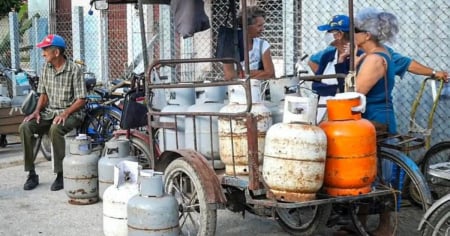
Mirella Herrera Delgado, an elderly woman from Matanzas with severe asthma, Chronic Obstructive Pulmonary Disease (COPD), allergies, and physical limitations, was denied access to liquefied petroleum gas (LPG) because, according to the state company, she does not meet the "priority" criteria.
This is how the letters section, Box 1433, of the official newspaper Girón, describes it, to which Herrera wrote, hoping to find a solution to his critical situation.
A resident of the Camilo Cienfuegos neighborhood in the city of Matanzas, the elderly woman acknowledged that "she is not permanently bedridden nor does she consider herself to be in a vulnerable category, but she needs the aforementioned domestic fuel for cooking her meals."
Due to the ongoing and prolonged blackouts that are affecting the country and the severe shortage of LPG, he has had to cook with charcoal, but his medical conditions make this not a safe option, but a direct threat to his health.
According to the response provided to the press by Lázaro R. Abreu García, territorial director of the Matanzas Fuel Marketing Company, the diseases described by the sender are not among those prioritized for the allocation of liquefied gas.
"In these cases, the vulnerable individuals monitored by the municipal government and homebound clients are included. Since the product was acquired on December 3, 2024, he is already entitled to purchase it from June 10 of this year," Abreu specified.
The official response, while adhering to the regulations, highlights the rigidity of a system that does not accommodate nuances or exceptions.
Mirella's case is not unique, but it is illustrative. It starkly demonstrates how the distribution policy for LPG, far from addressing specific human needs, is governed by cold classifications that do not adapt to the complexity of each situation. In the process, people with serious ailments continue to face decisions alone that overlook the essential: their right to live with dignity.
The sale of LPG has been suspended in almost all provinces of Cuba, after the inventory from the last ship that arrived on the island in May was depleted, confirmed Irenaldo Pérez Cardoso, deputy director of Unión Cuba Petróleo, to Granma.
The distribution remained for more than 30 days, but currently there will only be availability when a new ship arrives, which is currently in national waters, although its unloading depends on the country completing the payment to the supplier, authorities acknowledged.
This phenomenon is not new: for months and even years, Cuba has been facing periodic interruptions in the distribution of domestic gas, almost exclusively depending on the arrival of ships and the government's ability to make timely payments.
Whenever the reserves run out, the population is left facing long waits and uncertainty about when they will be able to cook with gas again.
The government attributes these limitations to a lack of funding and the economic sanctions imposed by the United States, which it qualifies as part of a “multidimensional blockade.”
At the moment, there is no prospect of a solution that would overcome the extreme dependency on specific imports to ensure a basic service like liquefied gas.
The country is also experiencing one of its worst energy crises in recent years, with a deteriorating electrical system, reliant on scarce fuels and with generation capacity on the brink of collapse.
La Unión Eléctrica (UNE) confirmed this Friday, July 4, that the National Electric System (SEN) continues to be immersed in a severe crisis, with a deficit that reached 1,767 MW on Thursday, a figure higher than the anticipated 1,650 MW and which reflects a situation of extreme vulnerability.
While official reports reflect a critical situation in technical terms, on the streets of Cuba, public perception goes beyond the numbers: despair has taken hold as a widespread sentiment in light of the worsening living conditions.
In the case of Matanzas, the Electric Company announced the implementation of several measures to mitigate blackouts, but their own statements confirm that the disruptions will continue.
In the yumurino territory, power outages of up to 32 consecutive hours have been reported, causing frustration and protests among the citizens.
Frequently Asked Questions about the Liquefied Gas Crisis in Cuba
Why was liquefied gas denied to Mirella Herrera Delgado in Matanzas?
Liquefied gas was denied because Mirella Herrera's illnesses are not among those prioritized for the allocation of this resource, according to the current regulations of the state company responsible for its distribution. Although Herrera has severe medical conditions, such as asthma and COPD, these are not considered within the established "priority" criteria, which are limited to bedridden individuals or vulnerable persons monitored by the municipal government.
What is the current state of liquefied gas distribution in Cuba?
The distribution of liquefied gas in Cuba faces serious difficulties due to a lack of inventories and financing issues for paying international suppliers. This situation has led to widespread shortages affecting millions of households across the island, forcing many families to resort to alternative cooking methods, such as using firewood and charcoal, which represents a setback in living conditions.
How does the liquefied gas crisis affect the Cuban population?
The liquefied gas crisis has forced many families to cook with firewood, which poses risks to health and the environment. Furthermore, the increase in electricity consumption due to the lack of gas has further overloaded an already unstable electrical system, exacerbating the impact of frequent blackouts. The situation has generated discontent and despair among the population, who face long lines and uncertainty regarding access to this basic resource.
What measures has the Cuban government taken to address the shortage of liquefied gas?
The government has attempted to prioritize the distribution of liquefied gas to vulnerable sectors, such as bedridden individuals and patients undergoing hemodialysis, and has implemented digital distribution systems to organize purchasing lines. However, these measures have not addressed the root of the problem: the lack of supply due to dependence on imports and financial issues to ensure deliveries. The situation remains critical, with few prospects for improvement in the short term.
Filed under: