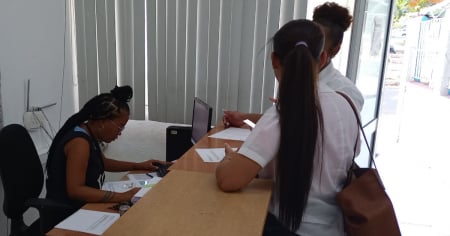
Six years after the fixed telephone service was assigned in the 24th district of the Popular Council of Coliseo, in the municipality of Jovellanos in Matanzas, residents are still without a line in their homes, caught between unfulfilled promises, contradictory accounts, and the silence of the state and sole Telecommunications Company of Cuba S.A. (ETECSA).
The neighbors' outrage is not out of whim. While they await a phone that was promised to them, after going through all the formal steps—local commissions, government-validated lists, and final referral to ETECSA—other Popular Councils like Yaguajay, Granma, and San Miguel de los Baños have already received the service.
In contrast, the residents of district 24 continue to be told, meeting after meeting, that the process has already "concluded," revealed the letter section Apartado 1433, of the official newspaper Girón.
The letter sent to the press detailed that the director of Etecsa in the region stated that “there would be no solution for the remainder of the year, and for the next year it would depend on the budget.”
In contrast, "at the monthly meetings of our People's Council, where all stakeholders are present, it was stated that the delivery of the referred services has already been completed in (the People's Council of) Coliseo. Who is lying? How many more years will we have to wait?", the letter's senders remarked.
On her part, the president of the Municipal Assembly of the People's Power in Jovellanos, Danay Rives Álvarez, and the superintendent Leovany Hernández Tanquero, noted that in the interview with José Luis Nieves, who was then the director of Etecsa, “he specified that in that area, 111 telephone services were delivered, dated January 21 and 28, 2022.”
According to Girón, both officials acknowledge that the neighbors' proposal is "partially correct and unresolved," a vague response that neither explains nor resolves anything.
Meanwhile, those waiting for the service understandably ask: who is lying? Etecsa, which admits it does not have the budget, or the local officials who declare the delivery complete? How can a delay of more than five years in a basic service, already approved and promised, be justified?
The phones do not ring because they were never installed, and the only tone that the residents of district 24 of the Coliseo Popular Council in the municipality of Jovellanos hear is the sound of institutional silence.
In mid-June, more than 60,000 fixed-line phone lines were affected in the province of Pinar del Río. However, complaints about prolonged interruptions are not exclusive to Pinar del Río. In Havana, there are customers waiting for more than a year for the repair of their phone lines. ETECSA is facing a structural crisis that is much deeper than a simple isolated technical failure.
The new tariff scheme from ETECSA, implemented at the end of May under a neoliberal logic that the Cuban regime has historically criticized, has been denounced as abusive and discriminatory by the majority of the population, with many users describing it as 'a daylight robbery.'
When the package the meager package allowed for browsing in a month (only 6 GB) runs out, the customer relies on top-ups in plans priced very high in CUP and foreign currency, far beyond the reach of most citizens who receive their salaries in a highly devalued Cuban peso within a context of rampant inflation.
The measure sparked student protests at several universities and reports of retaliation and harassment by the government against critical voices.
ETECSA justified the rate hike by highlighting the need to maintain submarine cables, radio bases, and millions of mobile lines, but it avoids the discussion on quality, real access, and affordability. The rhetoric of “sustaining the connection” rings hollow to a population that pays dearly for a limited and inadequate service.
The argument follows a familiar formula: highlighting infrastructure without accounting for its real impact on users' daily lives. While it's true that coverage has increased, it is equally true that the connection is expensive, unstable, and exclusionary.
The Decree 124/2025 from the Council of Ministers granted ETECSA exclusivity to provide public telecommunications services in Cuba for an additional 11 years, with the possibility of extending for two additional periods of 15 years each. This measure consolidates state control over the sector, maintains centralized rate setting, and restricts the participation of private operators.
Frequently asked questions about the situation of ETECSA in Cuba
Why do the residents of Coliseo, Matanzas, still lack telephone service after six years of waiting?
The residents of Coliseo, Matanzas, continue to be without telephone service due to unfulfilled promises and the lack of budget from the state-owned ETECSA, despite the fact that the line delivery process was supposedly completed. This situation reflects the inefficiency and lack of transparency of the telecommunications monopoly in Cuba.
What challenges does ETECSA face in providing quality service in Cuba?
ETECSA faces a series of issues that impact the quality of its service, including lack of investment, vandalism, and a pricing scheme considered abusive. These difficulties are compounded by the company's monopolistic structure, which hinders competition and the improvement of services.
How does ETECSA's new tariff scheme affect Cuban citizens?
The new pricing scheme of ETECSA has been denounced as abusive and discriminatory, forcing citizens to pay high prices for a limited and deficient service. This has led to protests and widespread dissatisfaction among the population, who see their access to telecommunications becoming even more restricted.
What impact do vandalism acts have on ETECSA's infrastructure?
Vandalism has caused significant disruptions to ETECSA's services, affecting thousands of users across Cuba. These incidents highlight the lack of effective security measures and the company's inability to protect its critical infrastructure.
Filed under: