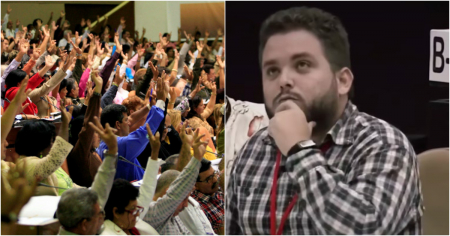
In the midst of the deep crisis faced by the Cuban people, the leader Miguel Díaz-Canel has once again resorted to the regime's empty propaganda, claiming that "it can be done."
"On July 26th in Ciego de Ávila, we will celebrate the certainty that it is possible. History says so and the present certifies it," he said on Friday during his speech at the closing of the National Assembly's session period.
The leader expressed gratitude “on behalf of the Party and the government to the entire people of Cuba for their resilience in the face of so many difficulties, their tireless creativity, and for never giving up, even when everything is lacking, sometimes even the essential means of communication.”
Díaz-Canel referred to the celebrations next month for the centenary of the late dictator Fidel Castro, for whom he stated, “the best tribute (…) is the work of the Cuban people.”
He acknowledges the crisis and defends dollarization
During his speech at the National Assembly, Díaz-Canel defended the dollarization of the economy as a solution to the deep economic crisis facing the island.
"To navigate this situation [of crisis], we have been compelled to accept the partial dollarization of the economy," he euphemistically stated on Friday during his speech at the closing of the National Assembly's session.
He also acknowledged that this circumstance further deepens the social inequalities in the country.
"What undoubtedly, in some way, benefits those who possess certain capital resources or receive remittances, translates into an undesirable widening of the gaps that define social inequality," said the ruler.
The regime leader acknowledged the dire situation in which Cubans live, which has worsened during his administration, without taking any responsibility for it.
“The high dependence on imports and the cross-cutting effects caused by the instability of the national electricity system lead to a significant paralysis or slowdown of economic activity, which not only results in a deficit in the supply of goods and services for the population but also leads to a contraction in exports,” he described.
"Consequently, the importation of food for the basic needs basket and the fuels necessary for electricity generation and the functioning of the economy is restricted," he continued.
Finally, he referred to "the limited availability of medications and the reduction of transportation services, solid waste collection, and water supply, among others, which shape the harsh reality our people face every day."
To alleviate inequality, Díaz-Canel stated that "we need to enhance the effectiveness of the state's redistributive social function," without clarifying how he plans to implement something that his administration has so far struggled with.
"It will not be the last time the revolution faces its most difficult moment."
He also stated that "this is not the first time, nor will it be the last that the Cuban revolution faces its most difficult moment," in a speech where he justified the complex current situation of the country by invoking a historical context of "resistance."
Díaz-Canel contextualized the current economic and social adversities of the island, asserting that the situation is "comparable" to other critical moments in Cuban history, such as the "Sanjón pact," the fall of independence leaders, or American intervention.
For this reason, he asserted that the Cuban people would be prepared for the current crisis and for those to come.
"This is not the first time, nor will it be the last, that the Cuban revolution faces its most difficult moment, in quotation marks," he said.
The ruler defended the "authenticity" of the Cuban regime and criticized those who compare the current times with the period before Fidel Castro came to power, pointing out that they "hide the misery" that existed at that time.
Díaz-Canel, as he has done in many other moments of his term, attributed most of the problems to external factors, mentioning the "suffocating economic blockade" imposed by the United States and Cuba's inclusion on the list of state sponsors of terrorism. He asserted that these measures "reinforce the blockade policy to unprecedented levels" and have a "multiplied impact" on the economy and the living standards of the population.
Frequently Asked Questions about the Economic Crisis in Cuba and Díaz-Canel's Statements
Why does Díaz-Canel defend the dollarization of the Cuban economy?
Díaz-Canel defends the partial dollarization of the economy as a necessary measure to navigate the island's economic crisis. He argues that, although this decision exacerbates social inequalities, it is a necessary step to improve the availability of foreign currency and control its illegal circulation. However, critics maintain that this policy is more of a political control strategy than a genuine economic necessity.
How does dollarization affect social inequality in Cuba?
The partial dollarization of the Cuban economy benefits those who have capital resources or receive remittances, resulting in an widening of the gaps that mark social inequality. This means that a minority with access to dollars benefits, while the majority of Cubans, without access to foreign currency, faces greater economic vulnerability.
What does Díaz-Canel acknowledge about the economic crisis in Cuba?
Díaz-Canel admits that Cuba is facing a severe economic crisis that has worsened during his administration. He acknowledges issues such as the high dependence on imports, the instability of the energy system, the shortage of medications, and the decline of basic services. However, he tends to attribute most of the crisis to the U.S. embargo, avoiding full accountability for the internal management errors.
What are the criticisms of Díaz-Canel's speech regarding the crisis in Cuba?
The criticism focuses on the lack of concrete and effective proposals from Díaz-Canel to resolve the crisis. His speech is filled with revolutionary rhetoric and historical justifications, but it lacks real and urgent solutions. Many Cubans perceive his statements as disconnected from the daily reality of shortages and social unrest they face on the island.
Filed under: