
Related videos:
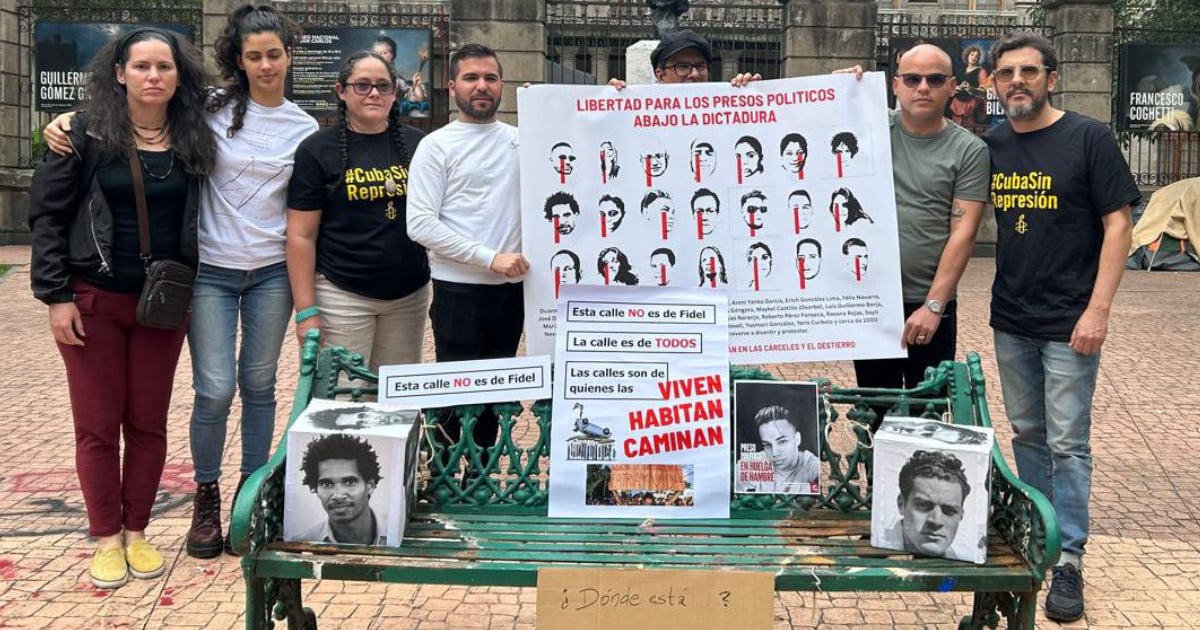
A group of Cuban exiles commemorated Cuban political prisoners at the bank where the statues of Fidel Castro and Che were removed, in the Tabacalera Garden of the Cuauhtémoc municipality in Mexico City.
“We went to the park where the sculptures of Fidel and Che were removed. We went so they no longer speak on our behalf, to remind everyone that the street does NOT belong to Fidel, that we are not interested in the heroes of metanarratives but rather the victims, and that public spaces (the streets and parks) belong to everyone,” wrote anthropologist Hilda Landrove on Facebook, one of the attendees.
The exiles, among whom were journalist José Luis Tan Estrada and filmmaker Laura Batista, carried signs with images of political prisoners that they placed on the bench where the statues used to stand.
In a subsequent statement released by the independent media outlet Rialta, they recalled that “the young Duannis Taboada is on a hunger strike demanding the freedom that has been unjustly and impudently taken from him.”
“He, and all those who have had to endure immense punishment for daring to stand against tyrants, are our heroes. We are not interested in symbols, but in people,” they added.
For these Cubans, their "heroes are not sculptures; they are in prison and in exile. No urge to silence us will suppress our voice."
"In the name of the victims, and the desire to one day see Cuba free of tyrants, we say This street is NOT Fidel's," they concluded.
The controversy following the removal of the statues by the mayor of Cuauhtémoc, Alessandra Rojo de la Vega, has intensified in Mexico at all levels.
Last Monday, the President of Mexico, Claudia Sheinbaum, harshly criticized the mayor's decision, describing the action as "illegal," "intolerant," and "hypocritical."
According to the newspaper La Jornada, Sheinbaum demanded the immediate return of the sculptures, which were recently removed from the San Carlos square without the authorization of the Committee on Monuments and Artistic Works in Public Spaces.
The president emphasized that this is the body responsible for approving any modifications to public spaces and is composed of institutions such as INAH, INBAL, and the capital's Ministry of Culture.
"You cannot just remove a statue or a monument on a whim, simply because someone had the idea. It has to go through a committee, and in this case, it did not," the leader stated.
Sheinbaum went further by stating that the decision was not only irregular but also motivated by contradictory ideological stances, recalling that the mayor herself vacationed in Cuba in the past.
In coordination with the head of government of the capital, Clara Brugada, and the Secretariat of Culture, the federal government has requested the
Frequently Asked Questions about the Removal of Statues of Fidel Castro and Che Guevara in Mexico
Why were the statues of Fidel Castro and Che Guevara removed in Mexico City?
The statues were removed by the decision of Mayor Alessandra Rojo de la Vega due to irregularities in their installation and after receiving multiple complaints from residents. The measure was defended as an act of respect for human rights and the will of the community. Additionally, the mayor emphasized that the necessary legal procedures for their placement were not followed.
What reaction has the removal of the statues generated among supporters of the Cuban regime in Mexico?
The removal of the statues has sparked strong reactions among supporters of the Cuban regime in Mexico, who view the action as an affront to the friendship between Cuba and Mexico. The Communist Party of Mexico described the act as "anti-popular and anti-communist" and has called for protests in response to the decision made by the mayor of Cuauhtémoc.
What has been the position of the Mexican government regarding the removal of the statues?
The President of Mexico, Claudia Sheinbaum, criticized the removal of the statues, calling it "illegal" and "intolerant." Sheinbaum has requested the return of the sculptures for their relocation to another space, arguing that they represent a "historical moment" related to the shared history between Cuba and Mexico. The controversy has exposed tensions between the federal government and the Cuauhtémoc mayor's office.
How has this event affected the Cuban exile community in Mexico?
The event has resonated within the community of Cuban exiles in Mexico, who have seized the opportunity to remember Cuban political prisoners and express their rejection of the regime on the island. A group of Cuban exiles gathered at the site where the statues once stood to honor the victims of Castroism, pointing out that their true heroes are those who have been imprisoned or exiled for opposing the regime.
Filed under: