
Related videos:
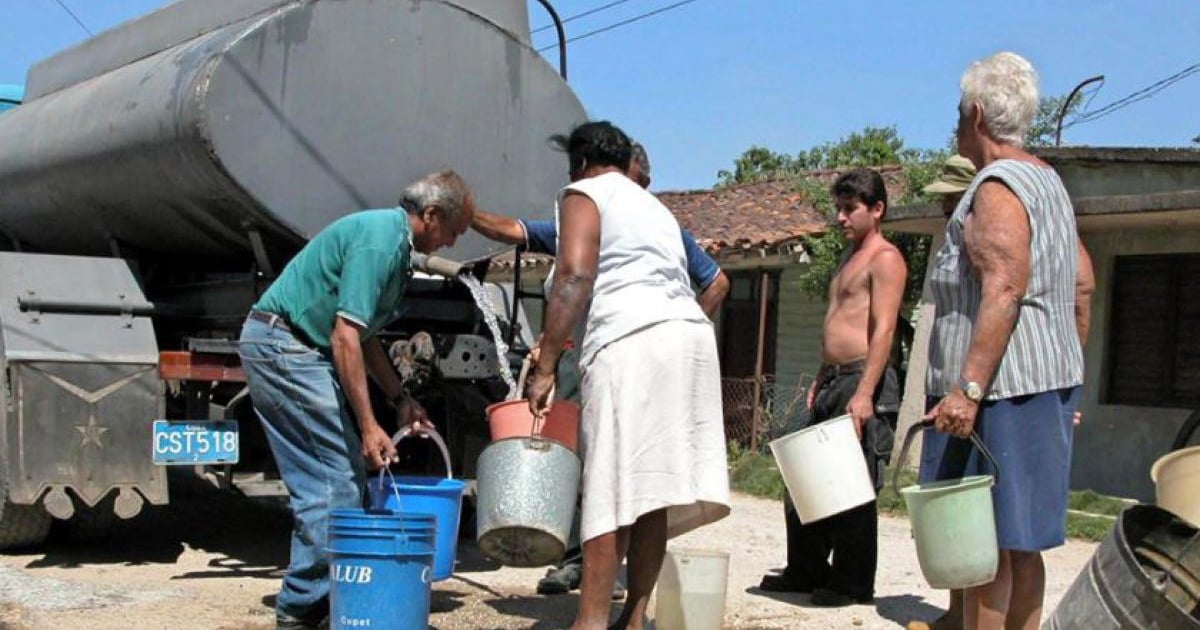
In several communities of the municipality of San Luis, in the province of Santiago de Cuba, accessing water is like “crossing Niagara on a bicycle” due to drought, collapsed infrastructure, and illegal charges for water deliveries, which forces thousands of people to survive without fully enjoying a basic human right.
There are places in San Luis that receive water regularly, with cycles exceeding 60 days or even more, while in others where the service is almost nonexistent, they have not received it for months or even years, revealed Arledis Chacón Suárez, head of the Aguas Turquino San Luis area, part of the Business Unit Centro located in the municipality of Palma Soriano.
“The situation is complex for both objective and subjective reasons; we must serve 29,000 users who are connected to the network and more than 3,090 via tank trucks, as they lack hydraulic infrastructure. Additionally, the territory lacks reliable sources of supply and depends on rivers, which have yet to recover from the intense drought,” Chacón stated in remarks reported by the official newspaper Sierra Maestra.
According to what has been stated, no pumping station has backup from generator sets; they depend entirely on the troubled National Electroenergetic System, which makes the service more fragile and exacerbates interruptions.
“It is an odyssey to access the liquid, and if we add the illegalities and indiscipline of truck drivers who charge between 2,000 and 3,000 pesos for the service, this issue becomes critical,” stated Zoila Hernández, a resident of the La Yagua neighborhood in the Dos Caminos district, which is part of San Luis.
Dos Caminos is the second most important locality in the municipality and is supported by a 14-kilometer pipeline from the pumping station La Laguna. This source allows the service to be maintained for 12 hours, thanks to a prioritized electrical circuit. Jutinicú only provides two days of pumping, and Guaninicum has been out of operation due to damage to the valve of the Maroto dam, caused by acts of vandalism, the newspaper reported.
The solution has been sought through quick fixes: diverting water from other sources, reallocating scarce resources, and maintaining worn-out equipment. The use of renewable energy has allowed for a partial reactivation of areas like Sopapo, Río Grande, and La Dalia, but the results remain insufficient. In areas such as the José Martí popular council in the municipal capital, the service continues to be irregular.
Pressure is also mounting on communities. In district 68, delegate Arael Trutié Medina is coordinating a local project with community support that successfully constructed a well to supply the Amiguitos de Teté daycare.
"Free services are provided to vulnerable individuals, pregnant women, and the elderly, while neighbors are reached with the service at an affordable price, which addresses issues related to access to water, and this idea could be expanded," emphasized Trutié.
According to Sierra Maestra, the immediate challenges include repairing leaks, reducing blockages in the networks, improving the distribution by tankers, "systematizing the supply of water to the population when sources allow it," and "promoting a culture of water consumption as a way to reduce the indiscriminate use of this resource during dry periods."
But beyond intentions, access is still marked by inequality and neglect. As Chacón himself admitted, it is urgent to “close the cycles, which are very prolonged,” in a supply system that can no longer endure.
In mid-May, the Acueducto y Alcantarillado Aguas Turquino company itself acknowledged that the water supply situation in Santiago de Cuba has crossed into critical territory, as in municipalities like Songo-La Maya, people have waited up to 85 days to receive the service.
Matanzas is also facing one of its worst water supply crises in years, with pumping equipment out of service, collapsed hydraulic networks, constant blackouts, and infrastructure at its limit despite being, ironically, an area with abundant underground water reserves.
This has forced families to seek alternative sources for supplies, which has increased challenges, as the situation affects not only domestic needs but also hygiene and public health in these communities.
The desperation over the lack of drinking water has driven dozens of residents from the Pinar del Río municipality of San Juan y Martínez to wash their clothes in the river. The scene, more characteristic of a rural area lacking basic infrastructure, has also been repeated in other regions of Cuba, where extreme solutions have been sought or going out into the fields to find water has been necessary to meet basic needs.
Along with the deterioration of basic service quality, several provinces are experiencing a severe drought that has forced the extension of water supply cycles.
Frequently Asked Questions about the Water Crisis in San Luis, Santiago de Cuba
What is the current situation of the water supply in San Luis, Santiago de Cuba?
The water supply situation in San Luis is critical. Water delivery cycles exceed 60 days in some areas, and in others, the service is almost nonexistent. The collapsed infrastructure and severe drought exacerbate the problem. Furthermore, the service relies on the battered National Electroenergetic System, which increases the interruptions.
What measures are being taken to improve access to water in San Luis?
Solutions are being sought through community projects, such as the construction of wells, and the use of renewable energy to reactivate some supply points. However, these measures are insufficient to permanently resolve the lack of access to water.
What problems do the residents of San Luis face due to the lack of water?
Residents are facing illegal charges for water trucks, with prices ranging from 2,000 to 3,000 pesos. Additionally, the lack of regular supply affects hygiene and public health, forcing families to seek alternative sources to meet their basic needs.
How does the energy crisis impact water supply in San Luis?
The energy crisis has a significant impact on water supply, as the pumping stations lack electrical backup and depend on the unstable National Electric System. This results in frequent and prolonged interruptions in access to water.
Filed under: