
Related videos:
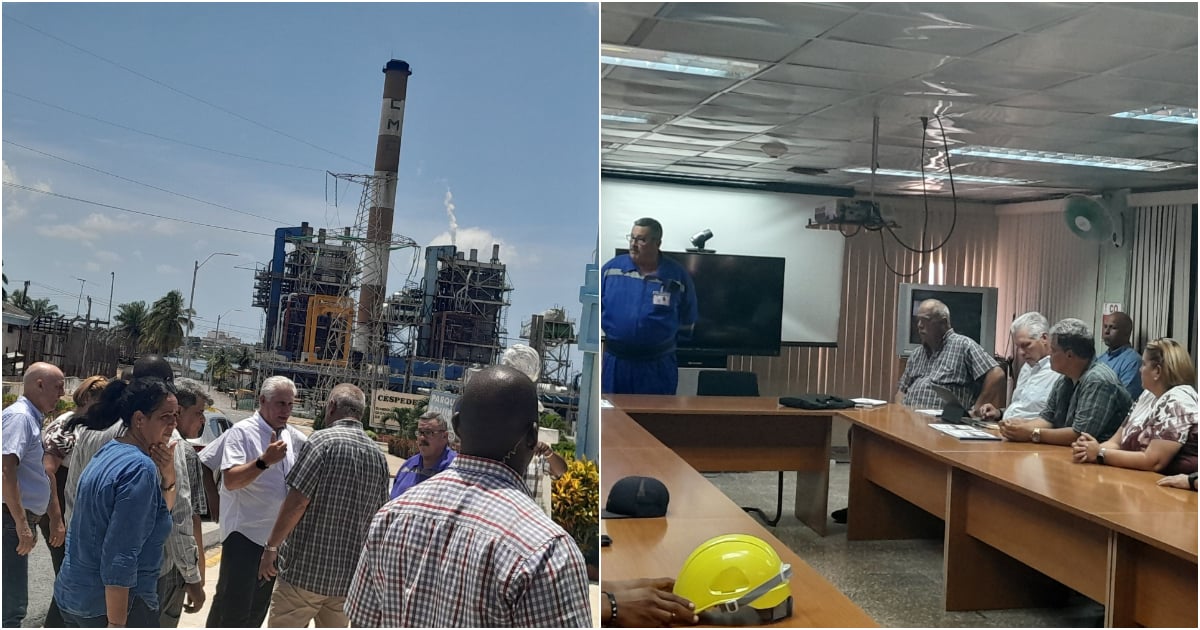
The ruler Miguel Díaz-Canel visited the Carlos Manuel de Céspedes thermal power plant (CTE) in Cienfuegos today to assess the progress of overdue repairs, in an official gesture that contrasts with the despair of millions of Cubans enduring daily blackouts due to the collapse of the national electrical system (SEN).
The leader arrived in the central-southern province of Cuba after his stop in Villa Clara, and included in his agenda a visit to the plant, whose unit 4 has been malfunctioning and out of the power grid since December.
The repair work on that unit began months ago due to issues with the boiler, and it remains unfinished, noted the profile on the X of the Presidency of Cuba.
He added that the major repair of Unit 4 is progressing in completing its main lines, although he did not provide specific dates for the block's reintegration into the system.
According to the management of the center, unit 3 is operating at 158 megawatts, while under normal conditions, the thermoelectric plant contributes 14% of the national electricity generation through the burning of fossil fuels, making it a strategic point for the country.
This unit resynchronized with the National Electric System at the beginning of May, after being out of service for more than three months.
The presidential tour also included the Astillero Centro Military Industrial Enterprise, where vessels are built and repaired, as well as a sanitation products plant linked to the Union of Military Industries.
Díaz-Canel was joined by the Minister of the Revolutionary Armed Forces, Álvaro López Miera, and other high-ranking officials during a visit where he urged to accelerate investment processes and address the accumulated delays, which have extended over time due to the complexity of the tasks.
The head of state began his work agenda at the Punta Las Cuevas farm, which has a diversified nature and also serves as a Teaching Unit for the Faculty of Agricultural Sciences at the University of Cienfuegos, reported the official newspaper 5 de Septiembre.
The day before, Díaz-Canel visited the CTE Ernesto Che Guevara in Santa Cruz del Norte, and demanded that the plant management supervise “even the welds” in the repairs, in an attempt to demonstrate control over an energy crisis that is no longer giving any respite to millions of Cubans.
It is not the first time that the leader has appeared at this thermoelectric plant. He did so in 2022 and 2024, and always with the same message promising that “this time” the capacities will indeed be recovered.
Meanwhile, blackouts continue to stretch on without relief in the daily lives of Cubans, who suffer from near-constant darkness as the new "normal."
For this Friday, during peak hours, the projected availability is 2,220 MW against a demand of 3,850 MW, resulting in a deficit of 1,630 MW and a total impact of approximately 1,700 MW.
In May, the Deputy Minister of Energy and Mines, Argelio Jesús Abad Vigoa, had assured that the outages would not exceed four hours.
However, Cubans are experiencing a summer marked by power outages of up to 20 hours, cooking with firewood or charcoal, losing food, and spending whole nights outdoors to escape the heat.
While officials call for "savings" and blame household use of appliances, most families feel their patience is running out.
Frequently asked questions about the energy crisis in Cuba and the thermoelectric plants
What is the current situation of the Carlos Manuel de Céspedes thermoelectric plant in Cienfuegos?
The Carlos Manuel de Céspedes thermoelectric plant is facing serious operational issues due to persistent breakdowns in its units. In particular, unit 4 has been out of service for months due to boiler failures, and while repair work is ongoing, there are no specific dates for its return. This adds to the overall collapse of the Cuban electrical system, which causes daily blackouts throughout the country.
How does the energy crisis affect the daily life of Cubans?
The energy crisis in Cuba has led to power outages of up to 20 hours a day, forcing families to cook with firewood or charcoal, losing food due to the lack of refrigeration, and enduring hot nights without ventilation. These electricity cuts have generated growing social discontent and sporadic protests in various localities.
What measures has the Cuban government taken to address the energy crisis?
The Cuban government has promised investments and a modernization plan that includes detailed oversight of repairs at thermal power plants, but so far, these promises have not turned into concrete improvements. Díaz-Canel's visits to the power plants aim to demonstrate control, although the situation remains critical and without a short-term solution.
Why have repairs in the thermoelectric plants not been effective?
The repairs on Cuban thermal power plants have been ineffective due to the obsolescence of equipment and the lack of adequate spare parts. In addition, energy management in Cuba has been characterized by improvisation and secrecy, which has hindered the planning and execution of effective maintenance, thus prolonging the energy crisis.
Filed under: