
Related videos:
The Cuban government reaffirmed its presence in Timor-Leste by signing an extension of the medical cooperation agreement, in a gesture that displays the continuity of its policy of exporting healthcare services despite international criticism and pressure from Washington.
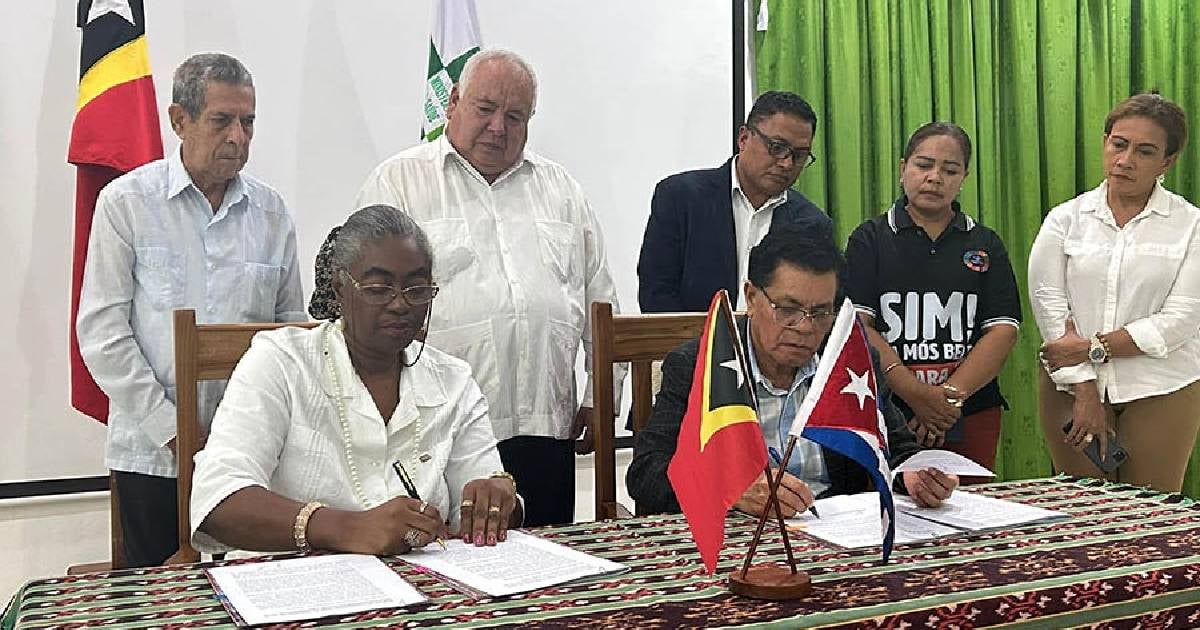
The Cuban ambassador Alina Aldama and the Timorese deputy minister José dos Reis Magno signed the document in Dili, the capital of the Asian country, which ensures the continuation of the healthcare professionals in that nation, reported the state agency Prensa Latina.
High-ranking officials from the Ministry of Health of Timor-Leste, the head of the Cuban Medical Brigade, Sergio Rabell, and the Minister-Counselor Pablo Romero were in attendance, the source added.
According to statements from the Timorese embassy, this agreement has its roots in the 2003 meeting between the dictator Fidel Castro (1926-2016) and the then-president (2002-2007) and current prime minister Kay Rala Xanana Gusmao, a historical connection that the Havana regime insists on presenting as a political legacy of the Cuban revolution.
The agreement encompasses both medical assistance and the training of professionals and specialists under the Cuban health model.
At the end of August, the Minister of Health of Timor-Leste, Elia A.A. dos Reis Amaral, held a meeting with the Cuban diplomat in Dili, where they reviewed the performance of their cooperation and discussed strategies to maintain the presence of the medical professionals, Aldama reported through his profile on Facebook.
The official statement described the meeting as "cordial" and reaffirmed the commitment to maintaining medical collaboration as a symbol of friendship between both peoples.
The ratification of the agreement strengthens one of the main sources of foreign currency for the Cuban regime, which has been criticized by international organizations and by doctors who view these missions as a form of labor exploitation disguised as solidarity.
Here you have an improved version with a different wording, but that maintains the same information:
The government of Havana reaffirmed on August 13 its decision to continue sending medical brigades abroad, despite the new sanctions imposed by the United States against officials from the island and other countries related to that program.
The Secretary of State, Marco Rubio, announced that Washington will implement visa restrictions on several Cuban, African, and Grenadian officials, identified for their alleged involvement in a forced labor scheme related to the export of medical services.
From Havana, Foreign Minister Bruno Rodríguez Parrilla rejected the measures, which he described as an act of “imposition and aggression,” and assured that Cuba “will continue providing” health services abroad.
In the same vein, the Deputy Foreign Minister Carlos Fernández de Cossío asserted that the programs are “absolutely legitimate” and emphasized that they “save lives and relieve communities” in dozens of countries.
The government asserts that these are "solidarity missions," not labor exploitation, and recently revealed in parliament that more than 24,000 healthcare professionals are working abroad under official contracts.
However, international reports and testimonies from doctors who have participated in these missions contradict the regime's narrative, denouncing abusive conditions and violations of labor rights.
Washington and various international organizations assert that Havana uses doctors and other healthcare professionals as a tool for political influence and a source of income, under conditions that violate international labor standards.
In this regard, they point out that the government of Miguel Díaz-Canel holds back a significant portion of the salaries of health professionals sent on missions abroad and imposes restrictions on their movement, which international organizations and former collaborators have denounced as forced labor.
The measures announced by the United States are part of a broader strategy to pressure the Cuban regime and its allies, in order to dismantle what it considers an international network of forced labor.
In June, Washington had already imposed similar restrictions against Central American officials linked to the hiring of Cuban doctors.
Despite the criticisms and sanctions, the island's government has reiterated that it will not give up one of its most profitable and emblematic programs, which is key to foreign currency income and its international projection.
Such a model leaves thousands of healthcare professionals sent abroad against their will voiceless, with no rights, and under the control of the state apparatus, while the doctors who remain on the island must work in miserable conditions and are regulated with no possibility of leaving the country.
Filed under: