
Related videos:
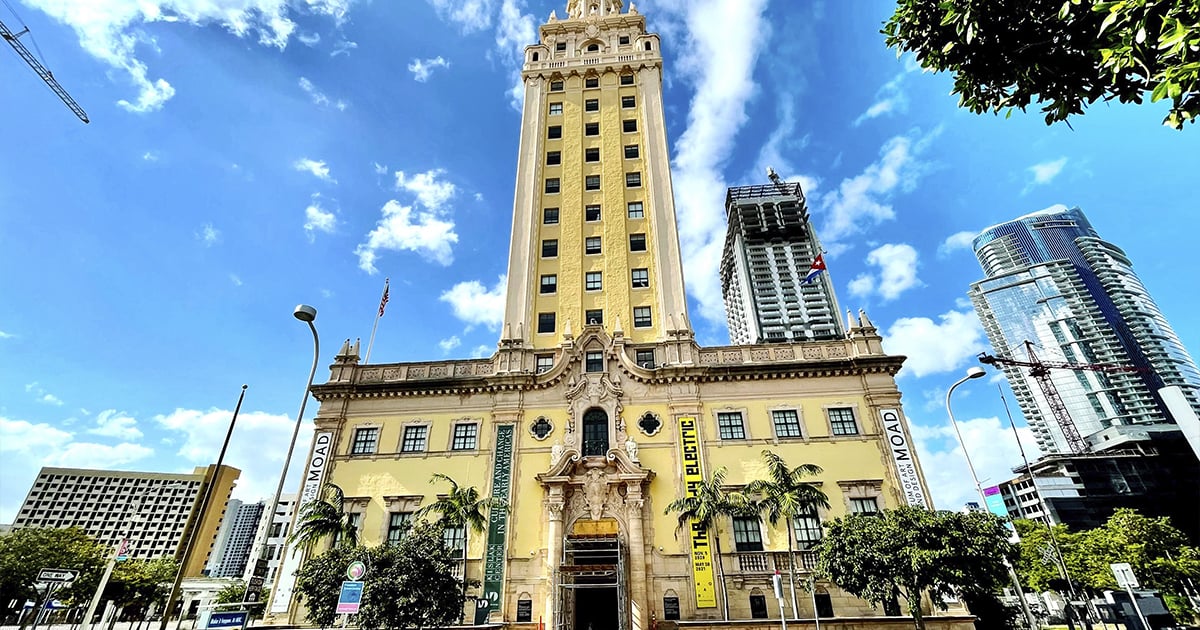
The Tower of Liberty, symbol of the Cuban exile in Mexico, will reopen next Tuesday, September 16, with a ribbon-cutting ceremony.
This was announced by the president of Miami-Dade College, Madeline Pumariega, and Amy Galpin, executive director of the MDC Museum of Art and Design, who toured the space with The Miami Herald during the preparations for the grand reopening, as stated in a report from this newspaper.
"We have worked on historical preservation, modernizing it to tell the story of the Tower of Freedom," Pumariega stated.
The architects even incorporated Spanish tiles that replicated the flooring
“The role of journalism in our society is closely linked to the building. That’s why we included the Miami Daily News, the Miami Herald, and we also chose Diario Las Américas because we really wanted to highlight Miami’s role as a hemispheric capital,” Galpin said.
"The newspaper played a fundamental role in understanding migration, exile, and Cubans in Miami," he added.
"From the beginning, we talked a lot about this room. Perhaps it would be a family space, perhaps more focused on migration. Then we reflected and decided that this sculpture would reflect the beautiful luminosity of the Magical City, instead of filling it with artifacts, we wanted to create a space where we could bring people together. The tower is filled with iconic spaces," Pumariega added.
The building, constructed in 1925, is 289 feet tall and was the tallest skyscraper in Miami. Initially, it served as the headquarters and printing facility for the newspaper The Miami News.
The fundraising campaign was launched by Miami-Dade College (MDC), the owner of the building since 2005, with the support of state grants and philanthropic contributions.
A symbol of renewed exile
The Tower of Freedom in Miami will reopen with immersive exhibitions dedicated to the history of migration, freedom, and the sense of belonging.
The 14-story building,constructed in 1925 in Spanish Renaissance style, was the epicenter for welcoming Cuban refugees fleeing Fidel Castro's regime during the 1960s and 70s.
Between 1962 and 1974, the then U.S. State Department and local organizations provided medical care, English classes, financial assistance, and even unknown products for many newcomers, such as peanut butter.
Almost 400,000 Cubans passed through the building during that period, popularly known as "The Refuge" and nicknamed by many as "the Ellis Island of the South," AP recalled.
The restoration, led by Miami Dade College with a total investment of 65 million dollars, has restored the splendor of one of the city's architectural icons.
The new galleries, designed by the same creative team behind the 9/11 Museum and Memorial in New York, include rooms dedicated to events such as the Bay of Pigs invasion, Operation Pedro Pan, and the stories of migrants from Venezuela, Haiti, and Nicaragua.
The building, declared a national historic monument, was rescued in 1997 by the Cuban-American businessman Jorge Mas Canosa and later donated to Miami Dade College.
Even in a state of disrepair, the tower has been a place of pilgrimage for the community: in 2003, tens of thousands gathered there to bid farewell to the singer Celia Cruz, and in 2015, the current U.S. Secretary of State, Marco Rubio, announced his presidential candidacy on its grounds.
Today, renewed and equipped with state-of-the-art technology, the Tower of Freedom is preparing to reopen its doors and continue sharing the story of those who left everything behind in search of a new beginning.
A few weeks ago, it was recalled how the Tower of Liberty was a refuge and embrace for thousands of Cubans fleeing Fidel Castro's regime, a place where they found medical care, financial assistance, and their first contact with a new life in the United States.
By 2024, curiosities and lesser-known facts about this iconic building had emerged, such as its nickname “Ellis Island of the South” and its central role in key episodes of the Cuban exile history.
A year earlier, it was highlighted that the tower is much more than a historical monument: it is a symbol of hope and perseverance, continuing to attract generations of migrants and visitors who see in it a living testament to the struggle for freedom.
Filed under: