
Related videos:
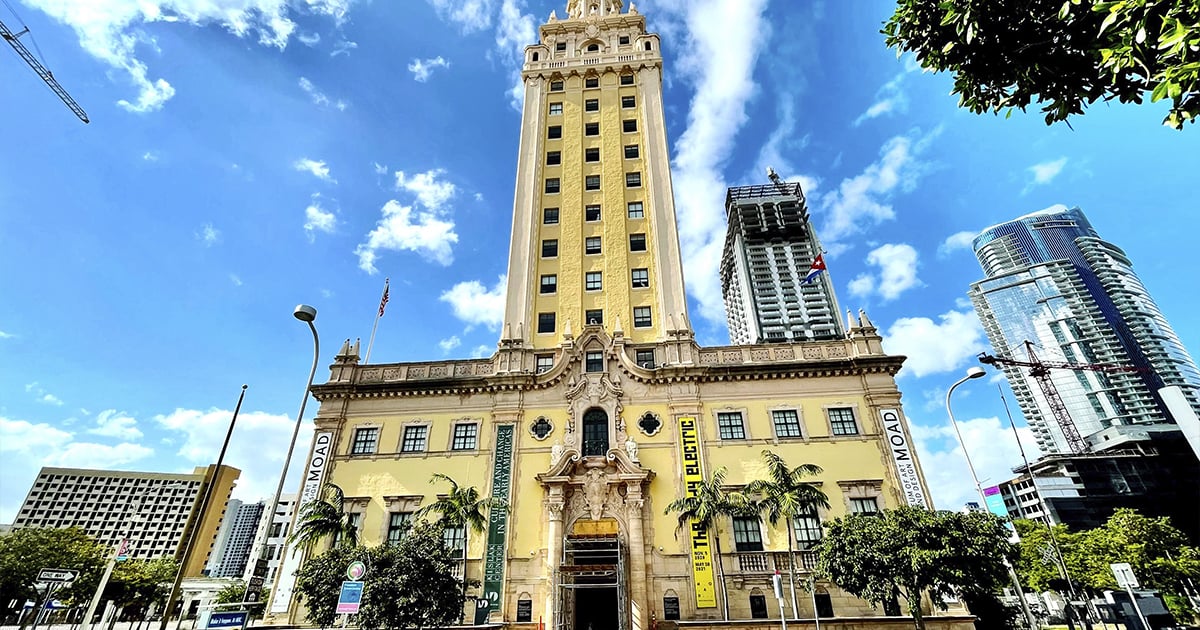
In the heart of Miami, on the iconic Biscayne Boulevard, stands a building that holds within its walls thousands of stories of pain, hope, and new beginnings. The Freedom Tower is celebrating its centenary this year, and its name resonates strongly in the collective memory of the Cuban community in the United States.
Although it was inaugurated in 1925 as the headquarters of the Miami News, the building became much more than a news center, recalls NBC News. For tens of thousands of Cubans fleeing Fidel Castro's regime, it became a symbol of welcome, a source of comfort in the face of forced exile, a first home away from home. That's why many began to simply call it “The Refuge”.
It was in 1962 when the Tower of Liberty began functioning as a support center for Cuban refugees. At that time, the number of people escaping the island was increasing every day. In 1960 alone, over 40,000 Cubans had arrived in the United States. The need for a space that offered humanitarian assistance, logistical support, and guidance for starting anew became urgent.
Thus, the first four floors of the building were configured by the U.S. government to provide direct assistance to newcomers. There, they received food, medical assistance, legal guidance, financial help, and, above all, a gesture of welcome amidst the uncertainty. For many, it was the first time they felt they could begin a life of freedom.
The Tower offered not just services: it offered dignity. And that is not forgotten.
Over the years, the Tower of Liberty also became a stage for political claims, vigils for Cuban political prisoners, events advocating for freedom on the island, and massive demonstrations from the exile community.
From the mass farewell to Celia Cruz in 2003, to the vigil for Luis Manuel Otero Alcántara in 2022, or the protests following July 11, 2021, the tower has served as a beacon for those who continue to dream of a free Cuba.
Three things you might not know about the Tower
- Its design was inspired by La Giralda in Seville and was built in just one year, thanks to the "steel cage" system, an innovation for its time.
- During its restoration, a time capsule containing newspapers and objects from 1925 was discovered.
- In 2012, a stainless steel sculpture was inaugurated at its base, dedicated to the families of Cuban refugees who passed through there between 1962 and 1974.
In 2008, the building was declared a National Historic Monument, and it currently belongs to Miami-Dade College, which has transformed it into the home of the Museum of Art and Design. According to the institution, the building will reopen its doors in 2025 with redesigned galleries that will tell its multifaceted story, including the crucial role it played in the history of the Cuban exile.
The gesture of Pedro Martín, a Cuban-American businessman and developer, who donated the tower to the college, is also part of that legacy of commitment to the community.
For many Cubans in South Florida, and for those who have heard the stories of their parents or grandparents, the Freedom Tower is not just bricks and concrete. It is a living memory and the symbolic entryway to a new life. It also serves as a reminder of what was left behind and a testament to the strength of a people who have known how to endure, rebuild, and create a new story while remembering their roots.
Today, as it turns 100 years old, the Tower of Liberty stands tall as a beacon of what freedom, exile, and solidarity mean.
Filed under: