
Related videos:
The province of Santiago de Cuba is experiencing one of the worst water crises in its history: in the main municipality, a new distribution cycle has been implemented that provides water to homes every 38 days since September 13.
According to a report published by TV Santiago, the situation stems from the drastic reduction of the flow that supplies the Quintero water treatment plant.
Of the 2,100 liters per second that the facility requires to ensure stable service, it only receives about 960 liters, which has forced a heightened focus on control and planning measures.
The established variant consists of distributing 800 liters per second through a rotating scheme that aims to cover the entire city, even if it means that certain circuits receive water only once every 38 days.
Local authorities acknowledge that the measure critically affects the higher areas, where it is not possible to maintain sufficient pressure.
As part of the contingency measures, maintenance work is being carried out on pumping stations, new equipment is being deployed at strategic points, and pipelines are being prepared to reinforce the Quintero plant.
However, major investments, such as the construction of a 7.5-kilometer pipeline from the El Jaguar tunnel to the Gilbert dam, are still in the project phase.
The Aguas Santiago Water and Sewerage Company reported that parallel to this, circuit redistributions and well improvements are being implemented in an effort to shorten delivery cycles in critical areas, although for the time being, the 38-day schedule remains the benchmark for supply.
As brigades from various provinces join the emergency efforts, authorities acknowledge that the combination of prolonged drought, losses in the supply systems, and lack of energy for pumping keeps Santiago in one of its worst crises for drinking water supply.
A few days ago, the Prensa Latina correspondent in Santiago de Cuba published a photo gallery that showed the current state of the severe drought: depressed reservoirs, reduced waterways, and land taken over by vegetation in areas where there were once flows.
Additionally, it was reported that the reservoirs were at 15% of their capacity, affecting more than 80% of the city.
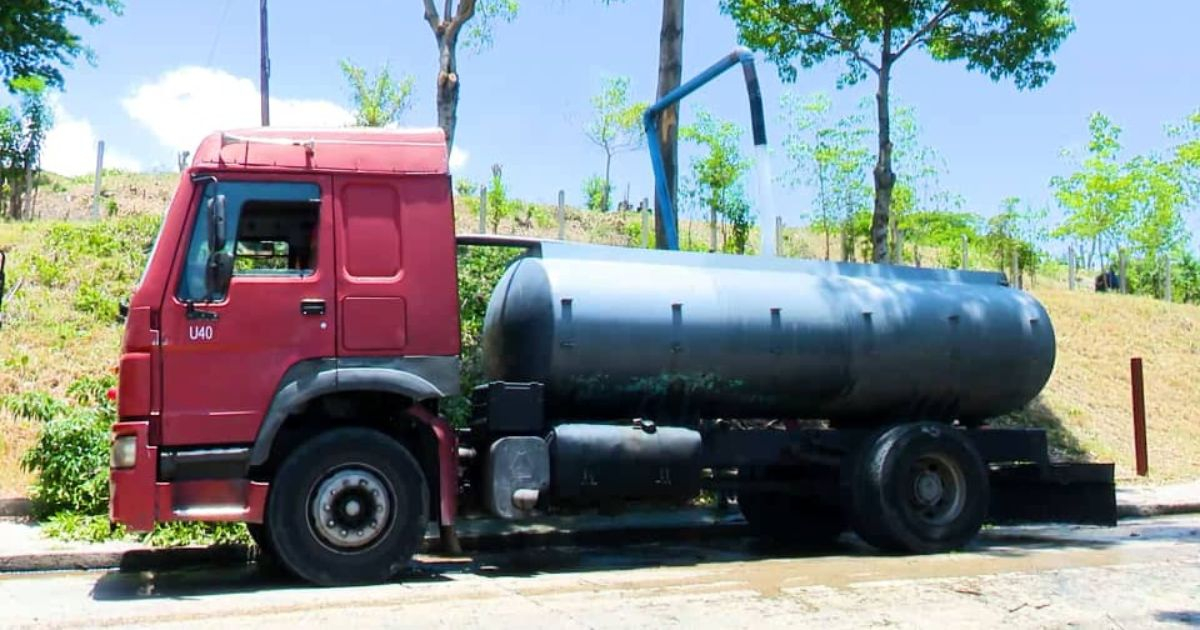
In this regard, in the Abel Santamaría urban center in Santiago de Cuba, residents are no longer waiting for paint or repairs for their buildings, but rather for a miracle in the form of a water truck.
Independent journalist Yosmany Mayeta Labrada shared images and testimonies about the desperation of residents in their search for water amid the worst drought in a decade.
Frequently asked questions about the water crisis in Santiago de Cuba
Why is Santiago de Cuba facing a water distribution crisis?
Santiago de Cuba is facing one of the worst water crises in its history due to a combination of factors, including intense drought, issues within the distribution system, a lack of energy for pumping, and reservoirs at critically low water levels. The Quintero water treatment plant, which is supposed to receive 2,100 liters per second, currently receives less than half that amount, leading to the establishment of water distribution cycles of up to 38 days.
What measures are being taken to address the water crisis in Santiago de Cuba?
Several measures have been implemented to address the crisis, such as the maintenance of pumping stations, the activation of new equipment, and the training of operators to reinforce the Quintero plant. The authorities have also activated tanker trucks to supply the most affected communities, although resources remain insufficient. Additionally, there are plans to construct a 7.5-kilometer pipeline from the El Jaguar tunnel to the Gilbert dam, but it is still in the project phase.
How is the drought affecting the population of Santiago de Cuba?
The population of Santiago de Cuba is facing serious difficulties in meeting basic needs such as hygiene, food, and sanitation due to water scarcity. In some cases, distribution cycles have extended to up to 38 days, and many communities rely on water tankers to obtain water. The situation has led to rising social unrest and has forced families to seek alternative sources of supply.
What are the authorities doing to resolve the water crisis in Santiago de Cuba?
The authorities have implemented emergency measures, such as maintaining pumping stations, activating new equipment, and preparing drivers to reinforce the Quintero plant. Cistern trucks have also been deployed to supply the most affected communities. However, the response has been deemed slow and insufficient, and the population continues to face serious limitations in access to water.
Filed under: