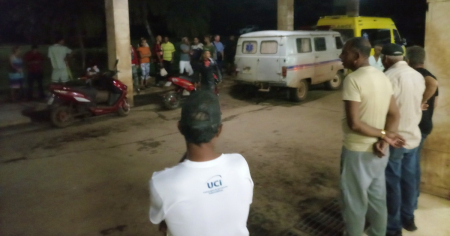
Irelemis Ortiz del Rosario, one of the four injured after a lightning strike in Moa that resulted in three fatalities and four injuries this Friday, provided a haunting testimony about what happened.
"I was on my way home when it started to rain and there were lightning strikes. A group of people took shelter under a canopy that was near the road. We went in there to protect ourselves from the rain and the thunder. After about an hour of being there, with the rain still pouring, a thunderbolt struck the tarp; it was a tent," Ortiz del Rosario recounted in statements to the local press.
Residing in the village of Yamanigüey, in the municipality of Moa, Irelemis Ortiz explained in detail what happened after the lightning strike.
“I felt my vision cloud over, I felt a strong jolt and fell to the ground. It threw me a long distance, about two meters. When I regained consciousness, I looked around and saw that everyone was lying on the floor, those who were taking shelter from the water,” she added.
The witness stated that he could not name the other people because he did not know anyone who was next to him.
"After the lightning struck, I tried to stand up, but I couldn’t walk. From where I was, I dragged myself about a hundred meters to the road and scraped all my knees. I had to drag myself with just one hand because I didn’t have strength in the other either; it was cramping," he recounted.
He recounts that while they were already on the road, he signaled to several vehicles, but some didn't stop, until one finally did and took them directly to the hospital.
“It was a tough experience because seeing so many people lying on the ground, unresponsive, having their pulses taken and not feeling anything… There must be some deceased, at least three, because I saw them trying to lift them and they weren’t moving. I grabbed one of them by the leg and he wasn’t moving,” he noted.
Regarding her medical evolution, Irelemis Ortiz said she was awaiting an ultrasound to determine the condition of her internal organs. She added that, apart from that, she could already squeeze her hand, walk, and move her feet, and that there were no visible symptoms of what had happened.
“Only God knows the experience we went through”, concluded Ortiz del Rosario, visibly affected.
Identification of the deceased
The three deceased as a result of the powerful electric shock that occurred in Moa were aged between 33 and 36 years.
The victims have been identified as:
- Eniolquis Romero Terrero, 33 years old (resident in Guamá, in Baracoa).
- Leonel Velázquez Legrá, 34 years old (resident in Armando Mestre neighborhood, in Moa).
- Lázaro Rodríguez Peña, 36 years old (resident in the city of Holguín).
The four injured individuals
In addition to the four deceased, there were injured in the accident:
-Yuxander Robles Robles (El Jobo de Sagua de Tánamo): Tremors in the body and numbness in the feet. He is stable.
-Irelemis Ortiz del Rosario (Yamanigüey, Moa): Numbness in the upper and lower extremities. Now stabilized.
-Lisbeth Pajan Silot (La Playa, Moa): Loss of consciousness and abrasions on the eyes. Remains under medical care.
-Dantry Revé Quiala (Sagua de Tánamo): Abrasions on the left knee and right ankle. Now stabilized.
lightning storms have caused at least 1,892 deaths in Cuba between 1987 and 2023, with an average of 51 fatalities per year, according to a recent study by the Institute of Geodesy and Astronomy (IGA),
Although the trend has been declining (69 deaths annually in the 90s, 56 in the 2000s, and 37 in the 2010s), the risks remain high.
The master's degree holder in Science, Neobil Vega Batista, head of the Department of Instrumental and Technological Development at IGA, warned that "the damages are not limited to the loss of human lives, but also include complex and difficult-to-quantify economic impacts."
Since 2024, institutions such as the IGA, the Meteorological Institute, the University of Havana, the Fire Department, and the Fire Protection Agency (APCI) have been involved in an Early Warning System and vulnerability study aimed at reducing the devastating effects of these natural phenomena.
A series of lightning-related deaths in Cuba in 2025
The tragic event in Cupey adds to a series of fatal accidents caused by electric shocks this year in Cuba:
June – Bauta, Artemisa: Two teenagers aged 13 and 16 died while playing soccer outdoors during a thunderstorm. On the same day, in a separate incident, a three-year-old girl drowned in Playa Baracoa.
August – Manicaragua, Villa Clara: Three adolescents died and one minor was injured by a lightning strike during an evening storm.
August – Colón, Matanzas: A 42-year-old woman died after being struck by lightning while working in agricultural activities near the community of La Luisa.
September – City of Holguín: A man lost his life after an electric shock on the terrace of his home while handling a beam that accidentally came into contact with high-voltage wires.
Additionally, in July, a group of young people was nearly struck by lightning while playing soccer in the rain in Ciego de Ávila. The meteorologist Frank Fernández Castañeda described the incident at that time as a “recklessness that could cost them their lives.”
Frequently Asked Questions about the Impact of Lightning in Cuba and the Tragedy in Holguín
What happened in Moa, Holguín, with the lightning strike that caused deaths and injuries?
A lightning strike hit the town of Cupey, Moa, Holguín, resulting in three deaths and four injuries. The victims were taking shelter under a tent when the tragedy struck. Irelemis Ortiz del Rosario, one of the injured, recounted how he was thrown by the shock and had to crawl to seek help. The deceased were identified as Eniolquis Romero Terrero, Leonel Velázquez Legrá, and Lázaro Rodríguez Peña.
How many people have died in Cuba from electric shocks in recent years?
Since 1987 until 2023, at least 1,892 people have died in Cuba due to electric shocks, according to a study by the Institute of Geodesy and Astronomy. Although the trend in deaths has decreased, it remains a considerable risk in the country.
What measures are being taken in Cuba to prevent tragedies caused by lightning?
Since 2024, Cuba has implemented an Early Warning System in collaboration with various institutions such as the Meteorological Institute and the University of Havana. This system aims to reduce the devastating effects of thunderstorms through vulnerability studies and preventive alerts.
What recent events related to electricity discharges are notable in Cuba?
In 2025, multiple tragedies related to lightning have been reported in Cuba. In June, two teenagers died in Bauta, Artemisa, while playing soccer during a thunderstorm. In August, three teenagers lost their lives in Manicaragua, Villa Clara, due to a lightning strike. These events highlight the dangers of thunderstorms in the country.
Filed under: