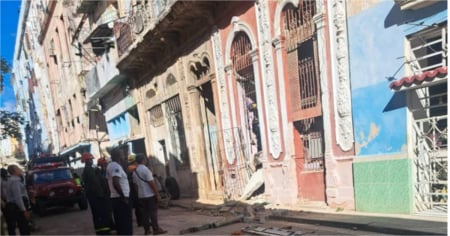
Several Cuban families live in extreme precarious conditions within the abandoned hospital of Guanito, in Pinar del Río, a former healthcare facility repurposed as an informal shelter after decades of neglect.
The content was documented by creator Abelito Nemo (@abelitonemo), who visited the location accompanied by one of the residents and a minor. In the video, the woman explains that she was born and raised there, and that the building has not functioned as a hospital for decades: “I was born and raised here, in this place, since I was a child. [...] I was about 19 years old when the hospital closed; I was 19 then, and now I’m 49.”
The lady showed the ruins of the place, which lacks basic services: “Here we have no water, here we have no bathroom, here we do our business in a little bucket and throw it out into the woods.” “As for food to buy, sometimes they prepare a little lunch at the cafeteria, but it’s not every day,” she added.
Among the spaces in the building are remnants of its former use as a health center: consulting rooms, bathrooms, a kitchen, and a completely destroyed pharmacy. "This here was the pharmacy. [...] They took everything from here, shutters; no, it wasn't the State, everyone took everything from here," he assured.
Regarding access to the location and the possibilities for medical assistance in urgent cases, he recounted: “Getting an ambulance here is also difficult; it may take a little while, but it always arrives.” As for public transportation, only one bus comes in the mornings on some days: “Today it arrived at 8:30; on weekdays, it arrives at 6 in the morning.”
According to the same source, they cook with firewood or charcoal: “A bag of charcoal now costs up to 700 or 600 pesos. [...] Gas doesn’t reach here.” It also noted that they only obtain drinking water thanks to a neighbor: “That’s rainwater that falls from the sky when it rains [...] and from a neighbor who shares their drinking water and water for cooking.”
In the comments of the video, Abelito Nemo himself replied that currently “about seven families” live in the abandoned hospital.
This property was the Antituberculosis Sanatorium Pilar San Martín, built in 1948 by order of President Ramón Grau San Martín. It first operated as a hospital for tuberculosis patients and later as a psychiatric hospital, until it was ultimately abandoned in the 1990s. The building had already been documented in 2024 by the YouTube channel Mario Sergio TV, whose reporters also explored its ruins to showcase the state of abandonment and the precarious living conditions of some families.
The situation of these families is part of a widespread housing crisis in Cuba. In the Riomar building, in Miramar, several homeless individuals have occupied abandoned apartments, where they survive without electricity or water, in an environment of decline and neglect.
In provinces like Granma, more than 30,000 families still live on dirt floors, and it is estimated that over 110,000 homes are in poor or fair condition. Nationwide, the housing deficit amounts to more than 800,000 homes.
As part of its proposals in response to this crisis, the government has begun installing homes made from shipping containers in provinces such as Las Tunas, a measure that has raised concerns about their suitability for the climate and basic needs.
Meanwhile, the number of informal and precarious neighborhoods continues to grow, with hundreds of settlements lacking legal recognition and guaranteed access to public services, which deepens social and urban exclusion in the country.
Frequently Asked Questions about the Housing Crisis in Cuba
What is the situation of the families living in the abandoned hospital of Guanito in Pinar del Río?
Several Cuban families reside in the abandoned hospital of Guanito under extremely precarious conditions. The building lacks basic services such as water and electricity, and the residents must improvise to meet their daily needs. This situation reflects the housing crisis in Cuba.
What measures is the Cuban government taking in response to the housing crisis?
The Cuban government has begun installing homes made from shipping containers in some provinces as a solution to the housing crisis. However, this measure has raised questions about its suitability for the climate and the basic needs of the citizens.
How many homes are estimated to be in poor condition in Cuba?
In Cuba, it is estimated that more than 110,000 homes are in poor or fair condition, contributing to a housing deficit that exceeds 800,000 homes nationwide. This situation has led to an increase in the number of informal and precarious settlements.
How does the health crisis in Pinar del Río affect living conditions?
The health crisis in Pinar del Río, marked by a spike in dengue and other viruses, is further exacerbated by unsanitary conditions in many areas, where trash and stagnant water are common. This directly impacts the quality of life of the residents, worsening the housing crisis.
Filed under: