
Related videos:
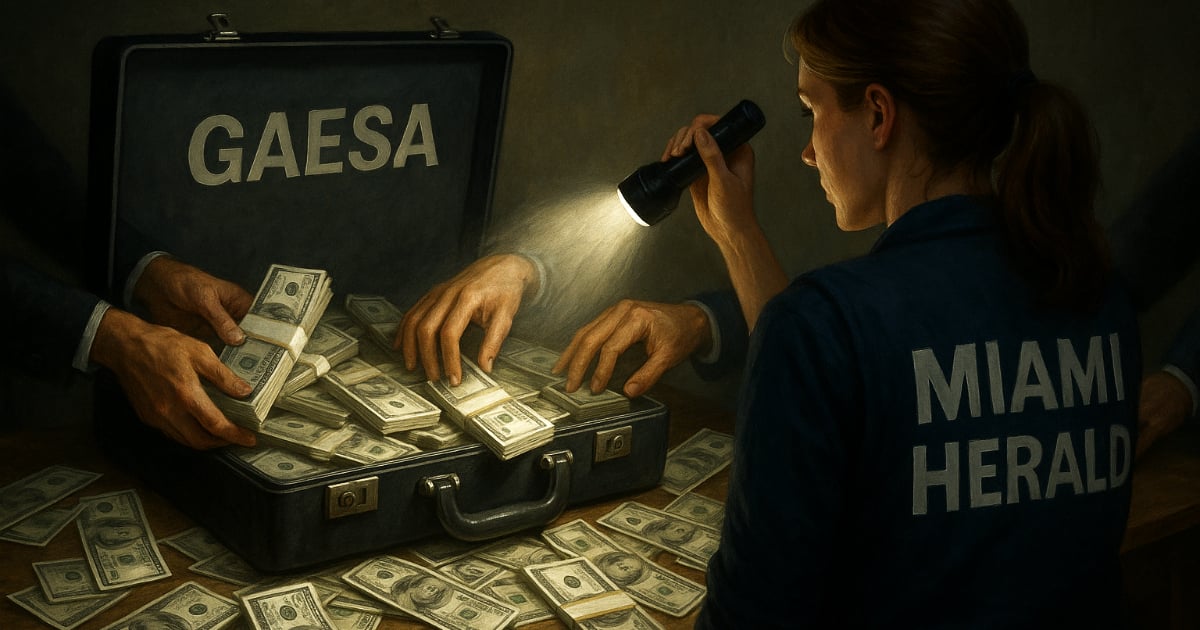
The Cuban regime has launched a new discrediting campaign against journalist Nora Gámez Torres of the Miami Herald, following her revelations about the 18 billion dollars in assets under the control of GAESA, the military-business conglomerate that monopolizes the country's main sources of foreign currency.
In a text published on October 5 by the official portal Cubadebate, titled "Journalists or Exposed Agents? The 'Cultured' Face of the CIA," the author Juan Fernández López devoted over a thousand words to attacking the Cuban-American reporter, using a rhetoric filled with conspiracy insinuations and personal offenses.
The article provided no references to the leaked documents or the investigation into GAESA that has shaken the Cuban public sphere since August, a silence that reinforces suspicion that the regime is attempting to silence any debate about the economic power of the military.
The attack: From argument to insult
The text from Cubadebate did not discuss facts, but rather constructed an ideological pamphlet. It questioned, for example, “who funds the news findings of Nora Gámez?” or “what connection does she have with Marco Rubio and the traitors from Miami,” accusing her without evidence of “servility,” “treason,” and “obedience to the CIA.”
In its usual style, the official publication employed defamatory language as a political tool. It portrayed Gámez as an “employee of the agency and the mafia” and even called into question her academic background—graduated in Journalism from the University of Havana, with a Ph.D. in Sociology from London—implying that her studies were “recruitment scholarships” of U.S. intelligence.
The attack also sought to undermine his professional legitimacy by dismissing his international awards as "rewards for servility."
However, the facts contradict the caricature: Gámez Torres received in 2025 the Gold Medal of the María Moors Cabot Prize, awarded by Columbia University, one of the most prestigious journalism awards on the continent. The jury highlighted his work as “rigorous, documented, and profoundly human” regarding Cuba and Latin America.
Silence on GAESA: The Real Reason
The most striking aspect of the article from Cubadebate is not what was said, but what was omitted. At no point was the Business Administration Group (or as it is commonly known: GAESA) mentioned, highlighting the reason for the government's anger.
In August of last year, the Miami Herald, under the byline of Nora Gámez Torres, published an investigation based on leaked internal documents from the business conglomerate, revealing that the military group holds over 18 billion dollars in liquid assets.
The amount would be almost one-fifth of Cuba's Gross Domestic Product and several times the budget of the national health system.
The documents, according to Gámez Torres' investigation, revealed that GAESA controls the main sources of foreign currency in the country: tourism, medical service exports, retail in foreign currency (MLC), and port and airport logistics.
Furthermore, it does not pay taxes in hard currency and receives state subsidies in pesos, in a financial scheme that lacks transparency and does not report to the National Assembly or the Comptroller's Office.
The exposure of this data triggered a political earthquake both on the island and beyond. Activists and independent economists denounced the military conglomerate's absolute control over the economy and the Government's silence, which has yet to provide a public explanation.
The new attack on Gámez confirms that the regime has chosen to kill the messenger rather than respond to the message.
Journalism Under Fire
Nora Gámez Torres, a former professor at the Faculty of Communication at the University of Havana, emigrated over a decade ago and joined the research team at the Nuevo Herald and the Miami Herald. Since then, she has established herself as one of the most respected and recognized journalists in the coverage of Cuban affairs.
Her name appears in high-impact international investigations, such as the Panama Papers and reports on espionage and human rights in Cuba and Venezuela. In recent years, she has been banned from entering the island, but this has not stopped her from continuing to work with sources and networks of independent journalists within the country.
The resentment with which the state media portrays her reflects the fear of power towards a free press. This is not an isolated case: the regime's media machinery has used the same pattern of defamation against intellectuals, artists, and journalists who expose their corruption or abuses.
As in the old manuals of the Ideological Department of the Central Committee, the method is predictable but effective: turn the dissident into an enemy, the journalist into a spy, and criticism into betrayal.
Between slander and censorship
The article from Cubadebate is part of a broader campaign of harassment against independent journalism. In recent weeks, authorities have intensified the threats against exiled media and digital platforms that have disseminated the leaks about GAESA.
Neither the Ministry of Foreign Affairs nor the Central Bank has issued a statement regarding the allegations. The usual spokespeople for the regime have also remained silent. The message is clear: to remain silent to protect the most closely guarded secret of the Cuban economy.
Paradoxically, that silence lends credibility to the work of Gámez Torres and other reporters who have challenged censorship to expose the financial mechanisms of military power.
An attack that reveals more than it conceals
In its attempt to discredit the journalist, Cubadebate inadvertently confirmed the significance of her investigation. If the accusation were false or baseless, it would be enough to present GAESA's financial statements or refute with data. But the regime prefers insults over arguments.
The official media obsessively cited the current Secretary of State of the United States as the alleged "mastermind" behind the leak, yet fails to provide a single piece of evidence.
Instead, he resorted to the metaphor of “Saturn devouring his children” to accuse Gámez of “betraying the homeland” -a crime that could be punishable by death-, employing a rhetoric rooted in the sixties that highlights the system's inability to tolerate journalistic scrutiny.
The price of informing
The case of Nora Gámez Torres illustrates the cost of reporting on Cuba from exile.
Being a woman, an academic, and an independent journalist makes her a perfect target for a smear campaign that combines sexism, resentment, and political revenge.
Unlike the bureaucrats who criticize her, Gámez does not have a propaganda apparatus. Her defense lies in her work, in the data she publishes, and in the credibility she has earned both inside and outside the United States.
Your investigation into the 18 billion of GAESA not only revealed the magnitude of the economic power of the Armed Forces but also the extent of the regime's fear of transparency.
And that, perhaps, is the most unforgivable crime for the Cuban leadership: having shown that, behind the narrative of the blockade and resistance, there is a system that accumulates wealth while its people survive amid blackouts, scarcity, and censorship.
Final note
The attack against Nora Gámez Torres is not just against a journalist; it is a warning to independent journalism. In Cuba, anyone who inquires about the millions of GAESA officially becomes a "CIA agent."
But every insult confirms what those in power fear: that the truth continues to seep through, even if they try to silence it.
Filed under: