
Related videos:
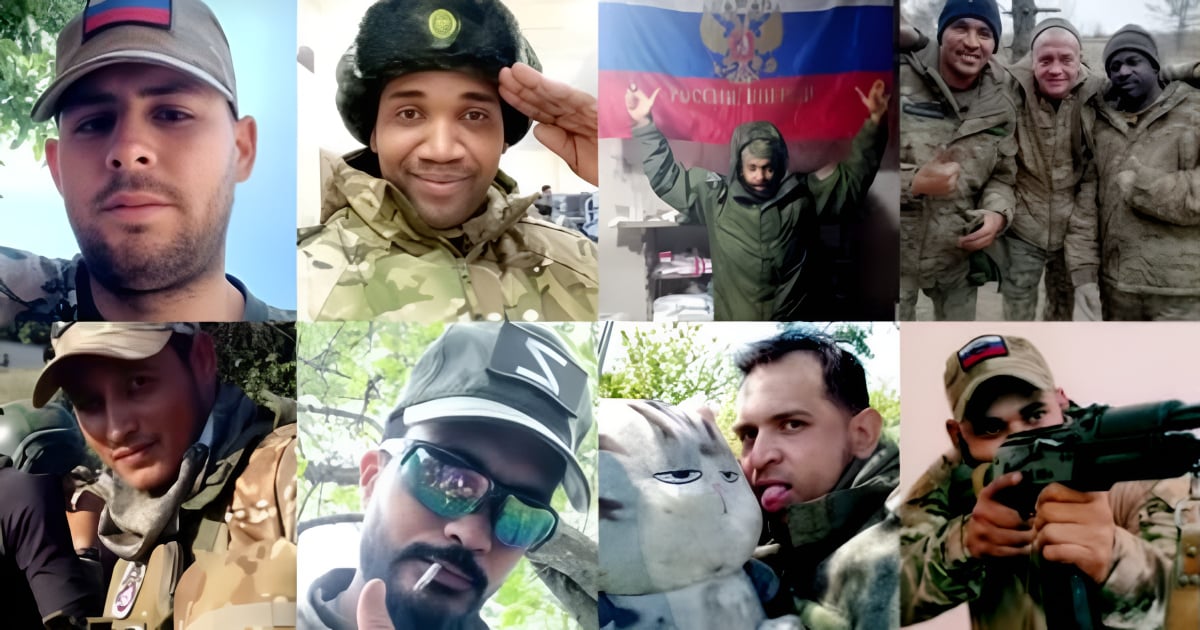
Russia is reportedly turning to mass recruitment of Cubans as soldiers in the war against Ukraine, as revealed this week by the American magazine Forbes.
The report, authored by journalist David Kirichenko, cites Ukrainian intelligence sources estimating that up to 25,000 Cuban citizens could soon integrate into the ranks of the Russian army, making Cuba the country with the highest number of foreign fighters serving Moscow.
The U.S. publication details that this practice seeks to compensate for the enormous human losses of the Kremlin and the lack of Russian volunteers to fight, after more than three years of a war that has left over a million casualties, both dead and wounded, according to estimates from British intelligence.
The journalist Kirichenko cited statements from the spokesperson for Ukrainian military intelligence, Andriy Yusov, who stated that “it is advantageous for Putin's regime to recruit Cuban mercenaries: if they die, there are no social or family compensations to protest within Russia, and, of course, there are fewer Russians who die.”
Poverty, despair, and manipulation
The Russian interest in recruiting Cubans is not coincidental. Cuba is experiencing its worst economic crisis in three decades, with daily blackouts, chronic shortages of food and medicine, and an average salary that barely reaches 20 dollars a month.
In light of this situation, the Russian promises of salaries of up to $2,000 a month, housing, and citizenship become an irresistible magnet for many young people— and not so young— on the island.
The academic Cristina López-Gottardi from the Miller Center at the University of Virginia explained to Forbes that the economic equation is sufficient to understand the magnitude of the phenomenon. “The average salary in Cuba is around 20 dollars, whereas Russia offers 2,000. Just that difference makes recruitment a difficult proposition to refuse,” she noted.
However, investigations by CiberCuba and other independent media have revealed that behind those figures lies a web of deceit, abuses, and scams.
A leaked dossier from May 2025 revealed a list of over a thousand Cubans hired by the Russian army, including elderly individuals over 60 years old. Some of them were recruited through social media with promises of civilian jobs in construction or factories, but ended up being sent to the trenches in Donetsk and Lugansk.
In September, Ukrainian intelligence reported to the United States Congress that at least 20,000 Cubans had already been recruited by Moscow, and that between 1,000 and 5,000 were actively fighting on the front lines.
A network of military exploitation
Investigative reporting suggests that the recruitment of Cubans is part of an international networking operation by the Russian army, which also involves African and Central Asian migrants.
A report by Bloomberg revealed that thousands of African students were forced to enlist under the threat of deportation, while The Telegraph documented cases of individuals deceived with supposed job contracts in Russia who ended up on the front lines after just a week of training.
In the Cuban case, the situation is even more outrageous because the regime maintains a tight grip on travel and passports, making it impossible for thousands of young people to leave the island without some form of official consent.
“Such a large-scale recruitment operation cannot go unnoticed by the Cuban authorities,” warned Forbes citing international analysts.
Nevertheless, the government of Miguel Díaz-Canel has denied any involvement, claiming “zero tolerance for mercenarism”.
However, the double standard of Havana becomes evident. While it accuses the United States of "imperialist aggression," it maintains military and intelligence agreements with Moscow and allows the use of Cuban territory for logistical operations of the Kremlin in the Caribbean.
Testimonies and victims
In August, Ukrainian authorities announced the capture of Cuban Ernesto Míchel Pérez Alvelaes, originally from Trinidad, Sancti Spíritus, who confessed to being deceived with a job offer in Russia and forced to fight in Ukraine.
“They told us we would be working in construction, but they gave us a uniform and a rifle,” declared the young man in a video released by Ukrainian media.
Military sources from Kiev claim that about 40 Cubans have already died in combat, and that Ukrainian forces possess passports and identity documents that prove the participation of citizens from the island in the conflict.
The fate of the Cuban prisoners remains uncertain. The government of Volodimir Zelenski has stated that it does not intend to return them to Cuba, except in prisoner exchanges with Russia, as it considers that they “acted as enemy combatants under contract with an invading power.”
The complicit silence of Havana
Meanwhile, the Cuban regime limits itself to remaining silent or issuing ambiguous statements.
In September, Chancellor Bruno Rodríguez Parrilla reiterated that “Cuba does not participate with military personnel in foreign conflicts,” but he did not explain how thousands of citizens have traveled to Russia with contracts signed by that country's Ministry of Defense.
Various analysts argue that the Cuban government tolerates or even facilitates recruitment in exchange for fresh foreign currency and to strengthen its political alliance with Vladimir Putin, in a context of international isolation.
According to political scientist Alexander Motyl, cited by Forbes, the regime also seeks to “revive its revolutionary image” and “challenge Washington” by aligning itself with Moscow.
"For the Kremlin, using Cuban soldiers is a cheap way to wage an unpopular war. For the Cuban regime, it is a source of income and propaganda," summarizes Motyl.
An expanding authoritarian axis
The recruitment of Cubans confirms the strengthening of a new authoritarian military axis composed of Russia, North Korea, Iran, Venezuela, and Cuba, which are exchanging weapons, technology, and military expertise.
According to experts cited by Forbes, foreign fighters are receiving training in drone warfare and electronic warfare, which poses a global risk: the tactics learned in Ukraine could be exported to other conflicts in Europe, Latin America, or Asia.
The American analyst Bill Cole, founder of the Peace Through Strength Institute, warned that "every foreign unit that goes through Ukraine is a modern war school," where Putin's allies learn and refine their strategies.
A country that exports soldiers
In just two years, Cuba has shifted from sending doctors and teachers as "internationalist missions" to exporting paid fighters.
On an island where thousands of young people dream of escaping hunger and power outages, Putin's war has become a deadly trap that offers money and ends in nameless coffins.
With the data revealed by Forbes and Ukrainian reports, the plight of Cubans in Ukraine shifts from rumor to a troubling reality: a new chapter in the long history of human exploitation by the communist regime in Havana.
Filed under: