
Related videos:
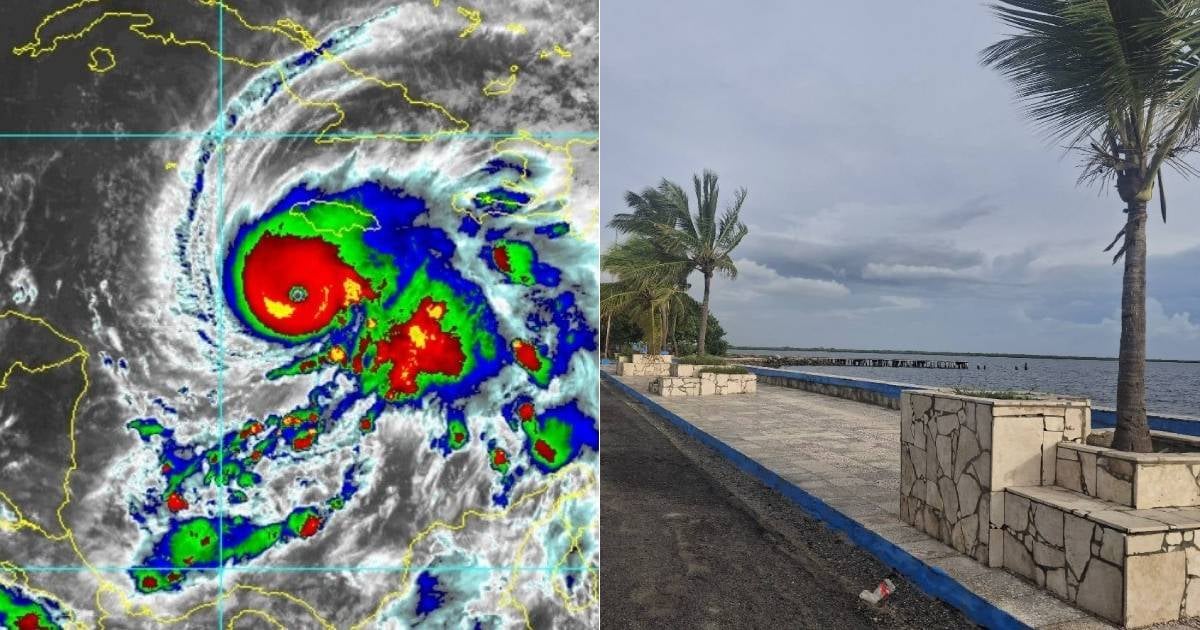
While eastern Cuba prepares for the impact of hurricane Melissa, now a powerful category 5, a voice from Puerto Padre, in the province of Las Tunas, captures in simple yet profound words the fragility with which thousands of Cubans confront a new meteorological threat.
The user José Luis Pérez Parra shared a message on his social media that has resonated with his compatriots, in which he reflects on the old wounds of the country that the cyclones repeatedly expose.
"The threat of Melissa is not only measured on the Saffir-Simpson scale. It is also measured by the vulnerability we carry," he wrote, recalling how the area along the malecón in Puerto Padre, with its inadequate drainage, could flood again as it did during Hurricane Ike: "The water descending from the higher part of the city without enough outlet to the sea. Every street turned into a temporary watercourse."
In his text, Pérez Parra also mentions the situation in other towns in Las Tunas, where danger increases with each downpour. "In Vázquez, Delicias, San Manuel, the settlements of La Base, and Parada, the danger comes not only from the sky but also from the ground," he warned. Intense rains could raise the levels of the reservoirs and cause flooding in rural communities with precarious infrastructure.
Your publication arrives at a time of utmost tension. According to the latest reports from the National Hurricane Center (NHC), Melissa is recording sustained winds of up to 270 km/h, a central pressure of 908 mb, and a path that directly threatens the eastern region of the country.
The provinces of Guantánamo, Santiago de Cuba, Holguín, Granma, Las Tunas, and Camagüey remain under a cyclone alert, with forecasts of torrential rains, waves of up to three meters, and landslides.
From his coastal municipality, Pérez Parra warns of the everyday fears that the imminent hurricane revives: “Now more than ever, prevention is not just a slogan: it is a vital necessity. Because nature does not wait. And resilience is not improvised: it is built before the storm.”
His words reveal a shared sentiment among many Cubans who live far from urban centers or in areas where infrastructure is degraded. In Puerto Padre, as in much of the eastern interior, issues such as electricity supply, access to drinking water, and food shortages turn each weather alert into a significant crisis.
"Melissa is no longer a threat; it is a certainty that will impact the East of our Cuba with an irrational force. To our people on the Island, I urge you to be strong to endure what lies ahead, not only during the passage of the phenomenon but also for the destruction it will leave in such a impoverished region that will test them to their limits," he wrote.
While the Civil Defense coordinates evacuations and the population seeks shelter, José Luis's words resonate as an echo of resistance and civic awareness.
They are not just a chronicle of fear; they are also a warning about the urgency of investing in prevention, reconstruction, and real planning in response to climate change and the structural deterioration of the country.
Melissa, which threatens to be one of the most intense hurricanes to impact the Caribbean in recent years, will not only test the strength of roofs but also, as Pérez Parra wrote, “for those of us who are currently outside, all we can do is pray with a broken heart.”
Filed under: