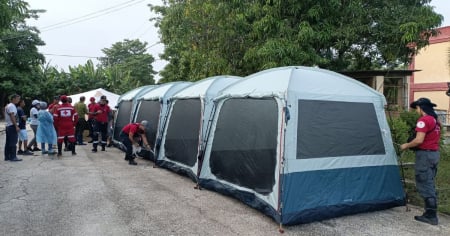
The Cuban government assured this Friday that the United States has not made any concrete offers of humanitarian aid following the devastating passage of the hurricane Melissa, which left a scene of destruction in the eastern part of the Island.
The statement was made by Johana Tablada, deputy general director of the United States Directorate at the Ministry of Foreign Affairs (MINREX), who noted that the Cuban embassy in Washington reached out to the State Department "regarding what they published," but that so far "the United States has not made any offers nor responded to the questions" raised about the announced aid.
According to Tablada, other countries and United Nations organizations have already made offers that are in the process of being finalized, and he reiterated that "in no case has the Cuban government imposed extraordinary conditions."
It was also noted that there are "ways" for individuals and organizations in the United States to channel donations to those affected, although, according to the official, these initiatives must "overcome restrictions imposed by the U.S. government."
From diplomacy to arrogance
Tablada's statements come after several contradictory and arrogant messages from high-ranking Cuban officials who, rather than showing concern for the human tragedy, have chosen to engage in political confrontation.
The Cuban ambassador to the European Union, Juan Antonio Fernández Palacios, sparked controversy by describing Washington's offer as "handouts."
No more handouts or conditions. The international community has overwhelmingly stated what must be done. There's nothing more to say," wrote Fernández Palacios, with the disdain with which the regime typically responds to any gesture of cooperation from the United States.
The comment provoked outrage among Cubans both inside and outside the country, who questioned the government's lack of humanity and its decision to prioritize political rhetoric over the suffering of the people.
An aid conditioned solely by politics
The controversy arose after the U.S. Secretary of State, Marco Rubio, announced Washington's readiness to provide immediate and direct humanitarian assistance to the Cuban people.
"We are prepared to offer immediate humanitarian aid to the people of Cuba affected by the hurricane," he stated.
In a statement, the State Department clarified that there are legal exemptions for private donations of food, medicines, and emergency supplies, and urged those who wish to help to contact the humanitarian aid office for Cuba directly.
Subsequently, he published an official guide that outlines the licenses and exemptions allowing the shipment of food, medicine and emergency supplies to the island, despite the ongoing embargo.
The regime's initial reaction, through the Deputy Minister of Foreign Affairs, Carlos Fernández de Cossío, was less confrontational.
In a message shared on X, it was confirmed that Havana was "in contact" with the State Department to learn the details of the offer and to understand "how and in what way they are willing to help."
However, the subsequent statements from senior officials of the Communist Party and the Ministry of Foreign Affairs indicate an openly political rejection.
The Secretary of Organization of the Communist Party, Roberto Morales Ojeda described the U.S. offer as "undignified" and stated that if there were a genuine willingness to help, “they would have lifted the criminal blockade and removed Cuba from the list of state sponsors of terrorism.”
For her part, the Deputy Minister of Foreign Affairs, Anayansi Rodríguez Camejo, stated that if Washington had "any minimal concern for the Cuban people," it should "suspend or make humanitarian exceptions to the blockade" in light of the damages caused by the hurricane.
These stances, repeated time and again by the highest levels of the regime, stand in stark contrast to the silence of Chancellor Bruno Rodríguez, who has yet to make any statement regarding the aid offered by the United States or the dire situation of the victims.
Official triumphalism and a reality in ruins
While the officials from MINREX trade statements and accusations, Eastern Cuba remains mired in chaos.
In Santiago de Cuba, Holguín, and Granma, hundreds of communities remain isolated, with destroyed homes, devastated crops, and hospitals lacking basic supplies.
However, from the state-controlled media run by the Communist Party, the official narrative remains the same: "everything is under control" and "no one will be left behind."
A rhetoric that clashes with the reality of thousands of people who have lost everything and survive, once again, without institutional support or resources.
The government insists on blaming the embargo for all evils, but Melissa's humanitarian disaster reveals something much deeper: the ruin of the system itself, incapable of anticipating, organizing, or protecting its population against natural disasters.
Arrogance neither feeds nor rebuilds
The United States, for its part, has reiterated that its intention is to directly support the Cuban people, without going through the regime.
"While the embargo remains in effect, the U.S. government prioritizes humanitarian support for the Cuban people," states the Department of State's statement.
But for Havana, "sovereignty" remains the favored argument to justify the paralysis and opts to revive the rhetoric of confrontation.
Instead of allowing aid to reach the affected communities directly, the government prefers to maintain absolute control over any shipment of supplies, even at the cost of hunger and suffering for its people.
Thus, while families in the east await mattresses, medicines, and food, regime officials engage in debates over ideological concepts and accuse Washington of interference.
Once again, tragedy reveals the reality of power in Cuba: a State that speaks of dignity while leaving its people abandoned among the ruins.
Filed under: