
Related videos:
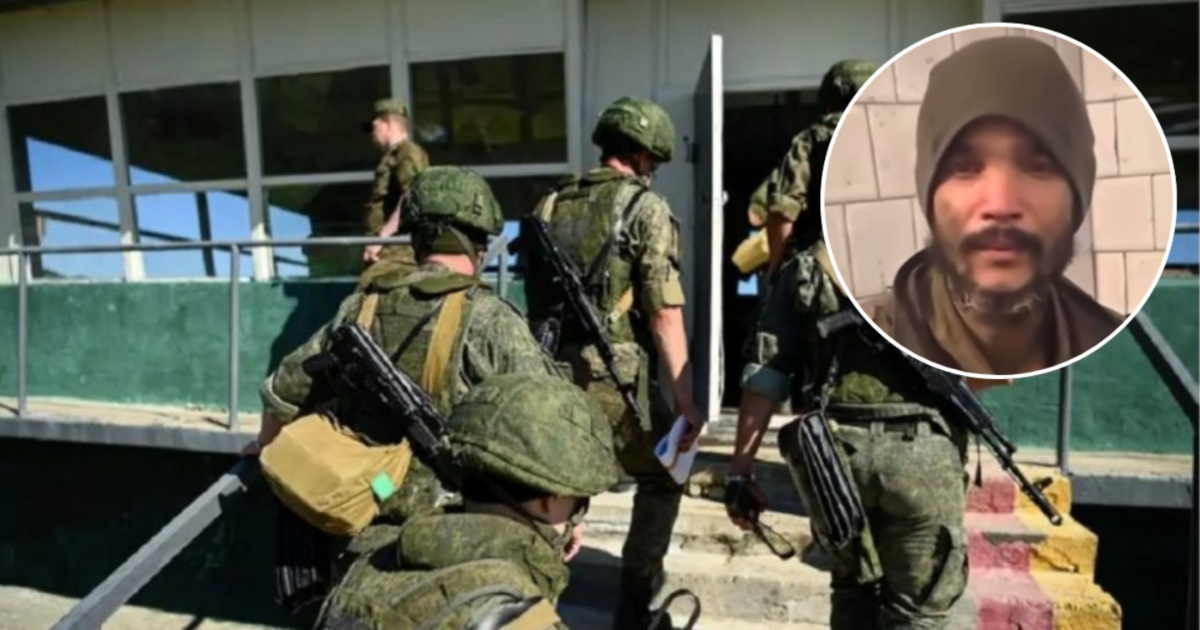
A Cuban who is fighting as a mercenary in the ranks of Russia in the war against Ukraine sent a desperate message to his fellow countrymen urging them not to follow his path or travel to that country lured by economic promises.
In a video released by Telemundo 51, the young man, one of the four Cubans recently captured alive, claims that he was forced to sign a contract to go to the front, alleges that he is not being paid, that he is not allowed to communicate with his family, and describes Russia as “a government scam.”
In his testimony, directed “to all Cubans who do not have the opportunity to have a good position in Cuba and choose to leave Cuba for Russia,” the mercenary who remains detained in Ukraine describes the journey as a mistake that he does not want others to repeat.
"I want to tell you that Russia is a government scam. Everyone thinks that Russia is a great country where you can succeed, but that is not the case," he states, dismantling the notion that enlisting in the Russian army is a quick way to improve one's economic situation.
He recounts that he arrived in Russia and there was detained by the police, who forced him to sign a contract to go to war.
"In my case, I was arrested by the police and forced to sign a contract to go to war, and here I am," he explains.
From the front, he asserts that recruits do not receive the promised money, that the authorities prevent them from communicating with their families, and that they are sent into combat without knowledge or military training. “Please, don’t go to Russia, Latinos,” he pleads.
The fighter repeatedly warns other young people on the Island and in the region: "Russia is a bad country to live in and to get ahead. Don't go to war with Ukraine, don't sign any contracts because it's not worth it."
In his message, he blends repentance with a religious invocation: "I ask God for forgiveness for being in this place but I also thank Him for being with me," he says, hinting at the constant fear of dying on the frontlines.
His report comes in a context where Ukraine has begun to identify the bodies of Cubans who fell fighting on the Russian side.
Ukrainian authorities have managed to identify the bodies of 39 deceased Cubans and state that they are committed to continuing their efforts to determine the identities of more compatriots and notify their families "what has happened to these men," as explained by Deputy Maryan Zablotskiy, chairman of the Pro-Cuba Libre Committee of the Ukrainian Parliament, during a press conference in Miami.
Zablotskiy detailed that, in addition to those 39 identified, there are "hundreds of dead Cubans" whose identities have yet to be determined.
He stated that Ukraine is holding four Cuban prisoners, whom he claims are being treated humanely, and proposed two possible ways to resolve their situation: exchanging them for Ukrainian prisoners held by Russia or considering their release on humanitarian grounds if the Cuban government, in parallel, frees a group of political prisoners on the Island.
The deputy also emphasized that, since the beginning of the invasion, Russia has not requested the exchange of foreign fighters, only Russian citizens, which leaves mercenaries from other countries in a more vulnerable situation. According to his data, the largest foreign contingent within the Russian ranks is Cuban, according to reports from their foreign ministry.
During the conference, organized by the Assembly of the Cuban Resistance and the Cuban Democratic Directorate, Zablotskiy presented a list shared with the media Cubanet that lists 1,028 Cubans recruited by Russia, including the 39 deceased, although in his speech he mentioned a total of 41 deaths.
The document states that only three Cubans died in 2023, while 36 passed away in 2024, aged between 23 and 58, which illustrates the predominantly young profile of the recruits.
The revelations from the Ukrainian legislator are part of broader estimates from Ukrainian authorities and exile sources, which calculate that up to 25,000 Cuban citizens may have been recruited by Russia to fight in the invasion, a figure that highlights the scale of the phenomenon.
The main incentive is economic: according to Forbes magazine, Russia offers salaries around $2,000 a month, a staggering amount compared to the $20 that an average worker earns on the Island.
However, behind the salary hook lies a web of deception and exploitation.
False civilian job offers in Russia have been documented that, once in the country, end up in the signing of military contracts and deployment to the front lines with no preparation or clear information.
Many signed documents in Russian without an official translation, leaving them legally vulnerable.
Ukraine's Defense Intelligence (HUR) interprets the use of foreign fighters as a low-political-cost strategy for the Kremlin: if recruits from other countries die, there are no social benefits to pay, nor is there pressure from dissatisfied Russian families over the number of casualties.
In this scenario, the video of the Cuban mercenary pleading not to go to Russia or sign contracts to fight in Ukraine adds to the information emerging from Kiev and from exile: hundreds of dead Cubans, thousands recruited under dubious promises, and families on the Island who do not know if their children are alive or dead.
His message, "it's not worth it," summarizes the assessment he makes from the trenches of a war that he claims to have entered deceived and coerced, and from which he now only hopes to emerge alive.
Filed under: