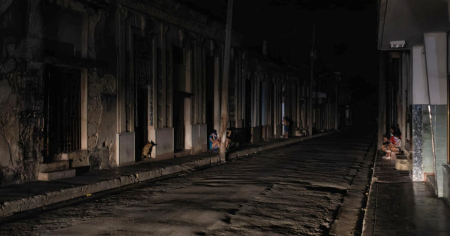
The Minister of Energy and Mines Vicente de la O Levy predicted that 2026 will be "slightly better" due to repairs in thermoelectric plants and increased solar capacity, but he warned that the lack of fuel and the state of the electricity system (SEN) will prevent the elimination of blackouts.
In an extensive interview published by the official newspaper Granma, O Levy stated that the energy situation will remain constrained next year despite the addition of recently repaired thermal power plants and the completion of the 1,000 MW of solar power expected for this year.
According to the official, the country will begin the next calendar year with more operational infrastructure than in 2025, but he clarified that this capacity cannot be sustained without a stable supply of hydrocarbons, which is currently not in place.
The minister explained that units such as units three and four of the Carlos Manuel Céspedes (Cienfuegos), unit five of Renté (Santiago de Cuba), and unit two of the Ernesto Che Guevara (Santa Cruz del Norte) will be available starting in January after extensive maintenance work.
He also noted that, during specific moments in 2025, renewable sources covered up to 30% of the demand, but emphasized that this contribution cannot offset the prolonged fuel deficit.
He also recalled that Antonio Guiteras, in Matanzas, will have a short stop at the beginning of 2026 and that Felton (Holguín) remains in an unstable situation.
De la O Levy emphasized that the National Electric System (SEN) technically has more capacity than the current demand, but the financial crisis restricts the imports necessary to sustain distributed generation, even though it maintains an availability of over 80%.
He admitted that the transmission and distribution networks remain a critical point due to their deterioration and lack of resources.
The minister noted that in 2025 there were advances in the installation of solar parks and in the reception of international donations, but he described the year as "tenacious" and extremely difficult.
Regarding the upcoming situation, it was clear: there will be a moderate decrease in disruptions, but power outages will continue because the country does not have enough fuel to ensure stability.
The Electric Union (UNE) forecasted widespread blackouts for this Friday that will simultaneously affect up to 61% of the national territory during peak demand hours, an unprecedented figure that sets a new record in the ongoing energy crisis impacting the island.
For the Cuban engineer Jorge Piñón, director of the Energy Program for Latin America and the Caribbean at the University of Texas, the mass disconnection that left several western provinces without electricity on Wednesday is the most recent evidence of an electrical system in "total collapse" with no real prospects for recovery in the short term.
Piñón warned that Cuba currently relies on 25,000 to 30,000 barrels of Venezuelan oil per day, a supply that is becoming increasingly uncertain. “If Venezuela collapses and Cuba loses those 30,000 barrels, the situation will be critical. 2026 will be worse,” he emphasized in Martí Noticias.
In September, Piñón told CiberCuba that he did not see any solution for 2026 and that Cubans should expect "continuity" of the crisis: blackouts similar to those of 2024 and 2025. He then reiterated that the solar parks announced by the Government were "a fairy tale," since, without batteries, they only generate electricity during the day.
Filed under: