
Related videos:
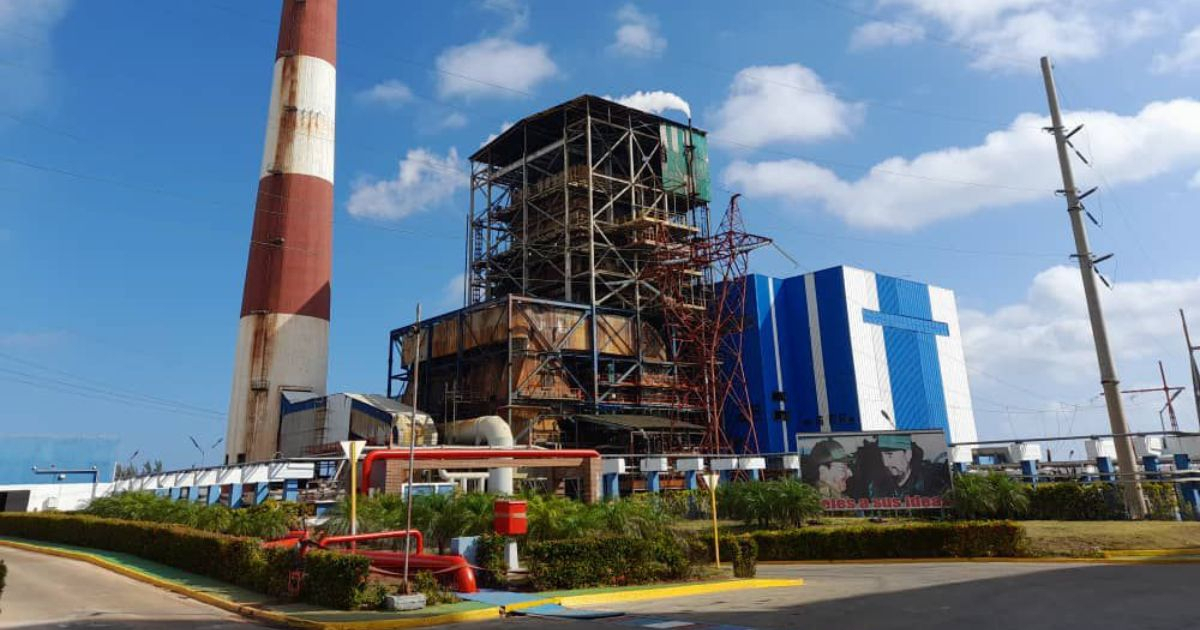
The Minister of Energy and Mines Vicente de la O Levy confirmed that the capital maintenance of the Antonio Guiteras thermoelectric power plant in Matanzas will be delayed due to a "current" technical and risk issue, so it will only undergo a short shutdown in January 2026, while the country attempts to sustain the unstable Felton.
The unit, known for its historical level of instability and its significance in national generation, will only have a brief pause of one month at the beginning of 2026 in an attempt to be operational by summer, reported O Levy in an interview published by the official Granma.
The measure is adopted at a time when the National Electric System (SEN) continues to face pressure due to a lack of fuel, despite the gradual integration of thermal units following major maintenance in 2025, including units three and four of the Carlos Manuel de Céspedes (Cienfuegos), unit five of Renté (Santiago de Cuba), and unit two of the Ernesto Che Guevara (Santa Cruz del Norte).
The minister assured that all of them will be generating from January, but warned that the additional power does not eliminate the risks associated with critical plants.
The decision regarding Guiteras is set against an even more tense backdrop due to the situation in Felton, which is also experiencing instability.
"We have to make a complex decision regarding Guiteras and Felton," acknowledged De la O Levy, who explained that keeping both units offline simultaneously would be unsustainable for the operation of the system.
Therefore, the government will prioritize supporting Felton while limiting intervention in Guiteras.
The minister acknowledged that, although the renewable program is progressing and it is expected to end 2025 with 1,000 megawatts of installed solar power, the main bottleneck remains fuel.
Currently, over 1,000 MW of distributed generation remain offline due to a lack of diesel and fuel oil, a shortfall that will persist into 2026 due to financial restrictions.
In this context, even with greater installed capacity, the impacts will continue.
Regarding the upcoming year, De la O Levy stated that it will be "difficult," with a reduction in blackouts compared to 2025, but without the possibility of eliminating them.
He emphasized that the postponement of the deep maintenance of Guiteras is part of the forced balance between sustaining the minimum generation and avoiding collapses in strategic units.
“There will be a decrease, but there is still a long way to go,” he said, emphasizing that the country’s energy transition is a long-term process.
La Guiteras, a plant that has historically set the rhythm of the SEN, thus finds itself once again in a midway position: too fragile to operate without risks, yet too indispensable to remove from the system in a time of extreme scarcity.
The result, once again, will be passed directly on to consumers.
Filed under: