
Related videos:
Today, December 31, in many parts of the world is a day of hugs, reflections, and hopes. People look at the clock, count down the seconds, and wish for the upcoming year to be better. It is a scene that repeats itself every year, almost like a ritual.
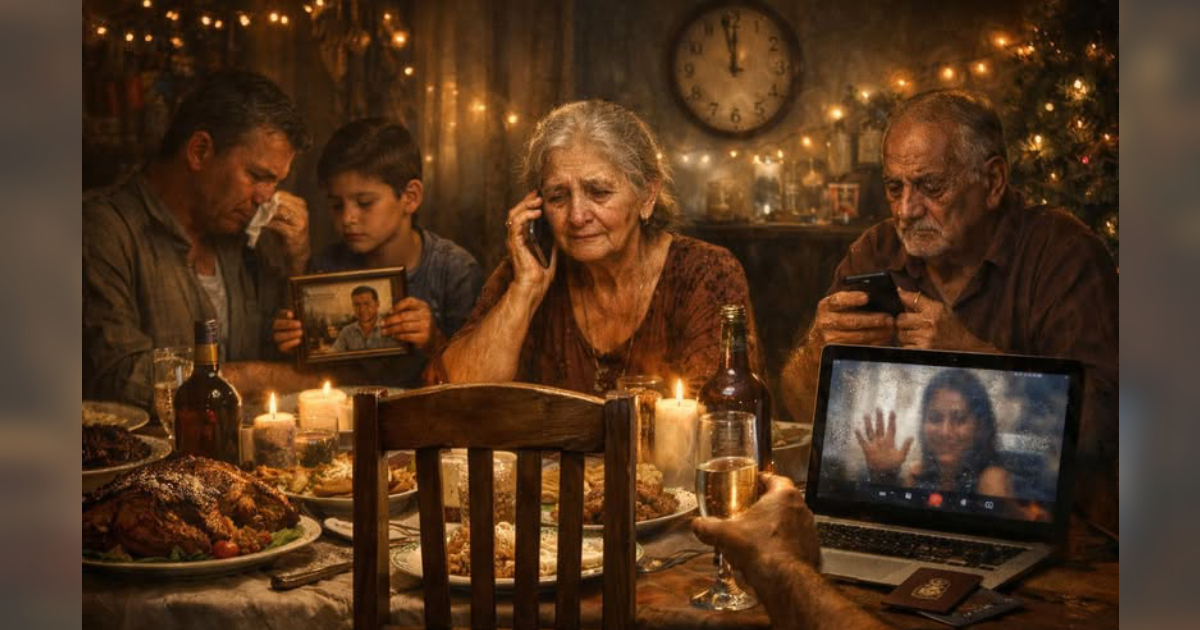
But for millions of Cubans, this December 31 is not just a celebration; it is also an open wound. A wound that affects entire families. Mothers, fathers, siblings, children, grandparents, and grandchildren will spend this night apart, united only by a phone that sometimes doesn't ring, or rings late, when the excitement has already mingled with exhaustion.
There are set tables, yes, but incomplete. And many of those tables exist precisely because of absence. Thanks to the son who left, the mother who emigrated, the father who works far away, the brother who supports his family from a distance. A toast is made for them while their chair remains empty, knowing that this sacrifice comes at a high price, paid with nostalgia, with tears, with distance, and with nights like this.
It’s a night when people look at their phones more than their watches. The lines break down, the signal falters, and the most important moment of the year turns into waiting. The embrace is replaced by a choppy voice, a frozen image, a “we'll talk tomorrow” that hurts more than it seems. And still, it's appreciated, because even that is better than not knowing anything at all.
This is the Cuban reality. A reality where absence sustains homes, where love travels in remittances, in packages, and in counted minutes, and where distance is not an exception but the norm. Each family carries its own story, but all share the same ache.
There are mothers who smile to avoid worry, fathers who remain silent to avoid breaking down, children who learn to be strong too soon, grandparents who wait in silence, and grandchildren who grow up not understanding why hugs are missing on important dates. It is a pain that is shared across generations.
And still, even from that heartbreak, the Cuban does not give up. We offer ourselves even when it hurts, we celebrate even when someone is missing, and we continue to dream, not because reality makes it easy, but because giving up has never been part of our history.
Hopefully, 2026 will not just be a change of numbers. Hopefully, it will be the year when many of these absences cease to be necessary, the year when tables are once again filled with people instead of silences. Until that day arrives, the Cuban will continue to resist, wounded but standing, clinging to a stubborn hope that, no matter how much they try to extinguish it, remains alive.
May 2026 bring back the hugs we are missing, the dignity we deserve, and the hope they could never take from us.
Filed under:
Opinion article: Las declaraciones y opiniones expresadas en este artículo son de exclusiva responsabilidad de su autor y no representan necesariamente el punto de vista de CiberCuba.