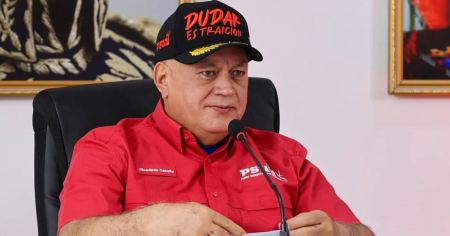
The Chavista leader Diosdado Cabello described the arrest of Nicolás Maduro and Cilia Flores by U.S. forces as "outrageous," but acknowledged that the Venezuelan government is taking steps to reopen the United States embassy in Caracas, in order to restore diplomatic and consular communication between both countries.
“The outrage we feel over Maduro's kidnapping is a deeply felt indignation that is hard to overcome. But we are doing what we must: first, to get our president and Cilia back. All necessary steps are being taken, lawyers have been appointed, and we are making progress toward the reopening of embassies in Venezuela,” declared Cabello during an event broadcasted by the state channel VTV.
The leader of the United Socialist Party of Venezuela (PSUV) explained that the reopening of the U.S. diplomatic mission and its counterpart in Washington would allow the regime to have consular representation in the U.S. to "ensure the security and peace" of Maduro and his wife.
“Right now, we have no one in the United States, apart from the lawyers, who are not Venezuelans. That is the main objective,” added Cabello, who, despite his confrontational rhetoric, acknowledged that there are communication channels with Washington, managed under the supervision of Secretary of State Marco Rubio.
Asked about the criticism regarding the resumption of oil sales to the United States, Cabello defended the measure as part of a historical relationship.
"Historically, we have sold oil to the United States. There was a moment, in 2005, when we sold one million five hundred thousand barrels per day," he recalled.
The statement from Diosdado Cabello confirms that, despite the anti-American rhetoric, Chavismo is prioritizing the reestablishment of economic ties with Washington amid the political crisis and the transition process overseen by the Trump administration.
Diplomatic sources in Caracas consulted by international media assert that the restoration of bilateral relations would include temporary missions in both capitals to facilitate humanitarian, migratory, and legal efforts related to Venezuelan and American citizens.
Meanwhile, the figure of Delcy Rodríguez, the interim president appointed by the chavista apparatus after Maduro's fall, is trying to maintain the cohesion of the regime amid growing international pressure and uncertainty about Venezuela's political future.
Filed under: