
Related videos:
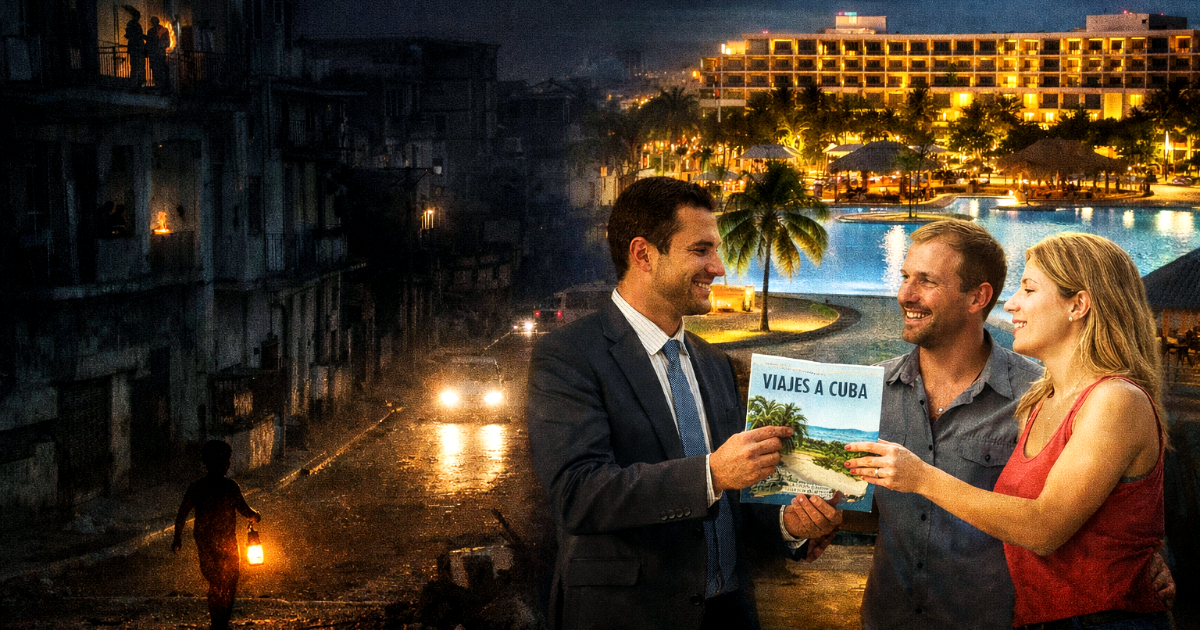
While Cuba sinks into darkness due to a lack of fuel, the regime sends its officials to Canada to sell a postcard of tourist stability.
The contrast couldn't be more striking: while millions of Cubans endure daily blackouts lasting over 12 hours, the Ministry of Tourism (MINTUR) assures abroad that "everything remains the same" on the island.
Led by Lessner Gómez, the marketing director of MINTUR, an official delegation traveled to Toronto and Montreal to reassure Canadian tour operators and agencies following President Donald Trump's warnings about cutting the supply of Venezuelan oil to Havana, reported Reportur.
“Cuba is operating normally. Everything remains the same,” insisted Gómez, who assured that the country receives crude oil from “other partners, such as Mexico,” and that it has sufficient reserves to cover the summer.
However, these statements contrast with the reality acknowledged by the Cuban authorities themselves.
The Ministry of Energy and Mines admitted that “there is no diesel for distributed generation”, which has left more than a hundred power plants out of service and maintains a deficit exceeding 1,900 megawatts during peak hours.
The situation is escalating and worsening. This Sunday, Havana remained completely in the dark for more than six hours, while tourist hotels, equipped with their own power plants and fuel guaranteed by GAESA, stayed lit.
The official discourse aims to reassure Canadian investors and tourists, who account for 40% of arrivals to Cuba, but it conceals a country on the brink of an energy collapse. Behind the propaganda is GAESA, the military conglomerate that controls hotel chains, foreign currency, and tourism flows.
A country in the dark while tourism shines
Blackouts in Cuba are not just a domestic nuisance; they are a reflection of a structural collapse that has left an entire country depending on luck and the empty promises of the government.
The lack of electricity paralyzes workplaces, schools, and hospitals, prevents food preservation, disrupts communications, and increases sources of unsanitary conditions. In many neighborhoods, the nights are endless and silent, marked by heat, mosquitoes, and the fear of crime.
While the regime allocates fuel and resources to keep the hotels in Varadero and Cayo Coco—controlled by the military conglomerate GAESA—running, millions of Cubans live with candles and depleted batteries.
The contrast is stark: the real country lies in shadow, while the tourist areas remain brightly lit like showrooms, upheld by generators and energy privileges that the rest of the population can only dream of.
This imbalance not only fuels popular resentment but also undermines Cuba's image in the eyes of its own visitors.
Tourists who venture beyond the hotel complexes encounter dark streets, piled-up trash, collapsed transportation, and an overall atmosphere of exhaustion. From the bright windows of their hotels, the contrast is even more striking.
Many return with a sense of insecurity, egregious inequality, and decay, far removed from the tropical paradise that MINTUR tries to sell abroad.
In a nation where electricity has shifted from being a public service to a selective luxury, power outages have become a metaphor for power: those in charge have light; those who resist remain in darkness.
The regime calls it "creative resistance." The people experience it as a daily sentence of backwardness and despair, while the dollars from tourism illuminate the hotels of GAESA and shadows cover the rest of the country.
Filed under: