
Related videos:
The Torch March on January 27 left a more eloquent image than any speech: the lit torches of young people forced to march on an island in darkness… and those of the historical figures, definitely extinguished.
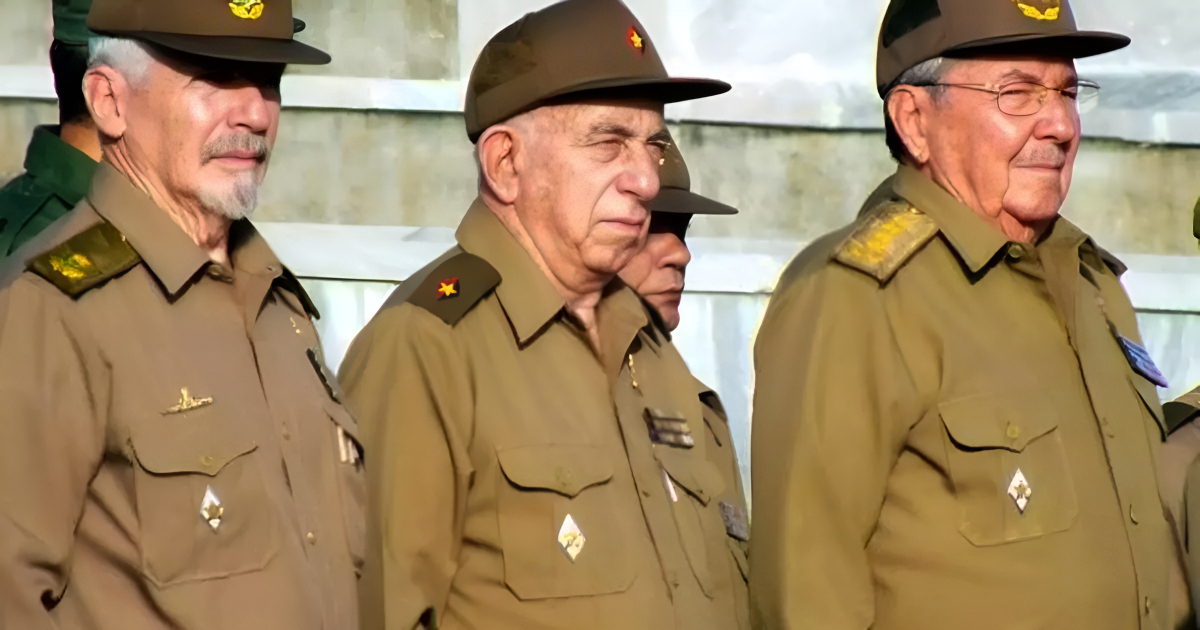
Raúl Castro (94), Ramiro Valdés (93), and José Ramón Machado Ventura (95) did not attend the event that the regime dedicates each year to José Martí and, this time, also to the centenary of Fidel Castro.
The contrast was notable. While the "appointed" Miguel Díaz-Canel appealed for "historical continuity" before a crowd of officials and mobilized students, the official cameras did not present the usual image of the foundational trio of real power in Cuba, the one that upheld the revolution for decades through repression, slogans, and Soviet manuals.
None of the three nonagenarians made an appearance. There wasn't even a formal mention of them, as if their absence were a trivial detail and not a symbol of the twilight of an era.
In the midst of the national blackout—both literal and political—the march served as an act of faith in propaganda. The young people marched with fire while the country remains in darkness; the torches were lit to obscure the fact that there is no longer electricity... nor leadership.
The silence of the elder commanders comes at a critical moment: the energy collapse has reached unprecedented levels, the diplomatic isolation of the regime worsens after the capture of Nicolás Maduro, and the pressure from the government of Donald Trump—now with Marco Rubio at the helm of the State Department—leaves Havana without its main oil supplier and with no room to maneuver.
In this context, the absence of Raúl, Valdés, and Machado does not seem to be just a matter of age or health. It is also a political void. Three men who defined repression, ideology, and the Cuban economy for decades are fading away just as the model they created is collapsing amidst blackouts, hunger, and distrust.
Last night, while Díaz-Canel was trying to ignite the flame of "continuity," Cubans on social media summarized the scene with irony: "Neither Raúl, nor Ramiro, nor Machado… nor current" .
Perhaps the true homage to Martí was not the march with fire, but the silence of those who, after nearly a century, can no longer even bear their own torch.
The totems of Castroism and its eternal "active presence"
For years, the Cuban regime has resorted to the same theatrical trick whenever the country is falling apart: dusting off its "historic leaders," giving them a microphone —or an archival photo— and presenting them as if they were still in charge of the nation.
Raúl Castro, Ramiro Valdés, and José Ramón Machado Ventura have become a sort of geriatric holy trinity of Castroism: three figures who no longer hold power, but whose image still serves to uphold the myth of "revolutionary continuity."
In 2025, for example, General Raúl, at the age of 94, reappeared every few weeks to "preside" over military meetings, "guide" the Party, or "order" the postponement of congresses, as if the Constitution were a minor procedure and biology a mere suggestion.
Each appearance, carefully choreographed by the official press, was presented as an act of vigor and leadership. "The general is on the cusp," the state media would repeat. In reality, it was a gesture of political survival: to show that the general is still breathing and that the system is as well.
Ramiro Valdés, for his part, continued touring half of Cuba inaugurating solar parks that don't even illuminate a flashlight.
At 93 years old, the veteran commander—whom the regime has touted as "the man who will save the electrical system"—has become an unwitting symbol of national absurdity: every time he cuts a ribbon, the power goes out.
But there he is, with his helmet and his engineer pose, reminding Cubans that the so-called revolution "continues to move forward"... even if it's by pedaling.
Then there's José Ramón Machado Ventura, the most discreet of the three and, paradoxically, the most cited by the propaganda. At 95 years old, the old Party bureaucrat continues to appear in the pages of Granma, offering lessons on socialist morality, austerity, and animal traction.
"I never worried about what I earned," he said in his last interview, without clarifying whether he was referring to his salary or the affection of the people. His final significant contribution to the official discourse was to recommend the cultivation of anamú, romerillo, and ginger as substitutes for modern pharmaceuticals.
Together, these three "historical leaders" function as legitimizing totems of a crumbling totalitarian power.
The regime portrays them as symbols of strength, but the people see them as relics: shadows of another century that still pose for the camera while the country fades away. They are, after all, the guardians of a flame that no longer ignites.
Filed under: