
Related videos:
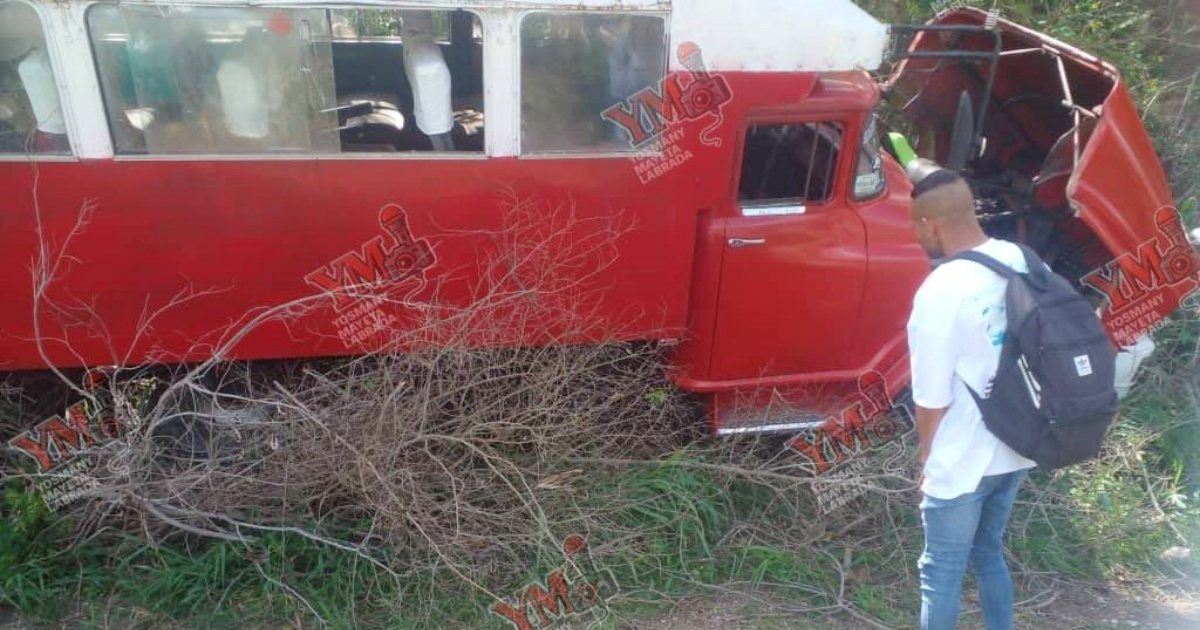
A bus intended for passenger transport crashed this Wednesday on the highway in Santiago de Cuba, in a new incident that highlights the critical situation of the transportation system on the island.
The incident occurred in the area known as "El Alambre," after the San Luis municipality, according to a report on Facebook by independent journalist Yosmani Mayeta Labrada.
Fortunately, there were no injuries or fatalities as a result of the incident.
According to preliminary information, the vehicle had departed from the city of Santiago de Cuba heading to the municipality of Contramaestre.
It was a truck adapted for transporting people on private trips, charging approximately 700 Cuban pesos per passenger.
Despite its informal use, this type of transportation has become a common option amid the collapse of the state system.
According to reports received by the journalist from witnesses, the accident was caused by a sudden mechanical failure.
"The direction might have broken," specified Mayeta Labrada, which caused the driver to lose control of the vehicle and crash into one of the sides of the highway.
The deterioration of transportation and structural precariousness
This accident, although without any fatalities, highlights once again the deep crisis of transportation in Cuba.
The lack of state buses and the limited replenishment of the fleet have led to a strong dependence on private trucks, many of which are handmade and lack basic safety guarantees.
"This type of event reflects the ongoing deterioration and increasing insecurity of transportation in Cuba," warned the reporter, who has documented multiple similar cases in the eastern region of the country.
In the specific case of Santiago de Cuba and its peripheral municipalities, travel by trucks and private vehicles has become the only viable option for many citizens who need to commute daily, whether for work, family, or medical reasons.
The fee of 700 pesos, although high for the average salary, is accepted as the lesser evil compared to the alternative of being stranded for hours or days.
The normalization of risk
Beyond the detailed account of the accident, the incident illustrates a pattern that has become routine for thousands of Cubans: traveling under risky conditions as the only viable option.
Vehicles lacking proper maintenance, drivers who sometimes lack specialized technical training, and a legal system that regulates but does not effectively supervise these transports create a scenario where accidents are merely a matter of time.
Meanwhile, the government has not provided structural solutions to the collapse of public transport, nor has it implemented an effective regulatory policy on the alternative vehicle fleet
Due to a lack of investments and institutional will, citizens continue to pay out of their own pockets—along with their safety—for the consequences of a model that has shown signs of exhaustion for years.
Filed under: