
Related videos:
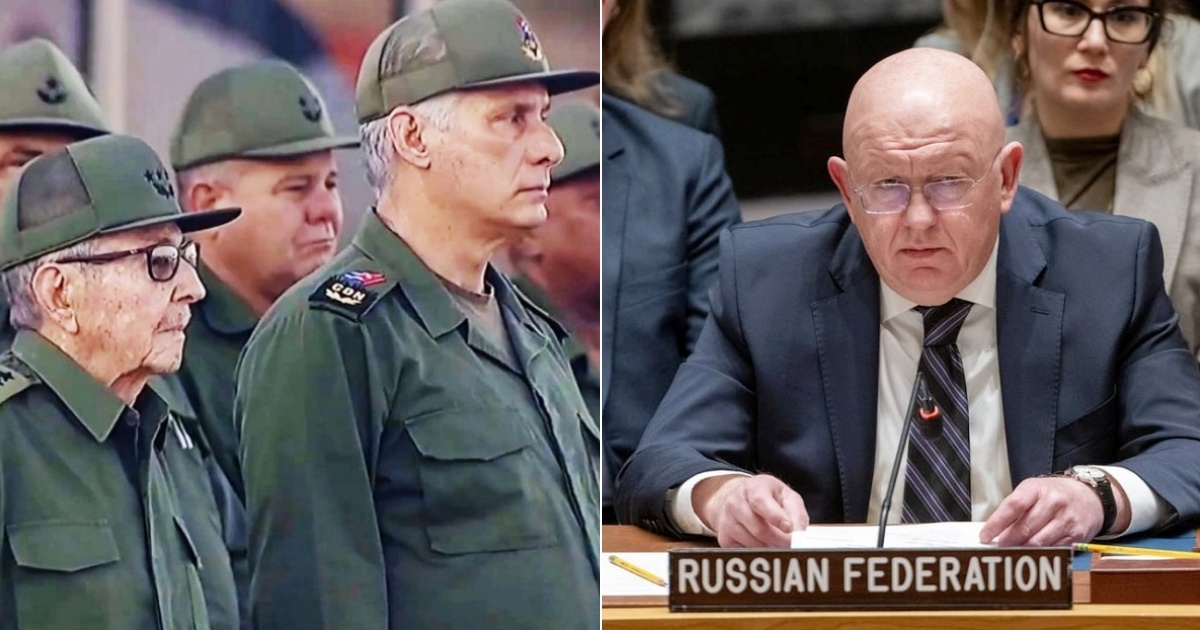
The Russian ambassador to the UN, Vasili Nebenzia, drew a parallel between the Venezuelan crisis and the future of Cuba amid rising tensions between Washington and Havana, following the surprising capture of Nicolás Maduro.
In statements to the Russian state television, cited by the agency EFE, Nebenzia asserted that, unlike Venezuela—where, according to the Kremlin, an internal betrayal led to Maduro's downfall—there are no fractures within the power apparatus in Cuba.
“In Venezuela, without a doubt, a betrayal took place. It is something that is talked about completely openly. A part of the high-ranking officials, in fact, betrayed the president,” he stated.
"That little number won't work in Cuba", he/she concluded.
The statements come at a particularly delicate moment for Havana, marked by an energy crisis, growing social unrest, the tightening of U.S. sanctions, and an increasing dependence on Russian oil following the collapse of Venezuelan supply.
The context of a prophecy
The ambassador not only absolved Cuba of the possibility of a similar betrayal but also elevated the statement to a sort of political prophecy, suggesting that the regime in Havana will withstand both external and internal pressures without collapsing.
The statement gains significance following the capture of Nicolás Maduro in early January 2026, an event that Russia has described as an act of "military aggression" by the United States.
Although he did not elaborate on the supposed betrayal that led to Maduro's arrest, Nebenzia's implicit message was clear: in Cuba, unlike Venezuela, the ruling elite remains cohesive and aligned with its leadership, without divisions capable of undermining the central power.
Cuba, the second ally in Latin America
The Russian reaction reflects the importance that the Kremlin places on its strategic partners in the region.
Maduro was considered by Moscow to be its main ally in Latin America, while Cuba would hold the second position in that hierarchy.
Havana, however, has become an increasingly fragile link in that alliance. Throughout 2024, Russia supplied the island with around 6,000 barrels of oil daily, according to the Energy Institute at the University of Texas.
But now, with the new executive order from the government of Donald Trump that imposes tariffs on countries supplying crude oil to Cuba, that lifeline is in jeopardy.
The Cuban government reacted harshly to the U.S. announcement, describing the measure as "an unusual and extraordinary threat to national security and U.S. foreign policy."
From Moscow, the Kremlin also warned about the risks of a potential “total blockade” and described the reports of a possible offensive to force a regime change on the island as “alarming.”
Trump toughens his tone: "Cuba will not be able to survive."
Tensions escalated even further when President Donald Trump openly declared that the Cuban regime is on the verge of collapse.
During a public presentation in Washington, Trump stated, "It seems that it will not be able to survive. Cuba will not be able to survive."
When asked if his government seeks to "suffocate" the island with these new sanctions, the president stated that that word was "very harsh," although he did not hide his disdain for the Cuban system, describing it as a "nation in decline."
"We must feel compassion for Cuba. They have treated the people very poorly. We have many Cuban Americans who were treated very badly and would probably like to return," added Trump.
This Thursday, the U.S. president signed an executive order imposing new punitive tariffs, specifically aimed at cutting off the supply of crude oil that continues to reach Havana.
The backing of Moscow
In response to the American blockade, the Kremlin has made diplomatic and military moves. In March 2025, Russia and Cuba signed a military cooperation agreement, further solidifying their strategic alliance.
More recently, the Russian Interior Minister, Vladimir Kolokoltsev, visited the island and met with Raúl Castro.
During that visit, Kolokóltsev harshly condemned the U.S. operation in Venezuela:
"The attack by the United States against Venezuela on January 3, 2026, was a military aggression," he stated, while expressing his condolences "to the families and loved ones of the agents from the Ministry of the Interior and the Revolutionary Armed Forces who lost their lives during these tragic events."
President Vladimir Putin, for his part, has thus far avoided any direct criticism of Trump, but he has reiterated his support for Cuba:
"Moscow expresses solidarity with the determination to defend its sovereignty and independence," stated a recent declaration from the Kremlin.
The shadow of a warning
The statements made by Ambassador Nebenzia are part of a broader narrative from Moscow, which seeks to project stability in its alliances and denounce any attempts at Western intervention as a form of hybrid warfare.
By dismissing the possibility of "traitors" in Cuba, Nebenzia not only praises the alleged loyalty of the Cuban regime's inner circle, but also issues a warning: if the United States expects to replicate the Caracas scenario in Havana, it may encounter a wall that is more difficult to break down.
Will such a prophecy be true?
Filed under: