
Related videos:
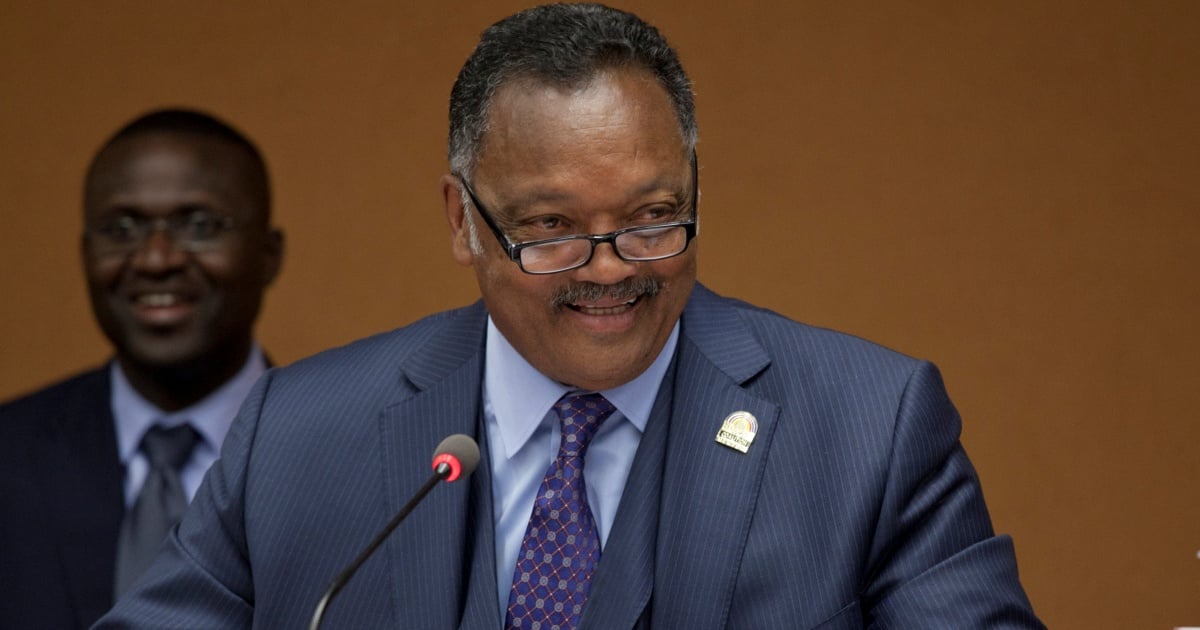
The Reverend Jesse Jackson, one of the most influential figures in the civil rights movement in the United States and a historical reference in the fight against racial discrimination, passed away this Tuesday at the age of 84, according to a statement issued by his family.
“Our father was a servant leader, not only for our family but for the oppressed, those without a voice, and the ignored of the world,” expressed his children.
In the message, they also emphasized that their "unwavering faith in justice, equality, and love inspired millions of people, and we ask that you honor their memory by continuing the fight for the values they lived for."
Jackson had been married to Jacqueline Jackson since 1962 and leaves behind six children.
The family did not specify the cause of death immediately, although the activist had faced serious health problems in recent years.
Donald Trump's reaction
Following the announcement of the reverend's death, President Donald J. Trump posted a message in which he highlighted his personal relationship with Jackson and defended his own political record on racial issues.
"The Reverend Jesse Jackson passed away at the age of 84. I knew him well, long before he became president. He was a good man, full of personality, determination, and shrewdness. He was very sociable, someone who truly loved people!”, he wrote.
Trump took the opportunity to respond to those who accuse him of racism and to highlight measures taken during his administration.
"Although the scoundrels and lunatics of the radical left, all democrats, constantly label me as a false and racist, it has always been a pleasure to help Jesse on his path," she stated.
The official listed actions that, he said, had the backing or interest of Jackson, including providing office space for his Rainbow Coalition in the Trump building at 40 Wall Street, as well as his role in the approval of criminal justice reform and in the long-term funding of Historically Black Colleges and Universities (HBCUs).
He also mentioned the so-called Opportunity Zones as "the most successful economic development package approved to date for Black entrepreneurs."
In his message, Trump described Jackson as “a force of nature like few before him” and maintained that he had “a lot to do” with the election of Barack Obama, although he claimed that the reverend “detested” the former Democratic president.
The president concluded with condolences to the family: “He deeply loved his family, and to them, I extend my heartfelt sympathy and condolences. We will miss Jesse!”
A life marked by struggle
Born as Jesse Louis Jackson on October 8, 1941, in Greenville, South Carolina, he grew up in the segregated South of the United States, in a humble family. He was an outstanding student and a talented athlete, but he chose the path of ministry and social activism.
He became a protégé of Dr. Martin Luther King Jr. and worked closely with him at the Southern Christian Leadership Conference (SCLC).
He participated in iconic moments of the civil rights movement, such as the March on Washington in 1963—where King delivered his historic speech "I Have a Dream"—and the marches from Selma to Montgomery in 1965.
He was also present on April 4, 1968, at the Lorraine Motel in Memphis when King was assassinated.
Decades later, reflecting on his mentor, Jackson stated: “He is a frame of reference. His resurrection is powerful.”
Regarding that murder, he stated: “All I remember is a voice saying, ‘A bullet cannot kill a movement’. We must move forward… If your key player gets injured on the field, you can’t give up.”
After King's death, Jackson founded the organization Operation PUSH (People United to Save/Serve Humanity) in 1971, dedicated to promoting economic and social justice for African Americans.
Later, he founded the National Rainbow Coalition, which aimed to increase the political participation of minorities.
Both organizations merged in 1996 into the Rainbow/PUSH Coalition, which it led until 2023.
Pioneer in presidential politics
Before Barack Obama arrived at the White House in 2009, Jesse Jackson was the African American who had gone the furthest in a presidential race. He ran for the Democratic nomination in 1984 and 1988.
In 1984, he placed third in the primaries. Four years later, he finished second, behind Michael Dukakis, winning 12 primaries and caucuses and receiving about 6.9 million votes.
His campaign was the most successful of a Black candidate until Obama's election two decades later.
Jackson was also elected as a shadow delegate for the District of Columbia in the United States Senate (1991-1997), and in 1999, President Bill Clinton awarded him the Presidential Medal of Freedom, the highest civilian honor in the country.
During the ceremony, Clinton stated, “It's hard to imagine how we could have come this far without the creative power, sharp intellect, loving heart, and unrelenting passion of Jesse Louis Jackson.”
His/Her relationship with Cuba
Jackson had a unique relationship with Cuba. He visited the island several times and held meetings with Fidel Castro.
Since his first visit in 1984, Jackson helped to open a new chapter in the relationship between the churches and the Cuban state.
The Reverend Raúl Suárez, director of the Martin Luther King Memorial Center, described that process in 2013 as a “blessing.”
His last visit, of a private nature, was in 2013, organized by the Catholic Church, with the aim - as reported by Reuters - of "seeking to improve relations between the two countries."
During that trip, he urged "to build bridges between the peoples of both countries" and stated that "Washington's sanctions against the Caribbean island restrict the Internet, phone calls, and transportation, among other effects on Cuba and also on American citizens."
"The Rev. Jesse Jackson understood the differences between his country and ours, and that these differences did not hinder building bridges and achieving a constructive and respectful bond. A prominent activist in the fight for civil rights and justice for his people," wrote Carlos Fernández de Cossío this Tuesday on X.
International mediator and global advocate
Beyond domestic politics, Jackson acted as a mediator in international conflicts.
He facilitated the release of American pilot Robert Goodman in Lebanon in 1984 and participated in negotiations for the release of prisoners in Syria, Iraq, and Serbia, including soldiers held in what was then Yugoslavia in 1999.
He was a staunch opponent of apartheid in South Africa and, in the 1990s, he was appointed special envoy for Africa during the Clinton administration.
He also advocated for the reauthorization of the Voting Rights Act of 1965 and promoted political participation among minorities in the United States and the United Kingdom.
In July 2023, he announced his retirement as the leader of Rainbow/PUSH after more than five decades at the helm. "We resign, we do not retire," he stated at the time, promising to remain connected to social justice causes.
Health and late years
In 2017, Jackson announced that he was suffering from Parkinson's disease.
In November 2025, he was hospitalized in Chicago due to complications related to progressive supranuclear palsy (PSP), a neurodegenerative disease.
The family then clarified that he "is not on life support" and that he was stable.
In recent years, he was also hospitalized for COVID-19, suffered a fall while participating in a protest, and faced other medical complications, including gallbladder surgery in 2021.
Filed under: