
Related videos:
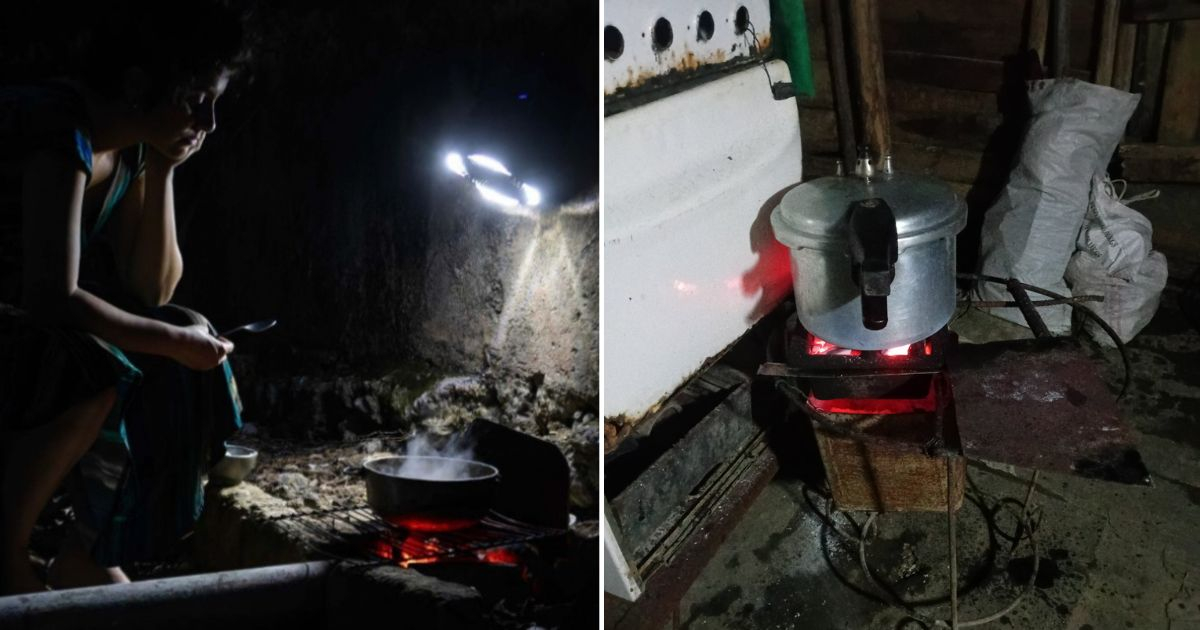
At 3:40 in the morning, Mary Leyva was up softening beans. It wasn't insomnia or a voluntary routine, but the necessity to make the most of the electricity while it lasted.
Her testimony, shared on Facebook, went viral and articulated a reality that thousands of women in Cuba face.
"Now I was up at 3:40 in the morning, taking advantage of the current to soften a little bit of beans, and the thing is my coal is all gone," she wrote.
She added that she knew many other women were doing the same: washing, preparing food in advance, charging phones, or filling water tanks.
In the comments, he summarized the situation with a striking phrase: "You can't even sleep anymore."
The post received over 10,000 reactions and garnered more than 1,600 comments in just a few hours.
Dozens of women identified with the scene. Ileana Ruiz recounted, “We were just like that in this house making beans and rice at 2 a.m. There’s no rest, not even at night. What a struggle.”
Idalis Torriente Cortegaza shared that she takes advantage of the early morning to "collect water, cook, charge the lanterns and phones, and do laundry," while Mariluz Tamayo explained that many women workers get up at 3 or 4 in the morning to prepare food before heading to their jobs.
Magalys Álvarez Almodóvar stated that she barely sleeps in order to take advantage of the electricity for cooking.
Sonia Montenegro wrote: “Right now, I'm just like you, my friend, it's three in the morning, making stew and rice, taking advantage of the electricity.”
Y Yulian Pacheco summed up the exhaustion: he woke up at 2:00 a.m., the power was cut at 3:00, and he ended up cooking with charcoal before heading to work “completely exhausted.”
There were also messages that reflected frustration and exhaustion. Carmen Fernández Arjona asked, “You can’t even sleep at night anymore. Is this life?”
Nubia García lamented that "there is no body that can withstand so much mistreatment," while María from Cuba pointed out that they are going through "the most difficult times, and the worst part is that we don't know how long it will last."
Other comments praised women's resilience. Karla Pastrana stated that the Cuban woman "should be awarded the Nobel Prize and an Oscar as well," while Marilín Basulto Estremera called for "a monument to the Cuban woman."
However, behind the praise lies a recurring pattern: fragmented nights, constant stress, and double or triple shifts to ensure the basics at home.
In a country marked by prolonged blackouts, gas shortages, and high coal prices, daily life is reorganized according to the unpredictable schedules of electricity.
For many families, the early morning hours have become the only possible time to cook or store water.
What began as a domestic confession ended up portraying a collective reality: thousands of women trading their dreams for the stove, their rest for daily survival.
Filed under: