
Related videos:
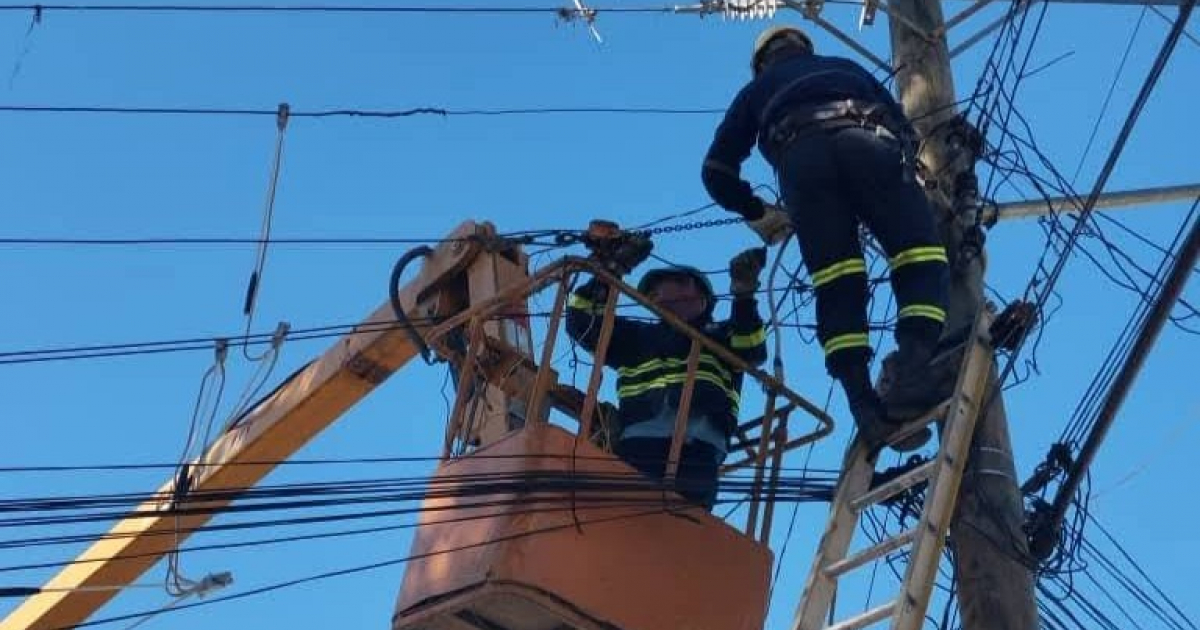
The pro-government journalist Lázaro Manuel Alonso reported on Facebook the identity of the worker injured in the accident that occurred on Friday morning in Havana.
According to the details provided, this concerns Joaquín Vázquez Vázquez, a 54-year-old electrician with 25 years of experience in the electrical sector.
According to hospital sources cited in the publication, Vázquez Vázquez is conscious and remains hospitalized with burns. So far, no prognosis for his injuries has been released.
The accident occurred at the Habana 220 kV Substation and caused disruptions to the electrical service in several municipalities in the center of the capital, as well as affecting areas in Artemisa and Mayabeque.
Alonso had previously reported that the incident occurred at 11:27 am and that a worker from a crew was injured, being immediately taken to an emergency medical service.
Minutes before the accident was confirmed, reports emerged of disruptions at several substations due to an Automatic Frequency Shot (DAF). The mentioned installations included Plaza, Príncipe, Tropical, and Rincón de Boyeros.
As a result, areas of the municipalities of Boyeros, Playa, Marianao, Plaza de la Revolución, Cerro, and Centro Habana were left without electrical service.
Subsequently, Lázaro Guerra Hernández, the general director of Electricity at the Ministry of Energy and Mines, explained that the primary malfunction could have originated at the CUJAE substation.
At 9:59 AM, the Unión Eléctrica (UNE) also reported the outage of Unit 1 of the CTE Ernesto Guevara de la Serna, which entered emergency free operation due to a failure in the speed regulator.
This incident prompted action from the DAF in the system and affected an additional 44 MW that were in the process of being restored.
Technicians from the national electric power system are working to locate and resolve the faults in order to restore service as quickly as possible, according to the authorities.
The sequence of events—shutdown of a thermoelectric unit, automatic trigger, impacts on substations, and finally an accident involving an injured worker—once again puts the vulnerability of the Cuban electrical system under scrutiny.
In recent years, interruptions and technical failures have been frequent, systematically affecting the population and highlighting the accumulated deterioration of the energy infrastructure.
Beyond the official statement, the fact that an electrician with 25 years of experience sustained burns during these tasks also reflects the high-pressure conditions under which workers in the sector operate.
The aging of the plants, the lack of sustained maintenance, and the poor management of resources have resulted in a situation where breakdowns are increasingly frequent and the safety margin is decreasing.
As blackouts and technical emergencies continue, workers in the electrical system are taking on increasing risks in a network that shows evident signs of fragility.
The accident at the Habana 220 kV Substation is not an isolated incident, but rather another episode in a prolonged energy crisis that has been escalating without the implementation of structural solutions capable of stabilizing the service and protecting both the population and those who work in its maintenance.
Filed under: