
Related videos:
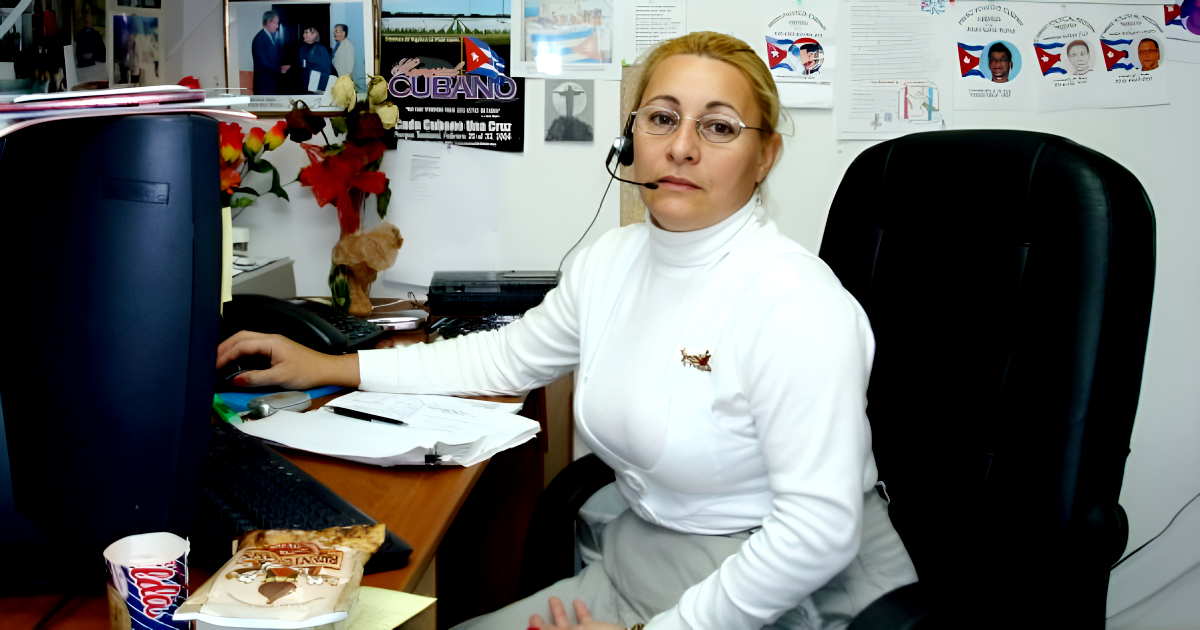
The recent accusation from the Ministry of the Interior (MININT), which identifies Maritza Lugo Fernández as the alleged “intellectual author” of a thwarted armed infiltration off the coast of Villa Clara, has once again placed her at the center of the Cuban political debate.
The accusation was presented on state television during the program Razones de Cuba, where it was claimed that there was organization and funding from the United States. However, to date, no documentary evidence has been publicly shown to support these claims.
Beyond the current official narrative, Lugo Fernández has a previous public trajectory linked to opposition activism and human rights advocacy that dates back to the 1990s.
Born in 1963 in Santa María del Rosario, on the outskirts of Havana, Lugo Fernández has recounted in interviews that she grew up in a rural environment, the daughter of farmers, in a family that discreetly listened to foreign broadcasts.
In an audiovisual testimony granted years ago to the Cuban filmmaker Lilo Vilaplana (“Plantados” and “Plantadas”), he remembered that his education was shaped by that experience and by an early critical perception of the Cuban political system.
During her adolescence, she practiced martial arts and specialized in judo. According to her own account, at that time she was approached by individuals linked to state structures interested in "recruiting" her, which she claims to have rejected.
It has also been noted that, following the Mariel exodus in 1980, she opposed the acts of repudiation against those who were emigrating, which—according to her account—marked her in the eyes of the authorities.
His organized activism formally began in the early nineties alongside his wife, Rafael Ibarra Roque. Both participated in the founding of the Democratic Party 30th of November “Frank País”, an opposition group that is not legally recognized in Cuba.
Ibarra Roque was sentenced to 20 years in prison for a sabotage offense in the 1990s, a process that opponents described as irregular. Following his incarceration, Lugo took on a more prominent role within the movement.
Profiles published abroad in the early 2000s describe her as an activist who was arrested and imprisoned multiple times between 1996 and 2001.
She herself has recounted periods of confinement in the Manto Negro women's prison and in interrogation centers like Villa Marista. In her testimony, she stated that she had undertaken hunger strikes and had been sanctioned for "bribery" by a military court, an accusation she connected to the reporting of complaints about prison conditions to international organizations.
One of the most widely publicized episodes in his history was the letter titled "I Accuse," written while in prison in 2001 and disclosed abroad, where he denounced abuses against political and common prisoners. The document was read publicly by U.S. legislators, amplifying his case beyond the island.
In 2002, she left Cuba and settled in the United States with her daughters. From exile, she has remained connected to the November 30 Movement and activities related to the memory of Cuban political prisoners.
In later interviews, he has advocated for protest methods that he describes as peaceful and symbolic, including improvised marches to evade repression.
This biographical account contrasts with the characterization now presented by MININT, which depicts her as the organizer of a violent operation with destabilizing aims.
So far, the accusation is based on official statements and alleged references from detainees, without any independently verifiable evidence being made public.
The Cuban regime has previously resorted to media processes in which opponents have been portrayed as responsible for violent or terrorist actions, at times in contexts marked by intense political confrontation.
That background is part of the context in which the current case is interpreted. However, the development of the investigation and the eventual presentation of evidence will be crucial in clarifying the facts.
Meanwhile, the figure of Lugo Fernández is marked by two opposing narratives: that of an activist who, for decades, denounced abuses and endured imprisonment, according to his own testimony and profiles published abroad; and that of an alleged organizer of an armed infiltration, according to the official account circulated on state television.
Between both versions, a space of uncertainty arises that can only be resolved with verifiable and transparent information.
At the same time, U.S. authorities have announced that they will conduct their own investigations into the maritime incident, both at the federal and state levels in Florida, with the aim of independently clarifying the facts and determining possible responsibilities.
That process could be pivotal not only for establishing what really happened in the waters near Cuba but also for shedding light on the allegations made against Lugo Fernández.
Until there are verifiable conclusions and public evidence, their case will continue to navigate the realm of opposing versions in a context of high political confrontation between the Cuban regime, the Trump administration, and the exile community.
Filed under: