
Related videos:
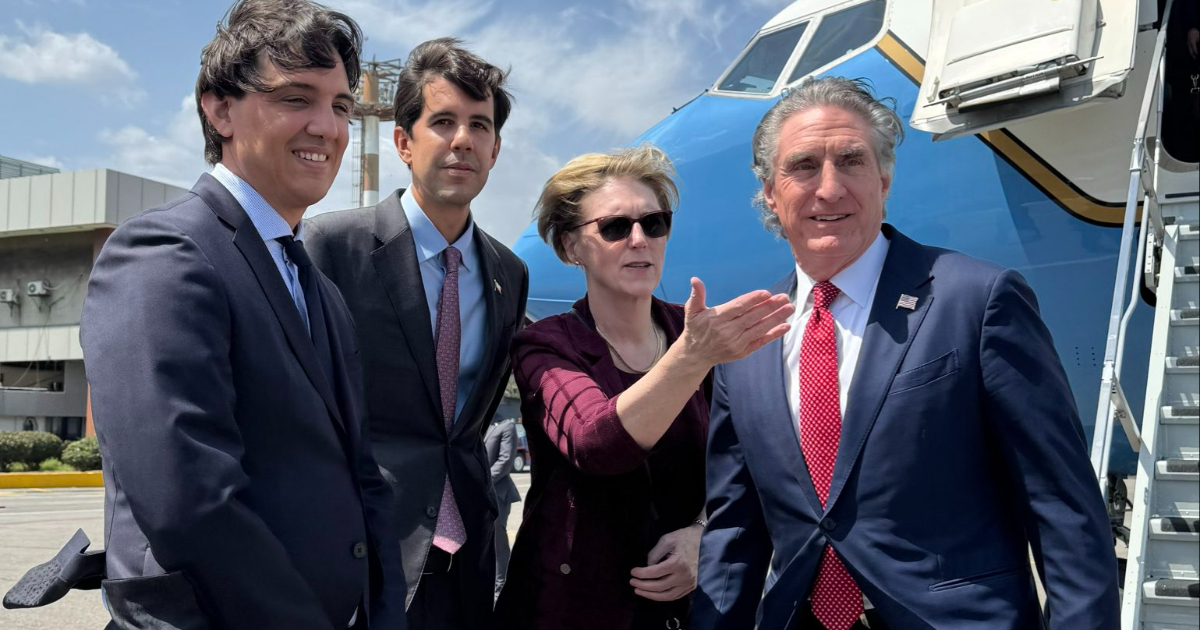
The United States Secretary of the Interior, Doug Burgum, arrived in Caracas this Wednesday to assess the Venezuelan mining sector and hold meetings with the interim authorities led by Delcy Rodríguez, marking a new step in the transition process the country is undergoing following the departure of Nicolás Maduro.
The U.S. Embassy in Venezuela reported on the social media platform X that Burgum, also the president of the National Energy Domain Council, “will meet with interim authorities, establish contacts with U.S. and Venezuelan companies, and work towards a legitimate mining sector and secure critical mineral supply chains.”
The diplomatic mission described the visit as "another vital and historic step" within the three-phase plan initiated by President Donald Trump for Venezuela, which includes stages of stabilization, recovery, and transition.
That plan was presented at the beginning of the year by the Secretary of State, Marco Rubio, following the capture of Maduro and his wife, Cilia Flores, in an operation carried out on January 3rd.
Since then, Caracas and Washington have intensified contact. The interim president, Delcy Rodríguez, recently assured that both governments are working on a "new bilateral cooperation agenda."
In recent weeks, he has hosted high-ranking U.S. officials, including the Secretary of Energy, Chris Wright, with whom he signed a long-term energy agreement.
In addition to the visit from Burgum and Wright, in recent weeks other high-level delegations from the United States have strengthened ties with Caracas as part of the three-phase plan promoted by Washington.
On February 18th, the head of the United States Southern Command, Marine General Francis L. Donovan, officially traveled to Venezuela to meet with interim president Delcy Rodríguez and other high-ranking officials from her administration, with the aim of assessing security and advancing the implementation of the U.S. strategy to stabilize and recover the country.
The U.S. Embassy emphasized that during those meetings, the commitment to cooperate on hemispheric security and strengthen the bilateral relationship in the new phase that Venezuela is experiencing was reaffirmed.
The backdrop of mining in Venezuela
Mining in Venezuela has been under scrutiny from international organizations and human rights groups for years.
Reports from the United Nations and civil society organizations have documented that large areas of the so-called Orinoco Mining Arc, a region rich in gold, coltan, and other strategic minerals in the south of the country, fell under the control of criminal groups during Nicolás Maduro's administration, leading to serious environmental and social consequences.
Recent research has also pointed out that the illegal exploitation of gold and other minerals has created networks of international smuggling and has directly impacted indigenous communities in states such as Bolívar and Amazonas.
Several reports warn that armed groups and criminal organizations controlled mining operations and used violence to maintain territorial control, while the activities led to deforestation, mercury contamination, and the displacement of local populations.
The rapprochement on this matter between Washington and Caracas occurs in an international context characterized by tensions in the Middle East. Following the joint operation by the United States and Israel against Iran, the Iranian Revolutionary Guard threatened to block the Strait of Hormuz, through which about 20% of the world's oil passes.
In that context, Venezuela has gained strategic relevance. President Trump highlighted in his recent State of the Union address the arrival of 80 million barrels of Venezuelan crude oil to the United States, describing the South American country as a “new friend and partner.”
Additionally, PDVSA announced this week new agreements for the sale of crude oil and derivatives to the U.S. market, while the interim government reported the unblocking of assets in the U.S., partially intended for the purchase of medical equipment.
Filed under: