
Related videos:
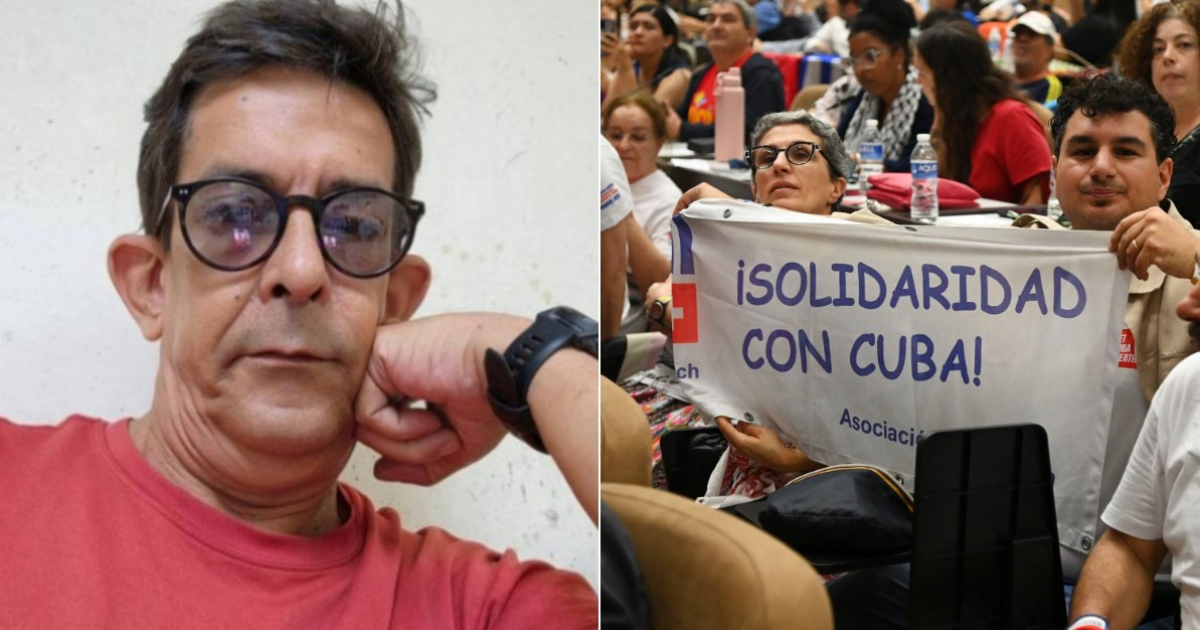
The Cuban comedian Ulises Toirac made an ironic critique about the visit of foreign activists to the Island, suggesting that instead of welcoming them with privileges, they should experience for a month the real conditions in which most Cubans live.
His comment, published on , has gone viral due to the biting and direct tone with which it summarizes a growing discontent within the country.
"Solidarity proposal: take away the suitcases they brought," the text begins.
The following presents an idea that, more than a literal suggestion, serves as a denunciation of the economic precariousness experienced by the Cuban people.
"Give them an abandoned little house in Palo Cagao (a neighborhood in the Marianao municipality) and let's be generous: give them 4000 CUP per person (without working for it), the ration booklet, a mobile phone with an Etecsa line, and go pick them up in a month," he detailed sarcastically.
With this, Ulises sets the tone for a criticism that not only targets the visitors but also the way the regime organizes these visits, showcasing a carefully polished reality.
The mentioned amount -4,000 Cuban pesos- barely lasts a few days in the current inflationary context, while the rationing booklet represents an inadequate system that does not meet basic needs. Additionally, access to the Internet is limited by high costs and hampered by poor service quality.
Toirac's message resonates with an increasingly widespread sentiment: the rejection of visits from foreign groups coming to Cuba to express political solidarity, but doing so from a privileged position, staying in hotels with conditions far superior to those faced by the local population.
That disconnect became evident recently when the very members of the Convoy Nuestra América were caught off guard by a general blackout, the second one in less than a week.
Although they witnessed the country's energy collapse firsthand, they did so from protected facilities, far from the neighborhoods where power outages last more than 20 hours a day.
Meanwhile, the government continues to attribute the crisis almost exclusively to external factors, especially the United States, avoiding recognition of the impact of years of mismanagement, lack of investment, and failed economic decisions that have brought the country to a critical situation.
The electrical system is collapsed, the fuel supply is insufficient, and the infrastructure is deteriorating, as even authorities in the energy sector have acknowledged. Additionally, there is a shortage of food, skyrocketing prices, and wages that cannot support families.
In this context, visits from international activists, coming from countries where they enjoy freedoms and much higher standards of living, are generating increasing rejection. For many Cubans, these delegations not only ignore reality but also contribute to upholding a narrative that does not align with what is happening on the streets.
Toirac's criticism is not isolated. Other voices have also expressed discomfort at what they consider a kind of "ideological tourism."
The journalist Yoani Sánchez was direct in stating: "We are not a theme park. Go do ideological tourism elsewhere. Here we are suffering".
Along the same lines, researcher Rosa Marquetti has criticized what she sees as a romanticization of the Cuban crisis, where precariousness becomes a political argument without addressing its human consequences.
Criticism intensified after figures such as Spanish Vice President Pablo Iglesias downplayed the seriousness of the internal situation or attributed it solely to external factors, thereby reinforcing the official narrative.
Toirac's proposal, although presented humorously, touches on a deep wound: the gap between the image projected outward and the reality that Cubans experience daily.
Filed under: