
Related videos:
The Ministry of Domestic Trade (MINCIN) informed that Cubans have a period of 30 days to acquire the donated items, starting from the arrival of the products at retail establishments. The distribution is carried out free of charge in the warehouses, with anotations in the supply booklet.
The statement coincides with the progress of the distribution of the third Mexican shipment, which arrived on March 13 containing sugar, beans, rice, lentils, and powdered milk. From the wholesale warehouse EMPA Habana I, the products have been distributed to Arroyo Naranjo, Marianao, Mayabeque, and Cienfuegos.
In the municipality of La Lisa, the distribution is limited exclusively to prioritized groups: pregnant women, children with low weight and height, and seniors over 65 years old. In Pinar del Río, with an allocation of one kilogram per child. Matanzas has also received part of the donation, which will soon be delivered to pregnant women and children with low weight and height.
For inquiries about distribution, the MINCIN has set up the Telegram channels "Bodegas," the Single Line of Commerce (80022624), and the number 78315238 for Havana. The ministry stated that "consumers have a period of 30 days from the arrival of products at retail establishments to make their purchases."
Since February 2026, Mexico has sent at least four humanitarian shipments to Cuba. The first, weighing 814 tons, arrived on February 12. The second, transported by the ARM Papaloapan and ARM Huasteco ships, totaled 1,193 tons of beans, powdered milk, and various foods, and arrived on February 28.
The third shipment, which is currently being distributed, arrived on March 13. President Claudia Sheinbaum confirmed the shipment of a fourth cargo with over 1,000 additional tons of food and medical supplies.
However, the distribution has been marked by controversy. A report from TV Azteca documented Mexican products donated being sold in TRD Caribe stores —linked to the Cuban army— at dollar prices: beans at $2.97 per half kilogram or $43 per 30-kilogram sack. The MINCIN denied the sale of Mexican donations, and the Cuban ambassador in Mexico, Eugenio Martínez Enríquez, rejected the accusations and labeled them as "lies and misinformation." The director of MINCIN, Marpessa Portal Devilliers, was firm: the donations "cannot be commercialized."
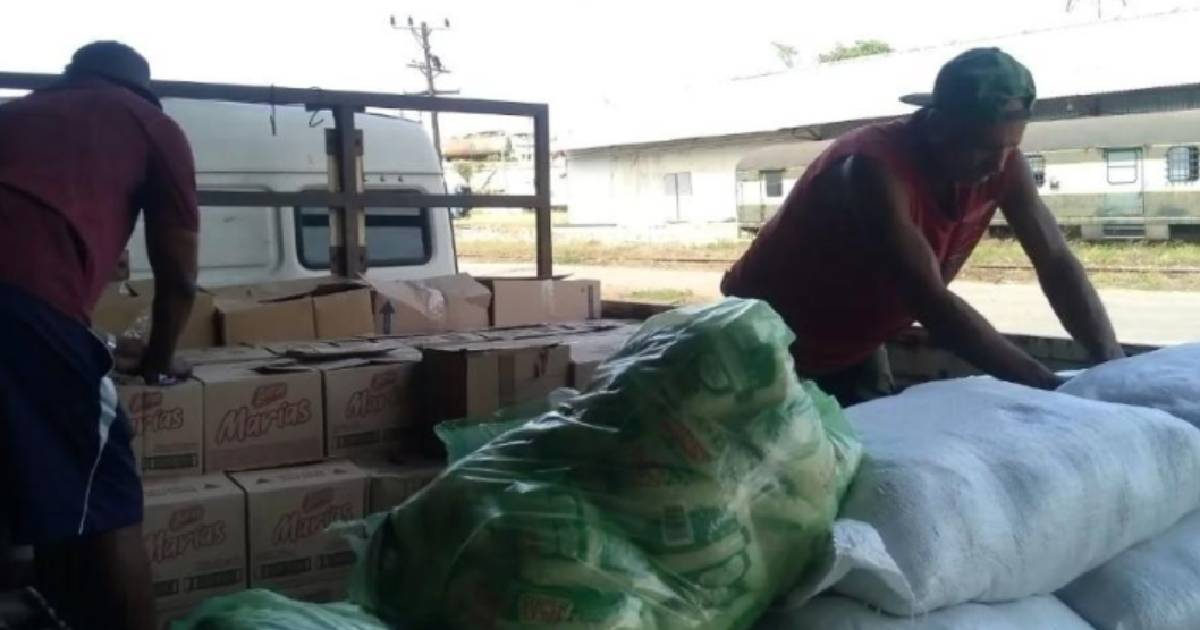
On the ground, citizen testimonies reveal deliveries far below expectations. A four-year-old boy from the Calleja neighborhood in Havana received a package of María cookies and two cans of tuna this Tuesday; his 12-year-old brother received a package of cookies and a can of vegetables. In Güira de Melena, families received barely a package of cookies per household. These cases stand in stark contrast to the total volume of the announced shipments and have generated dissatisfaction among the population.
Cuba is experiencing one of its worst humanitarian crises, with 36% of its population facing food insecurity according to the World Food Programme, and blackouts lasting up to 30 hours a day.
The MINCIN described the process as a "solidarity effort" that "reaffirms the bonds of brotherhood between Mexico and Cuba," but the gap between the official discourse and the reality experienced by Cuban families remains wide.
Filed under: